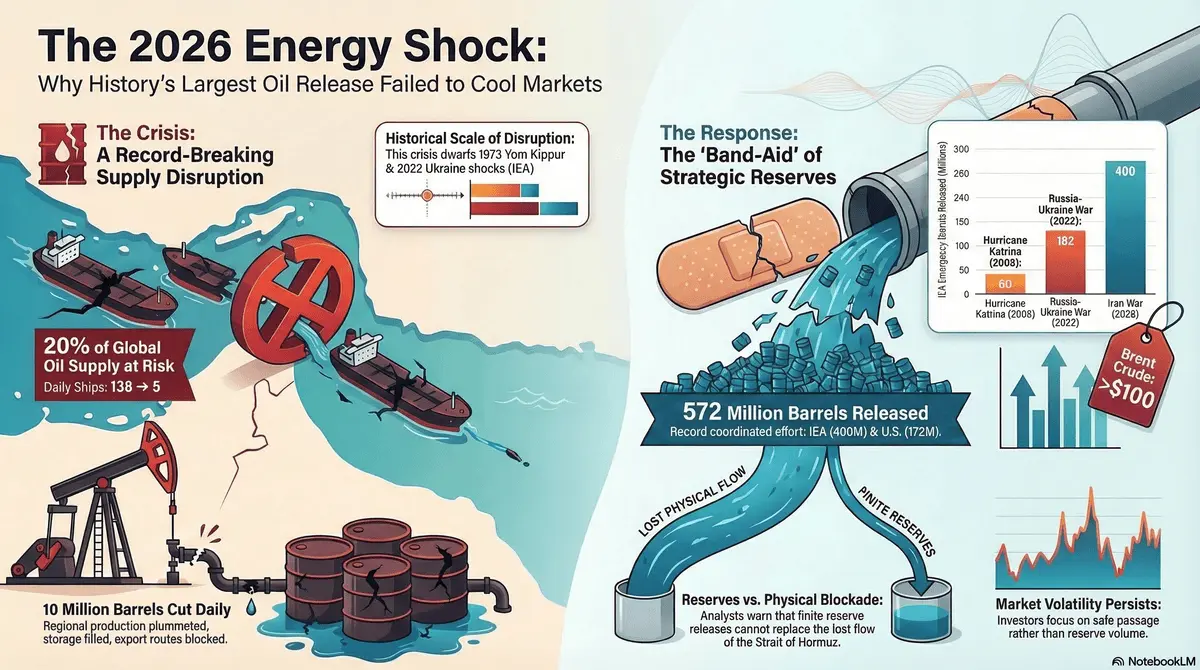
Global oil markets are experiencing unprecedented volatility as the ongoing war between the United States, Israel, and Iran effectively halts transit through the Strait of Hormuz. Tensions escalated significantly on March 12, 2026, pushing Brent crude past the $100 per barrel mark despite massive emergency reserve releases.
The International Energy Agency has characterized the situation as the largest supply disruption in the history of the global oil market—surpassing both the 1973 Yom Kippur War oil crisis and the 2022 Russian invasion of Ukraine.
The effective closure of the Strait of Hormuz threatens roughly 20% of the world’s daily energy supply. This disruption has already forced companies to halt regional operations, sending domestic gas prices climbing toward $4 a gallon in the United States and triggering significant downturns across global stock exchanges in Tokyo, London, and New York.
Context & Background
How did this start?
The crisis originated following joint strikes by the United States and Israel on Iran beginning on February 28, 2026. In response to these military actions, Iran launched retaliatory strikes on commercial vessels and energy infrastructure across the Middle East, severely disrupting the critical shipping lanes of the Persian Gulf.
The key players
The primary geopolitical actors include the governments of the United States, Israel, and Iran, alongside major intergovernmental organizations like the International Energy Agency. Mojtaba Khamenei, the new supreme leader of Iran, has advocated for the continued closure of the strait, while United States President Donald Trump has authorized emergency oil releases while maintaining military pressure.
Historical significance
The current situation represents a massive supply shock that the International Energy Agency warns is deeper than both the 1973 Yom Kippur War oil crisis and the 2022 Russian invasion of Ukraine. To stabilize the market, the organization initiated a historic release of 400 million barrels of emergency crude, marking the largest intervention since its founding in 1974.
Why this matters
The effective closure of the Strait of Hormuz threatens roughly 20% of the world’s daily energy supply. This disruption has already forced companies to halt regional operations, sending domestic gas prices climbing toward $4 a gallon in the United States and triggering significant downturns across global stock exchanges in Tokyo, London, and New York.
Expert Q&A: Unpacking the Global Energy Disruption
How are global financial markets reacting to the supply disruption?
Financial and energy markets have demonstrated severe volatility, marked by widespread sell-offs in equities and sharp spikes in commodity prices.
- Crude Price Surges: Brent crude exceeded $100 a barrel, jumping roughly 9% in a single day due to fears of prolonged supply shortages.
- Equity Market Declines: Major indexes, including the Dow Jones Industrial Average and S&P 500, experienced significant sell-offs, dropping between 1.5% and 1.6%.
- Retail Fuel Impact: Domestic gasoline prices in the United States have risen nearly 60 to 70 cents since the war began, reaching an average of $3.60 per gallon.
Why did the emergency oil reserve releases fail to immediately stabilize prices?
The historic injection of reserves by the International Energy Agency and the United States has not offset the fundamental logistical threats to shipping routes.
- Finite Supply Limitations: Analysts note that the 400 million barrels from the International Energy Agency and 172 million barrels from the United States represent temporary relief that cannot permanently replace the continuous flow of the Strait of Hormuz.
- Logistical Bottlenecks: The United States reserve releases will take 120 days to complete and will not reach the market immediately.
- Refining Constraints: Global refining capacity is currently limited, meaning the raw crude released does not instantly translate to available consumer products like jet fuel and gasoline.
How is the blockade of the Strait of Hormuz being enforced by regional powers?
Iran and its proxy forces have systematically targeted commercial shipping and energy infrastructure in the region to restrict maritime movement.
- Vessel Attacks: At least 16 commercial vessels have been attacked, reducing transit from an average of 138 daily ships to fewer than five.
- Infrastructure Strikes: Regional facilities, including an oil export terminal in Oman and operations in Iraq, have suspended activities following drone sightings and direct strikes.
- Political Directives: Iranian leadership, specifically Mojtaba Khamenei, has publicly declared the waterway’s closure a crucial strategic lever against the United States and Israel.
- Unverified Status: At this time, the exact timeline for the waterway’s reopening remains unverified by official sources.
How are governments and corporations mitigating the immediate energy deficit?
Stakeholders are deploying a mix of operational shutdowns, domestic rationing, and sanction adjustments to manage the crisis.
- Corporate Retreats: Major firms like TotalEnergies and SLB have suspended up to 15% of their total output in affected countries, including Qatar, Iraq, and the United Arab Emirates.
- Domestic Consumption Limits: India has implemented measures to limit fuel usage by certain businesses to prevent hoarding and market manipulation.
- Sanction Relief: The United States Treasury Department, under Secretary Scott Bessent, issued a temporary license allowing the purchase of previously sanctioned Russian oil stranded at sea.
Why hasn’t a military escort system been established for commercial tankers yet?
While proposed by the United States administration, naval escorts have been delayed due to logistical and tactical complexities in the contested waters.
- Preparation Timelines: United States Energy Secretary Chris Wright confirmed that while escorts are planned, the military is currently unequipped to begin them immediately, aiming for the end of the month.
- Coalition Requirements: Treasury Secretary Scott Bessent indicated that the operation will likely require the assembly of an international maritime coalition.
- Information Retractions: The United States was forced to retract a premature social media claim by Chris Wright regarding a successful tanker escort, highlighting the operational confusion in the Persian Gulf.
QnA News adheres to the highest standards of journalistic integrity and accuracy.
Verification Methodology: All market data, pricing metrics, and official statements have been cross-referenced with primary sources including government agencies, international organizations, and verified news outlets. Statistical claims have been independently verified through multiple authoritative databases.
Source Attribution: This article draws from official press releases from the U.S. Departments of Energy and Treasury, International Energy Agency reports, real-time market data from FactSet and GasBuddy, and coverage from CBS News, NBC News, Al Jazeera, and BBC.
Corrections Policy: We are committed to accuracy. If you identify any factual errors, please contact our editorial team immediately at news.desk@qnanews.com
Independence: This article contains no sponsored content and was produced independently by QnA News editorial staff.