Background & Context
Q: What is the breaking news?
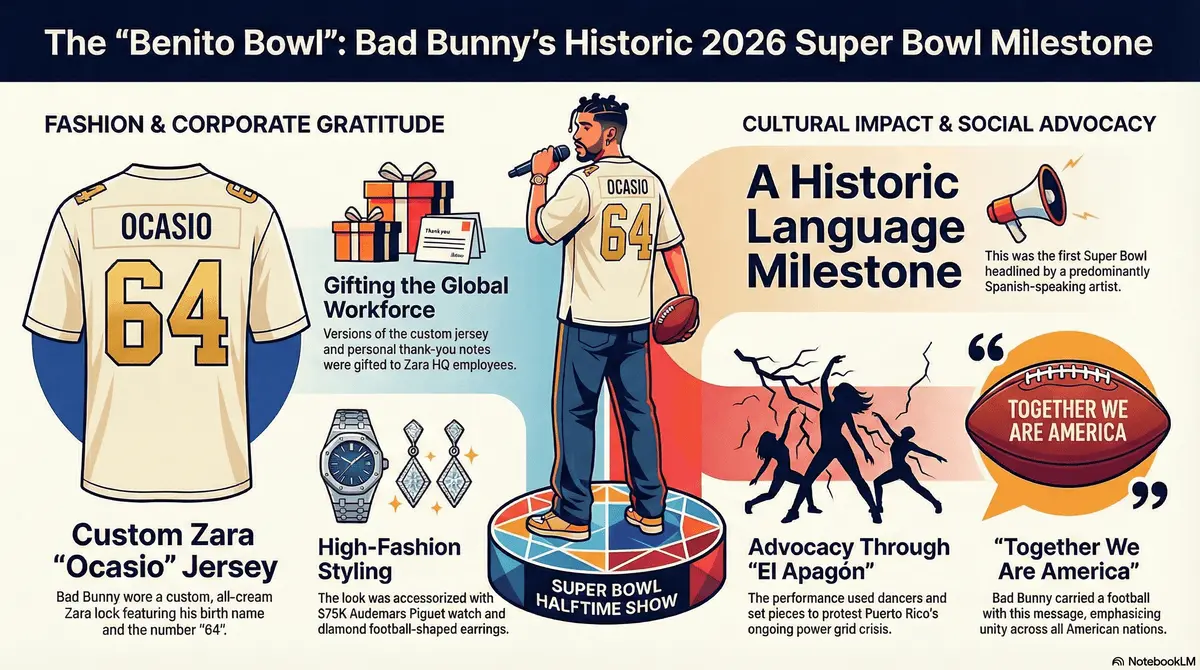
A: Bad Bunny made history as the first predominantly Spanish-speaking artist to headline the Super Bowl Halftime Show, delivering a performance steeped in cultural symbolism and social commentary.
Q: Where and when did this occur?
A: The event took place on Sunday, February 8, 2026, at the NFL Super Bowl held in Santa Clara, California.
Q: Who are the primary figures?
A: The primary figure was Bad Bunny (Benito Antonio Martínez Ocasio), supported by guest performers Lady Gaga and Ricky Martin, and cameos by Pedro Pascal and Cardi B.
Q: Why does this matter to the average reader?
A: Beyond entertainment, the show signaled a major shift in global media representation and used the world’s largest stage to highlight humanitarian issues like the Puerto Rican energy crisis.
Deep Dive Q&A
Q: Why did Bad Bunny choose a custom Zara outfit for such a massive stage?
A: The choice was a deliberate nod to his culture and the global reach of the Spanish brand, founded in 1975. By wearing “Ocasio” (his birth name) and the number “64,” he grounded the high-profile event in his personal identity. To emphasize the collaborative nature of the look, he gifted versions of the jersey-style shirt to Zara HQ employees in Spain, including a note stating, “This show was yours too”.
Q: How did the performance address the specific “grid crisis” in Puerto Rico?
A: During the song “El Apagón” (The Blackout), dancers dressed as electrical linemen hung from poles to protest the energy instability and privatization of Puerto Rico’s grid. This addressed the legacy of the longest blackout in U.S. history following Hurricane Maria and current frustrations with Luma Energy.
Q: What was the significance of the “Together We Are America” message?
A: In a performance often dubbed the “Benito Bowl,” the artist sought to redefine “America” as a collection of nations including Chile, Argentina, Canada, and his “motherland,” Puerto Rico. By carrying a football inscribed with “Together We Are America,” he aimed for a message of unity rather than political divide.
Q: How did political figures react to the performance?
A: The reaction was sharply polarized. While scholars and fans praised the “social democratic” messaging, President Donald Trump labeled the show “absolutely terrible,” and conservative activists criticized the lack of English and white representation.
Q: Fact-Check: Was Bad Bunny paid for his Super Bowl performance?
A: No. In accordance with standard Super Bowl Halftime Show practices, the artist did not receive a performance fee for the event.
Q: Fact-Check: Were there any English-language components to the show?
A: Yes. Despite claims by critics that “nobody understands a word,” Bad Bunny spoke English when referencing the “United States” and Canada, and his props included English-language calls for unity.
Q: At this time, is there a confirmed 2026 world tour following this event?
A: At this time, a 2026 tour schedule remains unverified by official sources. While he previously skipped U.S. touring due to disagreements with federal immigration policies, no official announcement has been made regarding his next steps.
Technical & Regulatory Compliance
Verification Log: This report draws from:
• Official credits for stylists Storm Pablo and Marvin Douglas.
• Verified quotes from Bad Bunny’s personal notes to Zara employees.
• Eyewitness accounts of the Santa Clara performance and social media commentary from U.S. Senators and former officials.
• Corrections: Contact newsdesk@qnanews.com for factual corrections.
• Privacy: Privacy Notice: This article respects user data under our Privacy Policy.
• Transparency: Editorial Disclosure: No sponsored content influenced this reporting.