Category: Science

  • Astronomers Uncover Evidence of a Cataclysmic Planetary Collision

    Astronomers Uncover Evidence of a Cataclysmic Planetary Collision

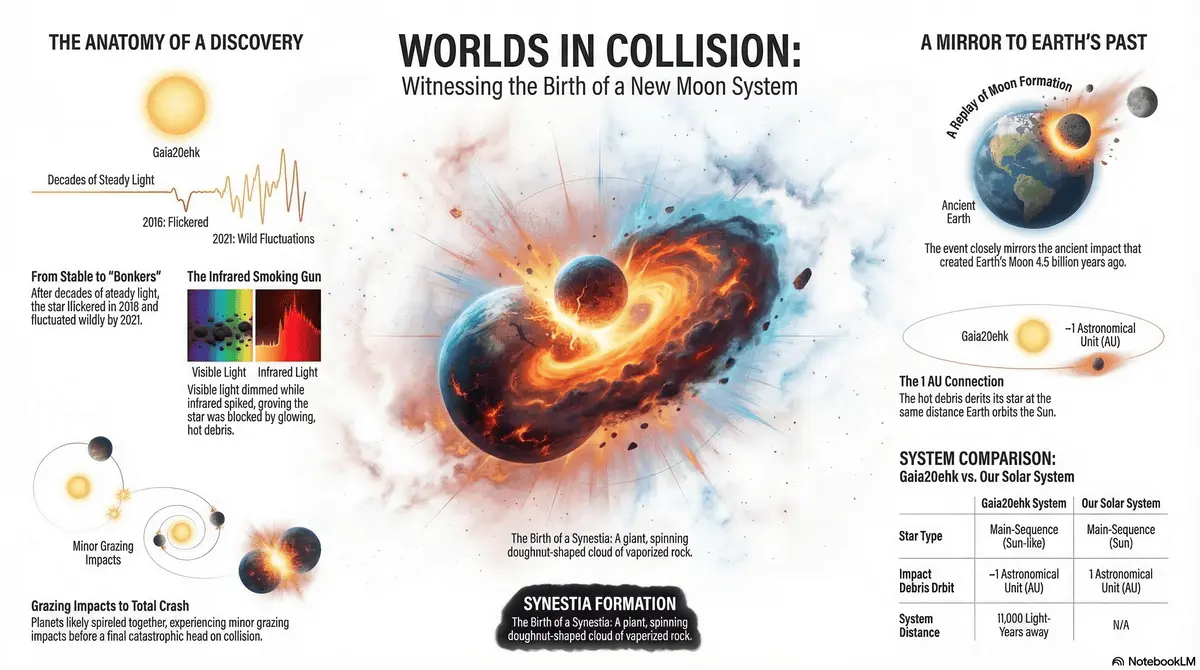
    Seattle / Washington — Researchers at the University of Washington have discovered evidence of a violent collision between two exoplanets orbiting a distant star. This rare observation, formally published in The Astrophysical Journal Letters on March 11, 2026, offers unparalleled insights into the chaotic formation of planetary systems and potential exomoons. The celestial event occurred around Gaia20ehk, a star located approximately 11,000 light-years from Earth near the constellation Puppis.

    Below is a detailed examination of this astronomical event and its implications for astrobiology.

    Context & Background

    The Initial Discovery The investigation began when astronomer Andy Tzanidakis observed anomalous dimming from Gaia20ehk, a typically stable main-sequence star. While the star’s light output was consistent for years, it began exhibiting unusual dips in brightness in 2016 and fluctuated chaotically by 2021.

    The Cause of the Anomalies Researchers deduced that the erratic flickering was not intrinsic to the star itself, but was instead caused by a massive cloud of hot dust and rock debris passing in front of it. This debris cloud is the resulting wreckage of a catastrophic collision between two planetary bodies within the system.

    Similarity to Earth’s Moon Formation This cosmic crash bears striking resemblances to the hypothesized impact of Theia that created the Moon roughly 4.5 billion years ago. The wreckage orbits the star at approximately one astronomical unit, which mirrors the distance between Earth and the Sun, suggesting the material could eventually coalesce into a similar Earth-Moon system analogue.

    Significance for Astrobiology Understanding the frequency of such planetary collisions is considered fundamental to astrobiology, as highlighted by James Davenport. The presence of a moon provides stable climates, ocean tides, and protection from asteroids, which are often viewed as critical components for making a planet habitable for life.

    Q&A: Unpacking The Planetary Collision

    Q: How did astronomers confirm that a collision had occurred rather than a standard stellar fluctuation?

    A: Astronomers identified the collision by analyzing the stark contrast between the star’s visible and infrared light emissions.

    • Visible Light Dimming: As rock and dust from the shattered planets passed in front of Gaia20ehk, the visible light reaching Earth was obstructed and flickered.
    • Infrared Light Surging: The collision generated extreme heat, causing the resulting debris field to glow intensely in the infrared spectrum.
    • Thermal Confirmation: This opposing light curve pattern proved that a hot, obscuring mass of planetary wreckage was responsible for the anomalies, rather than the star failing.

    Q: How did the collision process unfold over time?

    A: The event was not instantaneous but culminated after a series of preliminary impacts as the two planets spiraled toward each other.

    • Initial Grazing Impacts: Starting around 2016, the planets experienced minor, grazing collisions that caused slight dips in stellar brightness without producing massive infrared heat.
    • Catastrophic Impact: Around 2021, a catastrophic frontal collision completely pulverized the bodies, drastically increasing the debris volume and infrared heat signature.
    • Debris Dispersal: The pulverized rock vaporized into a massive, expanding cloud—sometimes referred to as a synestia—that now irregularly eclipses the host star.

    Q: Why is the location of the debris cloud significant for the future of this planetary system?

    A: The debris cloud is positioned in a specific orbital zone that might allow it to cool and form a stable planetary system.

    • Orbital Distance: The scattered material orbits Gaia20ehk at roughly 93 million miles, mimicking the distance from Earth to the Sun.
    • Solidification Potential: If the environment remains stable, this material is expected to cool and condense into solid bodies. At this time, the exact timeframe for this cool-down process remains unverified by official sources, though estimates suggest it could take millions of years.
    • System Evolution: This ongoing process could eventually yield a rocky exoplanet accompanied by a large exomoon.

    Q: How do these observations impact our understanding of the conditions required for life?

    A: Witnessing this event allows scientists to gauge the rarity of moon-forming impacts, which are thought to be essential for planetary habitability.

    • Tidal Generation: A large moon drives ocean tides, which facilitate the global mixing of chemical and biological materials on a planet’s surface.
    • Planetary Shielding: Natural satellites can intercept inbound asteroids, protecting the primary planet from potentially devastating impacts.
    • Tectonic Activity: Lunar gravity may help drive the tectonic plate activity necessary to regulate a planet’s climate and atmosphere over geological timescales.

    Q: How will researchers detect similar planetary collisions in the future?

    A: Astronomers will rely on next-generation surveying telescopes to scan the galaxy for similar long-term stellar anomalies.

    • Upcoming Technology: Instruments like the Simonyi Survey Telescope at the Vera C. Rubin Observatory will be crucial for capturing these rare events as they begin operations.
    • Decadal Monitoring: Researchers anticipate finding up to 100 new impacts over the next ten years by leveraging continuous, decade-long data collection.
    • Astrobiological Targeting: Identifying more systems with moon-forming collisions will help narrow the search for potentially habitable worlds outside our solar system.

    Editorial Note & Transparency

    Verification Log:

    • Academic Journal: Information sourced from peer-reviewed findings published in The Astrophysical Journal Letters.
    • Institutional Press Release: Statements and analyses provided by the University of Washington astronomy research team.
    • Science Media Coverage: Aggregated reporting from science news outlets analyzing telescope data from the Puppis constellation event.

    Compliance:

    • Privacy: This article respects user data under our Privacy Policy.
    • Transparency: No sponsored content influenced this reporting.

    Contact Us: For corrections or feedback, please email: news.desk@qnanews.com

  • NASA DART Mission Alters Asteroid Orbit Around the Sun and Reveals Cosmic Snowball Effect

    NASA DART Mission Alters Asteroid Orbit Around the Sun and Reveals Cosmic Snowball Effect

    Washington/Pasadena — New research reveals that NASA’s Double Asteroid Redirection Test (DART) successfully altered the heliocentric orbit of the Didymos-Dimorphos binary asteroid system, while also providing visual evidence of material exchange between the two bodies. The intentional kinetic impact occurred on September 26, 2022, and long-term observational data now confirms the broader systemic changes. The mission was initially designed to test planetary defense mechanisms by altering the smaller moonlet’s local orbit, but analysis of stellar occultations and images has demonstrated significant momentum enhancement and surface evolution discoveries.

    Below is a detailed examination of the DART mission’s orbital impacts and material exchange discoveries.

    Context & Background

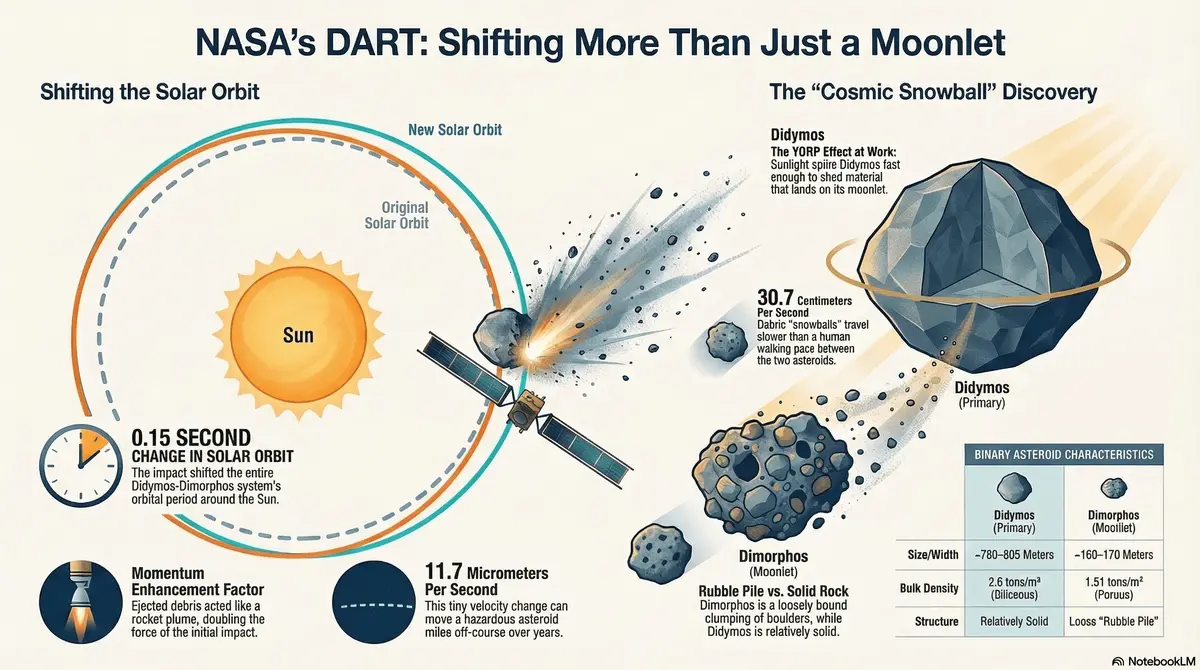
    How did the DART mission affect the entire binary system? While NASA initially designed the spacecraft to shorten the local orbital period of the moonlet Dimorphos around its parent body Didymos, long-term data showed the impact also changed the entire system’s trajectory around the Sun. By analyzing stellar occultation data and ground-based astrometric measurements, a research team led by Rahil Makadia determined that the binary system’s solar orbital period changed by a fraction of a second.

    What is the “cosmic snowball” phenomenon? Images from the mission revealed fan-shaped streaks on Dimorphos, providing the first visual proof that binary asteroids exchange material in what University of Maryland researcher Jessica Sunshine terms a cosmic snowball effect. These low-velocity impacts occur when sunlight accelerates the spin of the primary asteroid, causing loose rocks and dust to gently float toward and deposit onto its companion.

    What role did the momentum enhancement factor play? When the spacecraft crashed into the asteroid, it blasted a massive plume of pulverized rock and debris into space, creating a momentum enhancement factor. This ejected material acted like an extra rocket plume, doubling the propulsive punch created by the spacecraft’s kinetic impact alone.

    Why does this matter for planetary defense? This mission transitions planetary defense from theoretical computer models into practical, hands-on experience, proving that a kinetic impactor can effectively deflect celestial threats. Understanding the physical properties and orbital shifts of binary systems ensures humanity has viable techniques to redirect potentially hazardous objects detected far enough in advance.

    Q&A: Unpacking DART Mission Discoveries

    Q: How did scientists measure the minute change in the asteroid system’s heliocentric orbit?

    A: Researchers utilized a combination of stellar occultations and extensive ground-based astrometric data to pinpoint the system’s exact trajectory changes over several years.

    • Stellar Occultation: Astronomers measured the precise timing of when the asteroid passed in front of distant stars, causing the starlight to briefly blink out.
    • Data Integration: The team analyzed 22 occultations between October 2022 and March 2025, combining them with nearly 6,000 ground-based radar and astrometric measurements spanning 29 years.
    • Calculated Shift: This meticulous tracking revealed that the along-track velocity decreased by roughly 11.7 micrometers per second, shifting the solar orbital period by 0.15 seconds.

    Q: Why was the momentum enhancement factor critical to the mission’s success?

    A: The explosive thrust from the ejected debris significantly amplified the force of the spacecraft’s initial kinetic impact.

    • Debris Plume: The impact blasted a huge cloud of rocky debris into space, carrying its own momentum away from the asteroid.
    • Beta Parameter: Scientists calculated the momentum enhancement factor (beta) to be around two, indicating that the debris loss essentially doubled the push of the impact.
    • Escape Velocity: A crucial fraction of the ejecta achieved escape velocity from the entire binary system, shoving the center of mass of the whole Didymos-Dimorphos pair.

    Q: How did image processing lead to the discovery of material exchange between the asteroids?

    A: Specialized techniques developed by researchers like Tony Farnham were required to remove visual distortions from the spacecraft’s final images, uncovering hidden patterns of material deposits.

    • Lighting Corrections: Researchers had to remove shadows cast by boulders and lighting artifacts caused by the spacecraft’s direct approach angle.
    • Fan-Shaped Streaks: After corrections, subtle, fan-shaped rays wrapping around Dimorphos emerged, matching models of low-velocity impacts.
    • Source Tracing: By tracing these streaks back to an offset region near the moonlet’s edge, scientists confirmed the patterns were genuinely deposited material and not simply solar lighting effects.

    Q: Why do the differing densities of the two asteroids surprise scientists?

    A: Previous assumptions held that both bodies in the binary system would have equal densities, but calculations revealed a stark contrast that explains their formation.

    • Primary Density: The primary body, Didymos, is relatively solid with a bulk density of around 2.6 tons per cubic meter, aligning with siliceous asteroid estimates.
    • Moonlet Porosity: Dimorphos has a surprisingly low density of 1.51 tons per cubic meter, indicating it is essentially a fluffy, loosely bound “rubble pile” with empty voids.
    • Formation Theory: This contrast supports the theory that the moonlet formed from porous, loose material shed by the rapidly spinning primary asteroid via the YORP effect.

    Q: How will the upcoming Hera mission expand upon the DART mission’s findings?

    A: The European Space Agency‘s upcoming mission will perform independent, in-situ measurements to confirm remote calculations and assess the collision’s aftermath.

    • In-Situ Verification: The spacecraft will provide precise gravitational and physical data to refine the bulk density calculations of both asteroids.
    • Crater Mapping: Scheduled to arrive in late 2026, the mission will map the impact crater on Dimorphos and examine its internal structure.
    • Pattern Survival: At this time, whether the fan-shaped streak patterns survived the impact remains unverified by official sources.

    Editorial Note & Transparency

    Verification Log:

    • Government Agency Report: Data from NASA and the Jet Propulsion Laboratory regarding the Double Asteroid Redirection Test orbital changes.
    • Academic Journal: Research published in Science Advances on heliocentric orbital shifts and The Planetary Science Journal concerning material transport.
    • University Press Release: Statements and laboratory findings from the University of Maryland detailing the cosmic snowball effect.

    Compliance:

    • Privacy: This article respects user data under our Privacy Policy.
    • Transparency: No sponsored content influenced this reporting.

    Contact Us: For corrections or feedback, please email: news.desk@qnanews.com

  • Astronomers Detect Record-Breaking Cosmic Gigamaser 8 Billion Light-Years Away

    Astronomers Detect Record-Breaking Cosmic Gigamaser 8 Billion Light-Years Away

    Pretoria, South Africa — Astronomers using the MeerKAT radio telescope have discovered the most distant and luminous hydroxyl megamaser ever recorded. The findings, detailed in a pre-print study made available on March 2, 2026, reveal a powerful radio emission originating from a violent galaxy merger over eight billion light-years from Earth. The signal, amplified by a rare gravitational lensing effect, offers unprecedented insights into star formation and galaxy evolution when the universe was less than half its current age.

    Below is a detailed breakdown of the astrophysical mechanisms, technological achievements, and future implications of this discovery.

    Context & Background

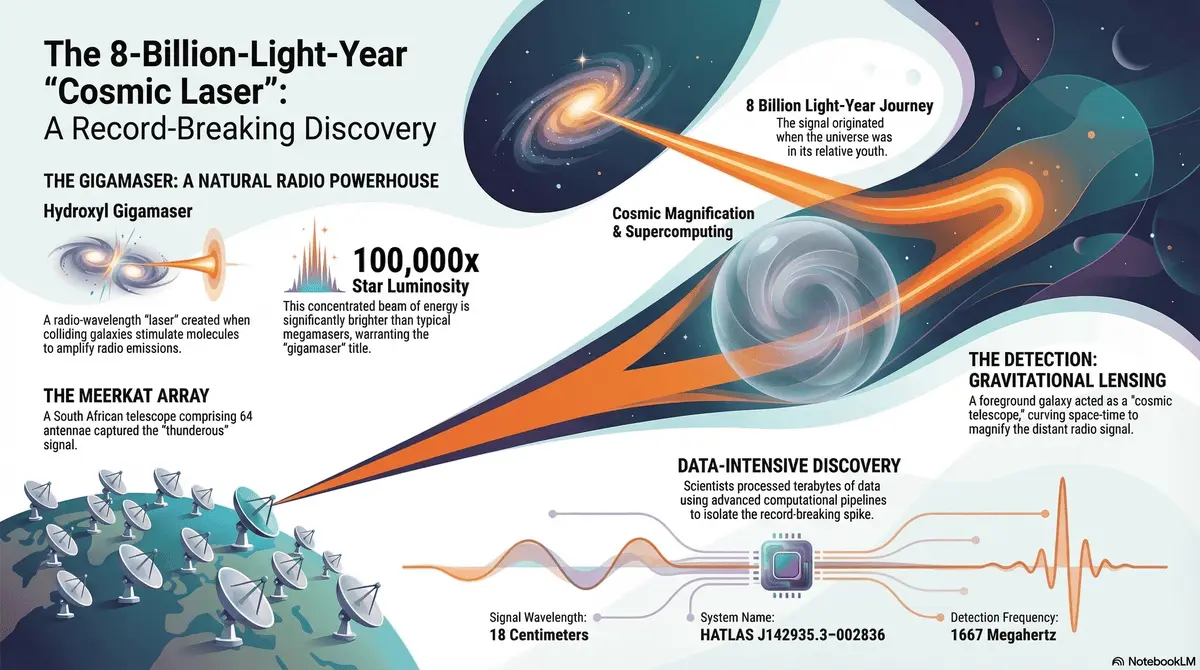
    What is a Hydroxyl Gigamaser? A hydroxyl megamaser is a naturally occurring, highly focused beam of microwave radiation produced when hydroxyl molecules in gas-rich galaxies are stimulated by intense light. This specific emission, named HATLAS J142935.3–002836, is so exceptionally bright that it earns the ultra-rare classification of a gigamaser, shining roughly 100,000 times brighter than a typical star.

    How the Discovery Unfolded The breakthrough was achieved by an international team led by Dr. Thato Manamela at the University of Pretoria, utilizing the MeerKAT radio telescope located in the Karoo region of South Africa. Researchers captured the booming 1667 megahertz signal while scanning the cosmos, relying on advanced computational pipelines developed by the Inter-University Institute for Data Intensive Astronomy to process terabytes of data.

    The Role of Gravitational Lensing A crucial factor in this detection was strong gravitational lensing, a phenomenon theorized by Albert Einstein where the mass of a foreground galaxy curves local space-time. In this instance, a perfectly aligned foreground disk galaxy acted as a cosmic magnifying glass, significantly amplifying the radio waves before they reached Earth.

    Why This Matters for Cosmic Evolution Observing a signal from eight billion light-years away allows astronomers to study the universe as it existed when it was less than half its current age. Because megamasers trace the most vigorous galaxy collisions and rapid black hole growth, finding these systems helps map the historical trajectory of cosmic evolution and star formation.

    Q&A: Unpacking Cosmic Gigamasers

    Q: How do galaxy collisions generate such powerful radio emissions?

    A: Violent mergers between gas-rich galaxies create the extreme physical conditions necessary to stimulate molecular emissions on a massive scale.

    • Gas Compression: The gravitational interaction between colliding galaxies intensely compresses vast clouds of interstellar gas.
    • Starburst Triggering: This dense gas initiates a rapid burst of baby star formation, generating an intense far-infrared radiation field.
    • Molecular Excitation: Photons from the newborn stars excite floating hydroxyl molecules, causing them to amplify radio emissions in a coherent 18-centimeter wavelength beam.

    Q: Why is gravitational lensing essential for detecting this specific signal?

    A: Without the magnification provided by an intervening celestial body, the radio waves from HATLAS J142935.3–002836 would likely be too faint for current telescopes to resolve clearly.

    • Space-Time Curvature: A foreground disk galaxy’s immense mass warps the fabric of space-time around it.
    • Magnification Effect: This warping bends the path of the background radio waves, acting like a cosmic magnifying glass that focuses the signal toward Earth.
    • Signal Amplification: The lensing boosts the apparent luminosity of the maser, allowing instruments like the MeerKAT radio telescope to capture the otherwise imperceptible emission.

    Q: How did the MeerKAT facility manage the immense volume of observational data?

    A: The detection relied on a combination of sensitive hardware and highly sophisticated computational infrastructure.

    • Antenna Array: The telescope utilized 62 of its 64 interconnected antennas to capture faint centimeter-wavelength signals over a targeted observation period.
    • Algorithmic Processing: Terabytes of raw data were funneled through specialized software pipelines, such as Oxkat and CubiCal, to calibrate the signal and remove interference.
    • Expert Support: Highly trained personnel and infrastructure supported by Prof. Roger Deane and the Inter-University Institute for Data Intensive Astronomy were critical in translating raw data into a measurable spectrum.

    Q: Why are astronomers targeting hydroxyl megamasers to study the early universe?

    A: These extremely bright emissions act as cosmic beacons that pinpoint the locations of the universe’s most extreme and transformative events.

    • Merger Signposts: They exclusively appear in the dusty, dense centers of merging luminous and ultra-luminous infrared galaxies.
    • Historical Snapshots: Because their light takes billions of years to reach Earth, observing them provides a direct look at the universe during a period of peak star formation.
    • Evolutionary Markers: Tracking these masers helps scientists understand the mechanics of rapid galaxy evolution and the feeding cycles of supermassive black holes.

    Q: How will this discovery influence the future of radio astronomy?

    A: This milestone detection establishes a foundational methodology for upcoming, more expansive systematic surveys of the cosmos.

    • Survey Expansion: Astronomers plan to transition from finding singular events to discovering hundreds or thousands of similar systems.
    • Pipeline Refinement: The computational algorithms developed for this study are preparing the scientific community for next-generation data loads.
    • Infrastructure Transition: This work serves as a direct precursor to the capabilities of the upcoming Square Kilometre Array, which will possess exponentially greater sensitivity and resolution. At this time, the exact operational limits of the fully completed Square Kilometre Array remain unverified by official sources.

    Editorial Note & Transparency

    Verification Log:

    • Scientific Preprint: Findings sourced from a paper accepted for publication in the Monthly Notices of the Royal Astronomical Society Letters and available on arXiv.
    • Institutional Statements: Commentary and technical details provided by representatives from the University of Pretoria and the Inter-University Institute for Data Intensive Astronomy.
    • Astronomical Data: Direct observation metrics from the MeerKAT radio telescope regarding signal wavelength (1667 megahertz) and distance (8 billion light-years).

    Compliance:

    • Privacy: This article respects user data under our Privacy Policy.
    • Transparency: No sponsored content influenced this reporting.

    Contact Us: For corrections or feedback, please email: news.desk@qnanews.com

  • Six Planets Align in Rare Celestial Event Across the Western Horizon

    Six Planets Align in Rare Celestial Event Across the Western Horizon

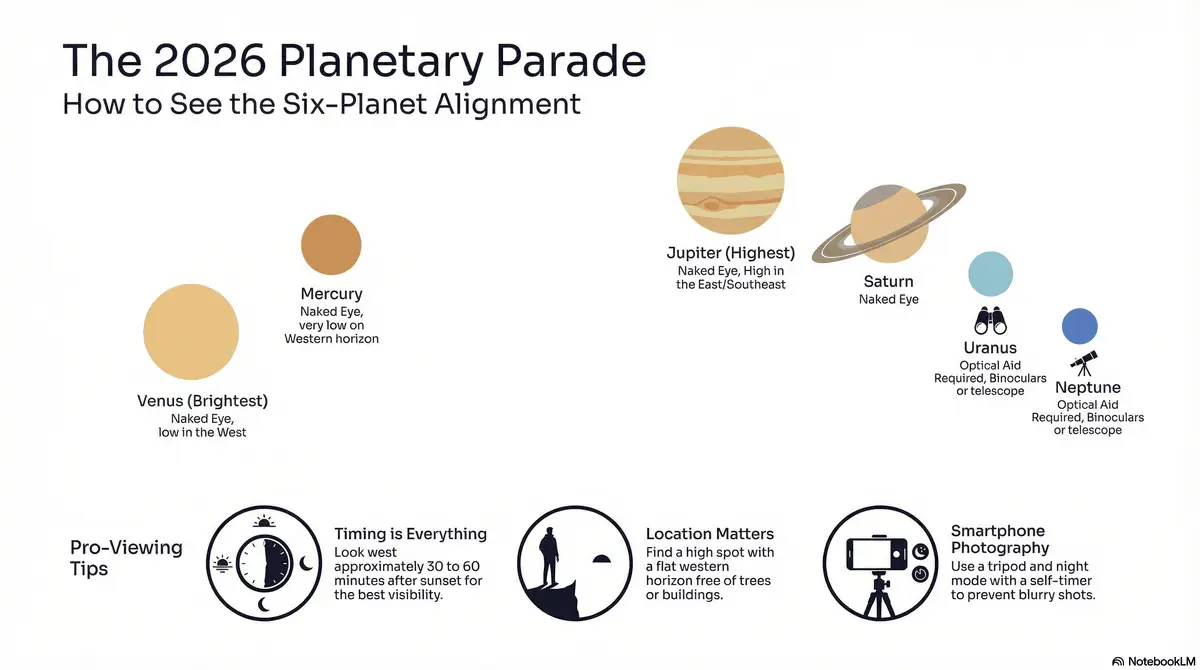
    New York/London — Stargazers and astronomers are preparing for a unique celestial alignment featuring six planets visible in the evening sky. Observers can witness this planetary parade shortly after sunset on February 28, 2026. The alignment offers an uncommon opportunity to view a large grouping of planetary bodies tracing a curved arc along the ecliptic plane.

    Below is a detailed examination of this rare planetary alignment.

    Context & Background

    What is a planetary alignment? A planetary alignment, often colloquially referred to as a planetary parade, occurs when several planets gather closely on one side of the sun simultaneously. From the perspective of Earth, these planets appear to line up along the ecliptic, which is the flat plane representing the path the sun takes across the sky. While they appear close together to observers, massive distances still separate these planetary bodies in deep space.

    Which celestial bodies are involved? The alignment features six planets: Mercury, Venus, Saturn, Jupiter, Uranus, and Neptune. Venus, Saturn, Jupiter, and Mercury will be visible to the unaided eye, whereas the ice giants Uranus and Neptune require optical assistance to be seen. Mars is the only major planet absent from this evening display, as it is currently positioned in the morning sky below the horizon.

    How does orbital mechanics create this view? All planets orbit the sun in a relatively flat disk, which scientists compare to spun pizza dough flattening out. Because each planet travels at a different speed, they constantly shift positions relative to one another. Occasionally, their independent orbital paths bring several of them into the same general quadrant of the sky from the vantage point of Earth.

    Why is this specific alignment significant? While seeing two or three planets in the evening is relatively common, a large planetary alignment featuring six planets is a much rarer occurrence. Observers last experienced a full seven-planet alignment in February 2025, and the next one is not predicted until 2040. The concentration of so many bright planets visible simultaneously makes this event a notable target for amateur skywatchers and professional astronomers alike.

    Q&A: Unpacking the Planetary Parade

    Q: How does the timing of sunset impact the visibility of this alignment?

    A: The viewing window is heavily restricted by the setting sun and the rapid descent of the inner planets below the horizon.

    • Twilight Interference: Venus and Mercury are positioned very low on the western horizon and will compete with the remaining glare of the sunset.
    • Brief Viewing Window: Observers have an optimal viewing time of roughly 30 to 60 minutes after sunset before the lowest planets disappear from view.
    • Horizon Obstructions: Because the planets sit so low, any physical obstructions like trees, hills, or tall buildings will completely block the view.

    Q: Why are telescopes required to view certain planets in this alignment?

    A: While the gas giants and inner planets shine brightly, the extreme distance and composition of the ice giants make them too dim for the naked eye.

    • Distance Factor: Uranus and Neptune are located incredibly far from Earth, drastically reducing the amount of reflected sunlight that reaches observers.
    • Optical Enhancement: A telescope with an aperture of at least 8 inches is recommended to reveal the tiny bluish disk of Neptune, which sits near Saturn.
    • Star Chart Navigation: Identifying these dim planets requires reference points; for example, Uranus can be located roughly 5 degrees below the Pleiades star cluster.

    Q: How do environmental factors and location dictate the stargazing experience?

    A: Local weather patterns and light pollution play critical roles in determining whether the alignment can be successfully observed.

    • Cloud Cover Constraints: Weather forecasts predict mixed conditions, with potential cloud cover obstructing views in locations like Ohio and northern California, while clear skies are expected in southern California.
    • Light Pollution Dynamics: For the best chance of spotting fainter bodies, observers must travel away from city lights to dark sky environments.
    • Night Vision Adaptation: Astronomers recommend giving eyes up to ten minutes to adjust to the dark and utilizing red-light modes on smartphones to prevent disrupting night vision.

    Q: Why has February 28 been specifically targeted as the peak date for this event?

    A: The concentration of planets is considered closest on this date, though the exact reason for its viral popularity on social media involves several variables.

    • Orbital Grouping: According to astronomy applications like Star Walk, the planets appear most closely grouped together from the perspective of Earth on this specific date.
    • Lunar Positioning: The waxing moon will be situated near the bright planet Jupiter, creating a visually appealing endpoint to the planetary line.
    • Social Media Amplification: At this time, the exact origin of why February 28 became the definitive viral date remains unverified by official sources, as the planets actually remain in these general positions for several weeks.

    Q: How does the visual arrangement of the planets differ across hemispheres?

    A: The observer’s geographical latitude fundamentally alters the orientation and trajectory of the planetary parade in the sky.

    • Northern Hemisphere View: Observers will see the planets form a curved line starting from the southwest horizon and stretching up toward the southeast, with Jupiter positioned high above.
    • Southern Hemisphere View: The alignment will appear visually reversed; for instance, observers in Australia will see Jupiter in the north and Uranus in the northwest.
    • Sunset Discrepancies: Variations in local sunset times across different latitudes dictate the exact minute stargazers must begin observing before the lowest planets set.

    Editorial Notes & Transparency

    Verification Log:

    • Scientific Agency Data: Verified via statements from the Royal Astronomical Society and NASA.
    • Meteorological Forecasts: Corroborated using weather reports predicting cloud cover in regions like Ohio and California.
    • Astronomical Software: Confirmed against planetary tracking applications such as Star Walk.

    Compliance:

    • Privacy: This article respects user data under our Privacy Policy.
    • Transparency: No sponsored content influenced this reporting.

    Contact Us: For corrections or feedback, please email: news.desk@qnanews.com