Category: Business

  • Global Fertilizer Crisis Mounts as War Closes Strait of Hormuz

    Global Fertilizer Crisis Mounts as War Closes Strait of Hormuz

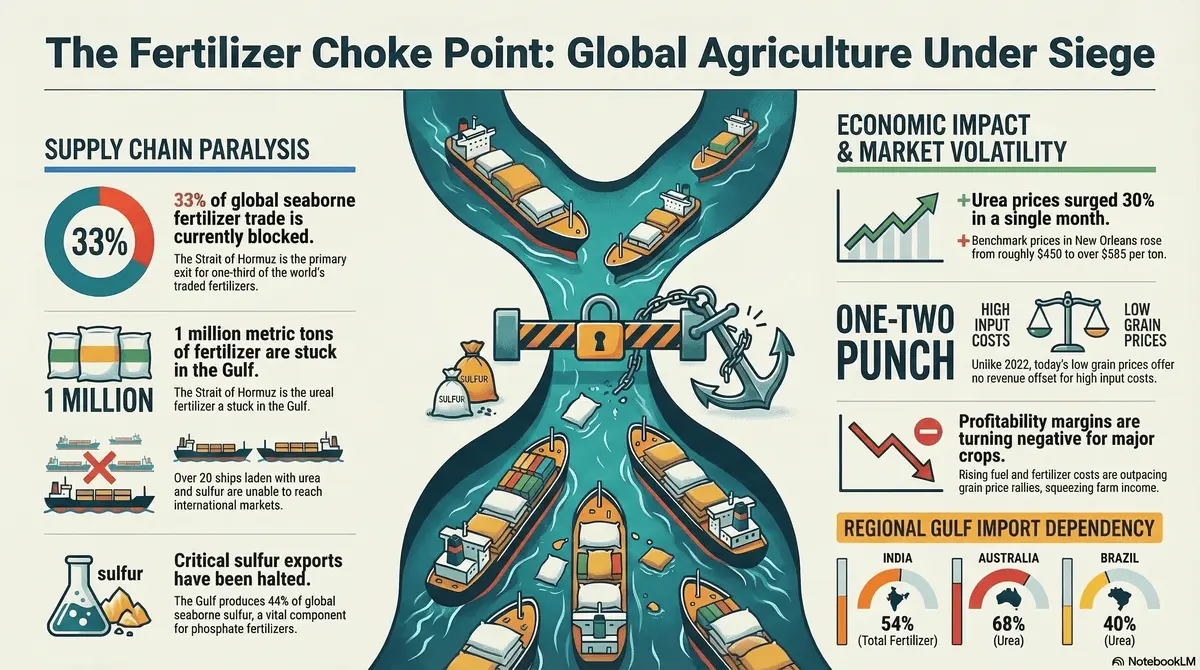
    Washington/Tokyo — The escalating military conflict in the Middle East has effectively closed the Strait of Hormuz, trapping nearly a million metric tons of fertilizer in the Persian Gulf and sending global agricultural markets into turmoil. The de facto closure, which began following strikes on February 28, 2026, has caused urea and sulfur prices to skyrocket worldwide. Farmers and economists warn this disruption threatens spring planting seasons and risks triggering a severe global food inflation crisis.

    Below is a detailed examination of the global fertilizer supply shock and its cascading agricultural impacts.

    Context & Background

    Origins of the Supply Shock The crisis stems from the recent military engagements involving the United States, Israel, and Iran, which led to the shutdown of the Strait of Hormuz. Because approximately one-third of the world’s seaborne fertilizer trade typically passes through this narrow waterway, the conflict has stranded dozens of cargo vessels. The restricted flow of nitrogen fertilizers has prompted agricultural industry leaders to petition President Donald Trump for maritime escorts.

    The Vulnerability of Global Agriculture Modern farming relies heavily on synthetic fertilizers to maintain crop yields and prevent widespread food scarcity. The Persian Gulf region accounts for 43% of seaborne urea exports and 44% of seaborne sulfur, the latter being a crucial ingredient for manufacturing phosphate fertilizers globally. Deprived of these essential inputs, agricultural sectors face a critical shortfall just as the spring planting season approaches in the Northern Hemisphere.

    Comparisons to Historical Disruptions Agricultural economists draw direct parallels to the 2022 supply shock caused by Russia invading Ukraine, but warn the current scenario poses unique financial dangers to producers. Unlike the previous crisis where elevated grain prices offset rising input costs, the Persian Gulf is not a major grain exporter, meaning farm revenues will not rise to match surging expenses. Consequently, farmers face compressed profit margins that could trigger widespread bankruptcies.

    Q&A: Unpacking The Fertilizer Crisis

    Q: How does the blockage of the Strait of Hormuz specifically disrupt fertilizer production in other countries?

    A: The blockage cuts off critical chemical feedstocks and energy supplies needed by fertilizer manufacturers located outside the Middle East.

    • Natural Gas Dependencies: Producers in India, Bangladesh, and Pakistan have been forced to halt operations due to severed natural gas supplies from Qatar.
    • Sulfur Shortages: The Gulf produces nearly half of the world’s seaborne sulfur, which is mandatory for converting phosphate rock into usable phosphate fertilizer globally.
    • Market Concentration: With alternatives limited by tariffs on Morocco and Russia, and suspended exports from China, the concentration risk surrounding Gulf supplies creates an inescapable supply bottleneck.

    Q: Why are domestic agricultural markets in the United States feeling the impact of a Middle Eastern blockade?

    A: Despite strong domestic production, the United States remains integrated into global commodity pricing and imports specific critical components from the Gulf.

    • Price Transmission: Even though the United States produces about three-quarters of the fertilizer it consumes, global supply constraints drive up domestic benchmark prices, with urea in New Orleans rising over 25% since the conflict began.
    • Import Reliance: Approximately 17% of American urea consumption and 20% of phosphate consumption transit the Strait of Hormuz, primarily from Saudi Arabia, Qatar, and Oman.
    • Logistical Delays: Farmers in states like California and Georgia, who are ahead of schedule for planting, are facing immediate product shortages as shipments taking up to 30 days remain stalled. At this time, the deployment of naval escorts for commercial fertilizer shipments remains unverified by official sources.

    Q: How are rising input costs expected to impact global food security?

    A: The surging cost of agricultural inputs will likely suppress crop yields and drive severe food inflation, disproportionately harming poorer nations.

    • Yield Reductions: High fertilizer prices force farmers to apply fewer nutrients to their fields, directly reducing the output of nitrogen-intensive staple crops like maize and rice.
    • Retail Inflation: Agricultural economists, including Joseph Glauber, warn that retail food prices will soar as the increased costs of both fertilizer and the diesel fuel needed for farming are passed on to consumers.
    • Vulnerable Populations: Regions like Sub-Saharan Africa, where over 90% of fertilizer is imported, face extreme risks of food scarcity and worsened poverty.

    Q: Why are agricultural experts warning that the current situation may be more financially damaging to farmers than the 2022 market shock?

    A: The lack of a corresponding surge in grain prices means farmers must absorb higher production costs without increased revenue.

    • No Revenue Offset: In 2022, export disruptions in the Black Sea caused wheat and corn prices to rally significantly, buffering the financial blow of high fertilizer costs.
    • Margin Compression: Currently, with commodity crops like corn near $4.00 per bushel and soybean margins already negative, elevated input prices will directly erode farm profitability.
    • Market Volatility: As noted by Kansas farmer Adam Baldwin, the rapid escalation of fertilizer prices is vastly outpacing marginal gains in commodity crops, eliminating potential profits.

    Q: Why does the lack of alternative transportation routes exacerbate the commodity crisis in the Persian Gulf?

    A: Existing regional infrastructure and security protocols are heavily skewed toward high-value energy exports, leaving agricultural commodities trapped.

    • Priority of Oil: Pipelines designed to bypass the Strait of Hormuz, such as those built by Saudi Arabia to the Red Sea, accommodate oil and gas rather than ammonia or urea.
    • Escort Preferences: Naval protections and risk-tolerant commercial shippers prioritize lucrative energy products over lower-value agricultural fertilizers.
    • Overland Limitations: While wealthy nations like Kuwait or Bahrain can afford expensive overland or air freight for consumer food imports, bulk commodities like fertilizer cannot be economically rerouted via these methods.

    Editorial Note & Transparency

    Verification Log:

    • News Reports: Regional and national broadcast reports detailing the physical shipment delays and domestic farmer concerns.
    • Economic Analyses: Market data from agricultural institutes regarding commodity pricing, historical comparisons, and trade dependencies.
    • Geopolitical Commentary: Expert assessments on international shipping bottlenecks and the strategic impacts of the Strait of Hormuz closure.

    Compliance:

    • Privacy: This article respects user data under our Privacy Policy.
    • Transparency: No sponsored content influenced this reporting.

    Contact Us: For corrections or feedback, please email: news.desk@qnanews.com

  • Global Oil Prices Surpass $100 as Middle East Conflict Disrupts Strait of Hormuz

    Global Oil Prices Surpass $100 as Middle East Conflict Disrupts Strait of Hormuz

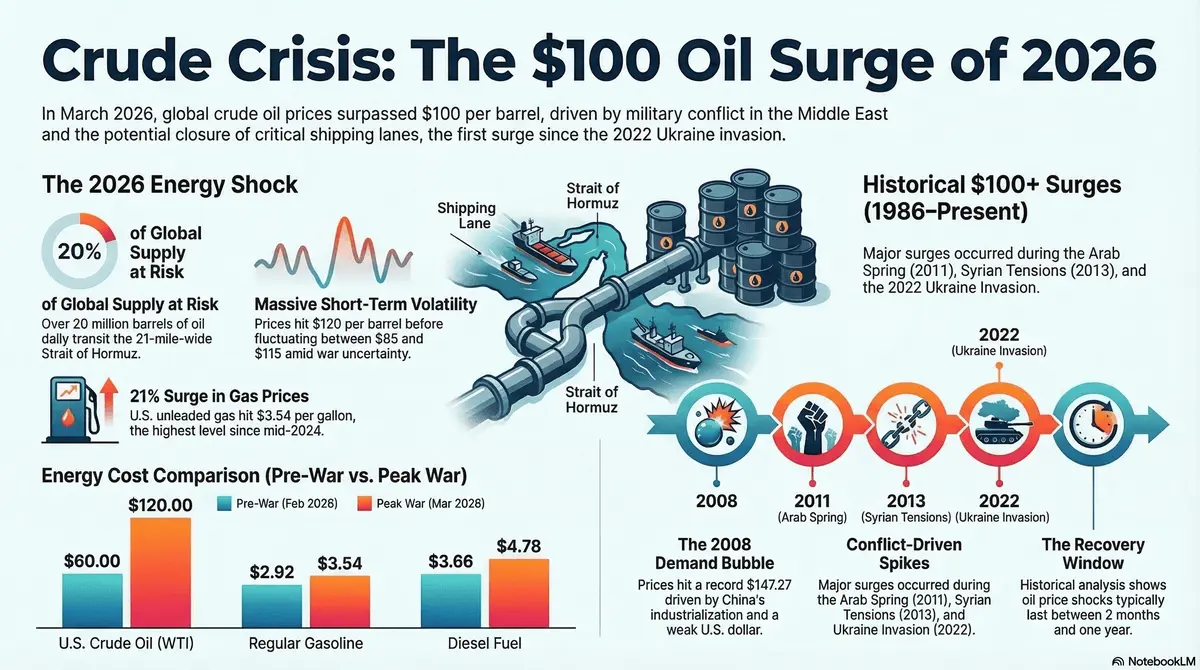
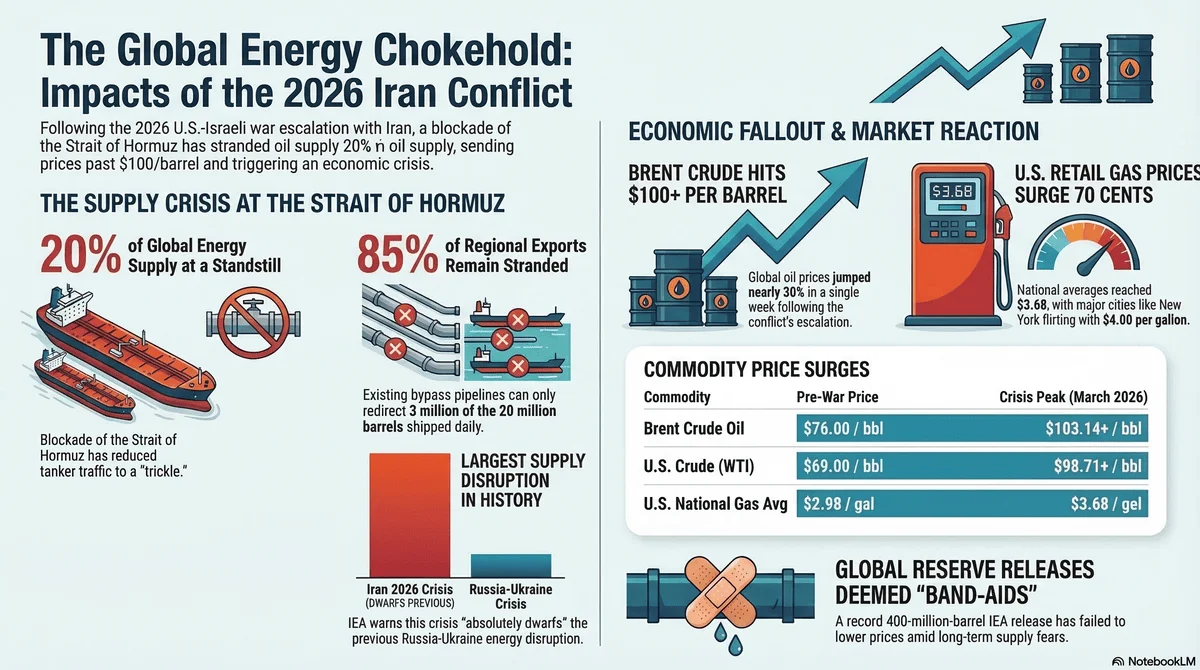
    London — Global oil markets are experiencing unprecedented volatility as the ongoing war between the United States, Israel, and Iran effectively halts transit through the Strait of Hormuz. Tensions escalated significantly on March 12, 2026, pushing Brent crude past the $100 per barrel mark despite massive emergency reserve releases. The International Energy Agency has characterized the situation as the largest supply disruption in the history of the global oil market.

    Below is a detailed breakdown of the global energy crisis and its economic ramifications.

    Context & Background

    How did this start? The crisis originated following joint strikes by the United States and Israel on Iran beginning on February 28, 2026. In response to these military actions, Iran launched retaliatory strikes on commercial vessels and energy infrastructure across the Middle East, severely disrupting the critical shipping lanes of the Persian Gulf.

    The key players The primary geopolitical actors include the governments of the United States, Israel, and Iran, alongside major intergovernmental organizations like the International Energy Agency. Mojtaba Khamenei, the new supreme leader of Iran, has advocated for the continued closure of the strait, while United States President Donald Trump has authorized emergency oil releases while maintaining military pressure.

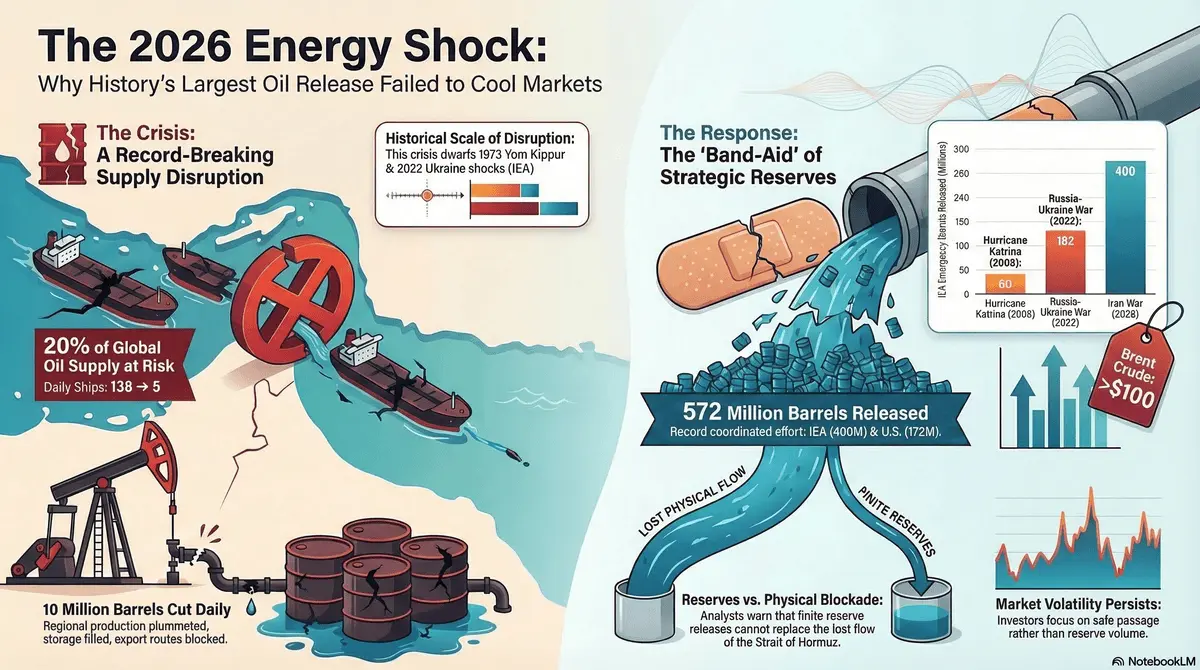
    Historical significance The current situation represents a massive supply shock that the International Energy Agency warns is deeper than both the 1973 Yom Kippur War oil crisis and the 2022 Russian invasion of Ukraine. To stabilize the market, the organization initiated a historic release of 400 million barrels of emergency crude, marking the largest intervention since its founding in 1974.

    Why this matters The effective closure of the Strait of Hormuz threatens roughly 20% of the world’s daily energy supply. This disruption has already forced companies to halt regional operations, sending domestic gas prices climbing toward $4 a gallon in the United States and triggering significant downturns across global stock exchanges in Tokyo, London, and New York.

    Q&A: Unpacking the Global Energy Disruption

    Q: How are global financial markets reacting to the supply disruption?

    A: Financial and energy markets have demonstrated severe volatility, marked by widespread sell-offs in equities and sharp spikes in commodity prices.

    • Crude Price Surges: Brent crude exceeded $100 a barrel, jumping roughly 9% in a single day due to fears of prolonged supply shortages.
    • Equity Market Declines: Major indexes, including the Dow Jones Industrial Average and S&P 500, experienced significant sell-offs, dropping between 1.5% and 1.6%.
    • Retail Fuel Impact: Domestic gasoline prices in the United States have risen nearly 60 to 70 cents since the war began, reaching an average of $3.60 per gallon.

    Q: Why did the emergency oil reserve releases fail to immediately stabilize prices?

    A: The historic injection of reserves by the International Energy Agency and the United States has not offset the fundamental logistical threats to shipping routes.

    • Finite Supply Limitations: Analysts, including Helima Croft, note that the 400 million barrels from the International Energy Agency and 172 million barrels from the United States represent temporary relief that cannot permanently replace the continuous flow of the Strait of Hormuz.
    • Logistical Bottlenecks: The United States reserve releases will take 120 days to complete and will not reach the market immediately.
    • Refining Constraints: Global refining capacity is currently limited, meaning the raw crude released does not instantly translate to available consumer products like jet fuel and gasoline.

    Q: How is the blockade of the Strait of Hormuz being enforced by regional powers?

    A: Iran and its proxy forces have systematically targeted commercial shipping and energy infrastructure in the region to restrict maritime movement.

    • Vessel Attacks: At least 16 commercial vessels have been attacked, reducing transit from an average of 138 daily ships to fewer than five.
    • Infrastructure Strikes: Regional facilities, including an oil export terminal in Oman and operations in Iraq, have suspended activities following drone sightings and direct strikes.
    • Political Directives: Iranian leadership, specifically Mojtaba Khamenei, has publicly declared the waterway’s closure a crucial strategic lever against the United States and Israel.
    • Unverified Status: At this time, the exact timeline for the waterway’s reopening remains unverified by official sources.

    Q: How are governments and corporations mitigating the immediate energy deficit?

    A: Stakeholders are deploying a mix of operational shutdowns, domestic rationing, and sanction adjustments to manage the crisis.

    • Corporate Retreats: Major firms like TotalEnergies and SLB have suspended up to 15% of their total output in affected countries, including Qatar, Iraq, and the United Arab Emirates.
    • Domestic Consumption Limits: India has implemented measures to limit fuel usage by certain businesses to prevent hoarding and market manipulation.
    • Sanction Relief: The United States Treasury Department, under Secretary Scott Bessent, issued a temporary license allowing the purchase of previously sanctioned Russian oil stranded at sea.

    Q: Why hasn’t a military escort system been established for commercial tankers yet?

    A: While proposed by the United States administration, naval escorts have been delayed due to logistical and tactical complexities in the contested waters.

    • Preparation Timelines: United States Energy Secretary Chris Wright confirmed that while escorts are planned, the military is currently unequipped to begin them immediately, aiming for the end of the month.
    • Coalition Requirements: Treasury Secretary Scott Bessent indicated that the operation will likely require the assembly of an international maritime coalition.
    • Information Retractions: The United States was forced to retract a premature social media claim by Chris Wright regarding a successful tanker escort, highlighting the operational confusion in the Persian Gulf.

    Editorial Note & Transparency

    Verification Log:

    • News Agency Reports: CBS News, NBC News, Al Jazeera, and BBC coverage detailing market fluctuations, geopolitical movements, and reserve releases.
    • Market Data: Pricing metrics and benchmark analytics sourced from the International Energy Agency, GasBuddy, and FactSet.
    • Official Statements: Public declarations and press releases from the U.S. Departments of Energy and Treasury, as well as statements from global energy executives.

    Compliance:

    • Privacy: This article respects user data under our Privacy Policy.
    • Transparency: No sponsored content influenced this reporting.

    Contact Us: For corrections or feedback, please email: news.desk@qnanews.com

  • February 2026 CPI Report Shows Steady Inflation Before Geopolitical Oil Shock

    February 2026 CPI Report Shows Steady Inflation Before Geopolitical Oil Shock

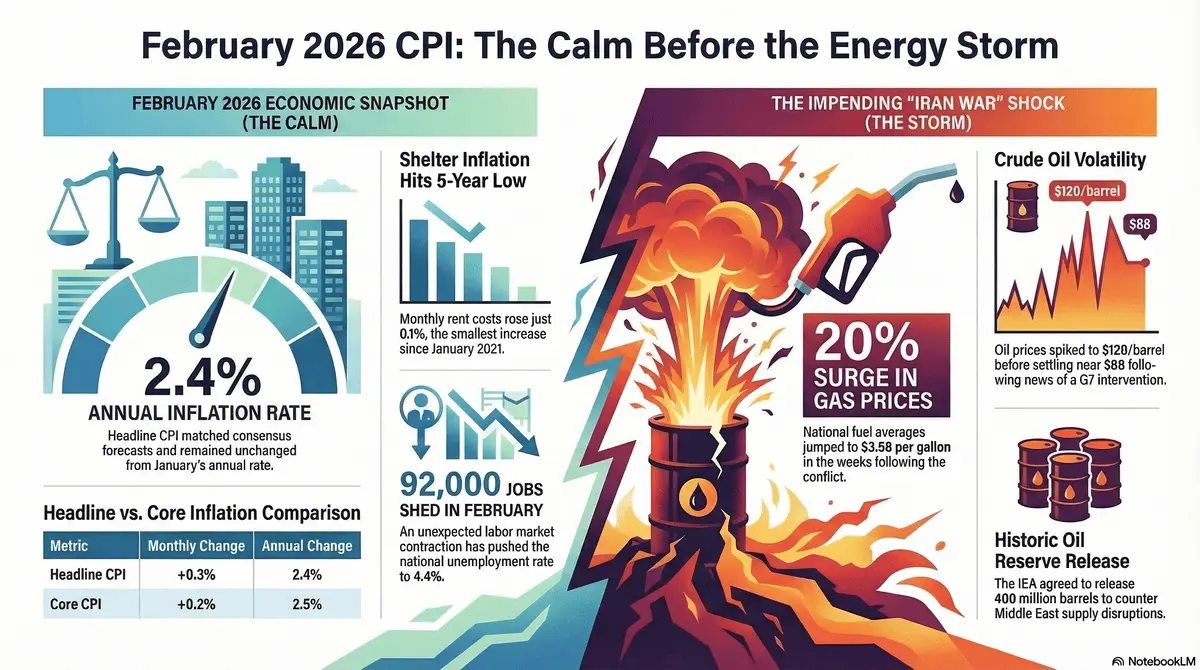
    Washington, D.C. — Consumer prices rose in line with expectations last month, but the data predates a major geopolitical shock that has since sent energy costs soaring. The Bureau of Labor Statistics released the Consumer Price Index on March 11, 2026, revealing a 2.4% annual inflation rate. However, economists warn that recent oil spikes linked to the conflict with Iran will likely complicate the economic outlook and fuel higher costs broadly.

    Below is a detailed breakdown of the inflation report and its broader economic implications.

    Context & Background

    The February CPI Findings The February Consumer Price Index (CPI) increased by a seasonally adjusted 0.3% for the month, maintaining a 12-month headline inflation rate of 2.4%. While core inflation, which strips out volatile food and energy sectors, held steady at an annual rate of 2.5%, notable declines were seen in rent increases, which saw their smallest monthly jump since January 2021.

    The Impact of the Oil Shock The February data serves as a snapshot of the economy before the U.S. and Israel attack on Iran, which temporarily shuttered shipping lanes and drove crude oil prices as high as $115 per barrel. This energy shock is expected to heavily impact the March CPI report, as the national average for regular gasoline has already surged to $3.58 a gallon.

    Tariff and Supply Chain Pressures Ongoing tariff pressures continue to influence the prices of specific goods, with apparel experiencing a 1.3% monthly gain—its largest since September 2018. Furthermore, industrial metals like aluminum have surged nearly 10% due to supply fears in the Middle East, a region that supplies roughly 9% of the world’s aluminum.

    Federal Reserve Implications Jerome Powell and the Federal Reserve face a difficult scenario marked by rising energy costs and a cooling labor market, highlighted by the unexpected loss of 92,000 jobs in February. These competing pressures of potential stagflation complicate the timeline for any anticipated interest rate cuts, likely keeping the central bank on hold during their upcoming policy meetings.

    Q&A: Unpacking The Inflation Report and Oil Shock

    Q: How might the sudden spike in crude oil prices cascade through the broader U.S. economy?

    A: The rapid escalation of oil prices threatens to reverse recent progress on inflation by increasing operational costs across multiple sectors.

    • Transportation Costs: Sustained gains in crude prices quickly increase the cost of gasoline and diesel, directly impacting shipping and freight expenses.
    • Consumer Goods Impact: Higher transportation costs inevitably filter down to a wide range of everyday consumer goods, from groceries to household furnishings.
    • Consumer Spending Squeeze: With gas prices reaching $3.58 per gallon, household budgets are tightened, which could slow the consumer spending that drives two-thirds of the nation’s economic growth.

    Q: Why are economists warning of a potential “stagflation” scenario in the coming months?

    A: A combination of geopolitical shocks and domestic labor weakness is creating a complex environment of rising prices and slowing economic growth.

    • Energy-Driven Inflation: The conflict in the Middle East is pushing headline inflation higher due to severe disruptions in global oil markets.
    • Labor Market Contraction: The unexpected loss of 92,000 jobs in February points to a softening labor market that contrasts sharply with rising energy costs.
    • Policy Gridlock: This dynamic makes it exceptionally difficult for the Federal Reserve to cut interest rates to stimulate employment without risking further inflation.

    Q: How is the Federal Reserve expected to navigate the conflicting data on inflation and employment?

    A: The central bank will likely maintain its current interest rates while closely monitoring the duration and severity of the geopolitical crisis.

    • Rate Hold Probability: Traders assign a nearly 100% probability that the Federal Reserve will keep its benchmark federal funds rate steady at its next meeting on March 17-18.
    • Delayed Easing: The combination of oil shocks and uncertain tariff policies has pushed back market expectations for the next rate reduction to September.
    • Dual Mandate Struggle: Policymakers must carefully weigh their mandate to maximize employment against their duty to control inflation, a calculation complicated by recent job losses.

    Q: Why did shelter and rent prices show such significant moderation in the latest report?

    A: The heavily weighted shelter component of the CPI indicated a cooling trend that initially offered hope to inflation-weary consumers.

    • Rent Deceleration: Rent rose by a mere 0.1% in February, marking the smallest monthly increase since January 2021.
    • Annual Shelter Index: The overall shelter index posted a modest 0.2% monthly increase, bringing its annual rate down to 3%.
    • Index Weighting Context: Because shelter is the single-biggest component of the CPI, this moderation was the primary reason core inflation remained steady before the oil shock.

    Q: How are ongoing tariff disputes influencing the cost of consumer goods and industrial materials?

    A: Trade policies and tariffs are creating uneven price pressures across different sectors of the economy, independent of energy costs.

    • Apparel Price Spikes: Clothing costs, which are highly sensitive to tariff pressures, jumped 1.3% in February alone.
    • Industrial Metal Surges: Supply fears and tariffs have driven up the cost of raw materials like aluminum, which is critical for infrastructure and technology.
    • Pending Tariff Refunds: At this time, the exact timing and execution of up to $175 billion in potential tariff refunds remains unverified by official sources.

    Editorial Note & Transparency

    Verification Log:

    • Financial News Outlet: CNBC provided detailed breakdowns of the February CPI report and market reactions.
    • Broadcast Network: Fox Business contributed analysis on the Federal Reserve rate expectations and labor market data.
    • Wire Service: The Associated Press reported on the macroeconomic impact of the Iran conflict and corresponding oil price spikes.

    Compliance:

    • Privacy: This article respects user data under our Privacy Policy.
    • Transparency: No sponsored content influenced this reporting.

    Contact Us: For corrections or feedback, please email: news.desk@qnanews.com

  • IEA Announces Historic Release of 400 Million Barrels of Emergency Oil Reserves

    IEA Announces Historic Release of 400 Million Barrels of Emergency Oil Reserves

    Paris/Washington — The International Energy Agency has coordinated an unprecedented release of emergency crude oil stockpiles to stabilize global markets disrupted by the ongoing war in the Middle East. The unanimous decision by 32 member nations was finalized on March 11, 2026, pledging to introduce 400 million barrels into the global supply. This intervention is the largest in the agency’s history, driven by severe transit restrictions in the Strait of Hormuz.

    Below is a detailed examination of the historic oil release and its economic implications.

    Context & Background

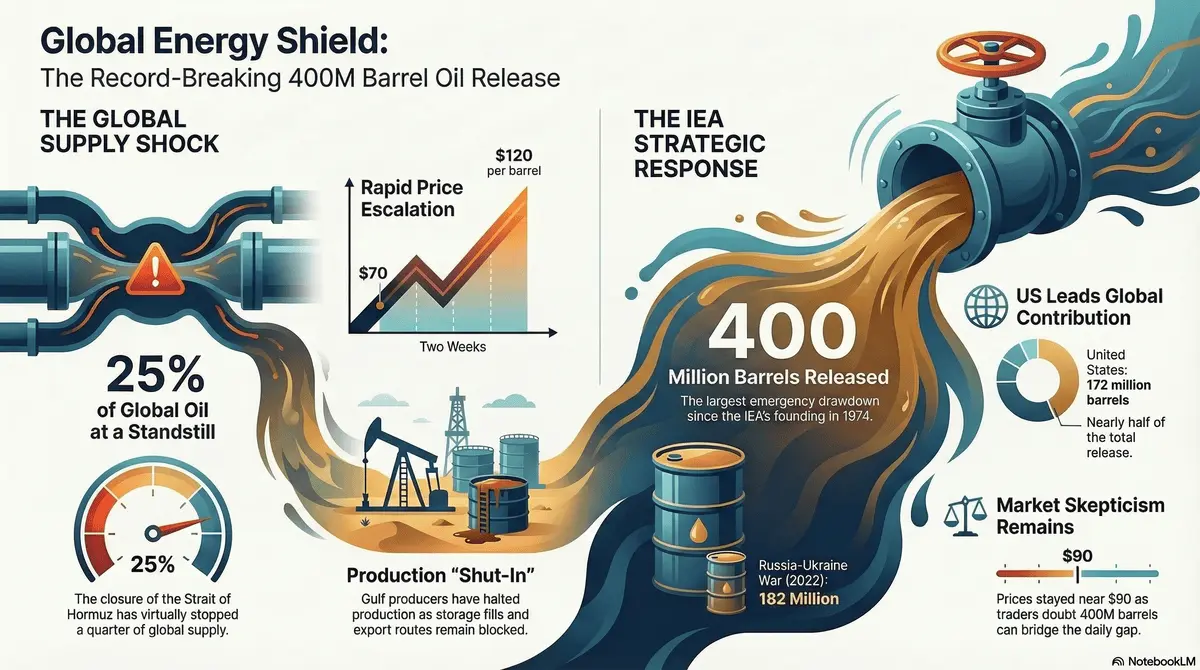
    What precipitated the emergency reserve release? The coordinated release follows the outbreak of the United StatesIsrael war with Iran that began on Feb. 28, 2026. Since the conflict initiated, Iran has effectively blocked the Strait of Hormuz, halting the flow of oil tankers through a critical maritime bottleneck that handles roughly 20 to 25 percent of the world’s daily oil supply. Consequently, global benchmark Brent crude oil surged to nearly $120 a barrel, prompting the International Energy Agency to intervene.

    The role of the International Energy Agency The International Energy Agency, headquartered in Paris, was established in 1974 following the Arab oil embargo to protect consumer nations from supply disruptions. Under current agreements, the 32 member nations are required to hold emergency stockpiles equal to 90 days of net imports. Collectively, these members control approximately 1.2 billion barrels in government reserves, with an additional 600 million barrels held by the industry.

    Historical significance of the intervention This marks only the sixth time the International Energy Agency has authorized a coordinated stock release. The volume of 400 million barrels is more than double the previous record of 182 million barrels released in 2022 following Russia‘s invasion of Ukraine. Executive Director Fatih Birol emphasized that the scale of current market challenges is unprecedented, necessitating this monumental collective action.

    Contributions from major nations While the release is a collective effort, the United States will contribute the largest portion by tapping 172 million barrels from its Strategic Petroleum Reserve. Other significant commitments include South Korea offering 22.46 million barrels and the United Kingdom contributing 13.5 million barrels. Germany, Austria, and Japan have also confirmed their participation in the historic drawdown.

    Q&A: Unpacking The Oil Reserve Release

    Q: How will the logistics of the oil release affect the timeline of market stabilization?

    A: The physical delivery of the stockpiled oil faces significant logistical hurdles, meaning market relief will not be immediate.

    • Delivery Estimates: Energy analysts suggest it will take between 60 to 90 days for the newly released oil to meaningfully enter the market.
    • United States Timeline: The Department of Energy stated that the delivery of the 172 million barrels from the United States will commence next week and take roughly 120 days to complete.
    • Refining Capacity: Producers will make the crude available for refineries to order, but a shortage of global refining capacity may further slow the conversion to usable fuel products.
    • Pipeline Constraints: Experts note that distribution is physically limited by pipeline capacity, which restricts how quickly the oil can flow from reserves to end-users.

    Q: Why have initial market reactions shown skepticism toward the price relief efforts?

    A: Despite the historic announcement, crude oil prices actually rose following the confirmation of the reserve release.

    • Volume Deficit: Analysts argue the release, equivalent to roughly three or four days of global supply, only closes a fraction of the 20 million barrels per day deficit caused by the Strait of Hormuz closure.
    • Finite Strategy: Stockpile releases are one-time solutions, prompting fears about future buffer capacity if the war continues for an extended period.
    • Transit Centrality: Industry leaders acknowledge that reserves cannot structurally substitute the resumption of regular transit through the currently blockaded waterways.

    Q: How has the war fundamentally disrupted regional oil production beyond shipping?

    A: The inability to export oil via traditional maritime routes has triggered severe operational bottlenecks for major Middle Eastern producers.

    • Storage Exhaustion: Nations like Iraq, Kuwait, and the United Arab Emirates have been forced to cut production because they are running out of physical storage space for their crude.
    • Infrastructure Damage: Iran, Israel, and the United States have executed strikes on energy-related infrastructure, including refineries and fuel tanks, further exacerbating regional supply constraints.
    • Alternative Routes: Producers are attempting to redirect some exports, such as utilizing a pipeline across Saudi Arabia to the Red Sea, but these alternatives lack the capacity to replace the primary maritime route.

    Q: Why does the United States maintain the largest stockpile despite being a net exporter?

    A: The United States holds massive reserves to shield its economy from global price volatility, despite its robust domestic production.

    • Regulatory Exemption: As a net exporter, the United States is technically exempt from the International Energy Agency mandate requiring 90 days of reserve imports.
    • Market Vulnerability: Because oil is globally priced, the United States remains vulnerable to international price spikes, necessitating the 715-million-barrel capacity Strategic Petroleum Reserve for economic buffering.
    • Refill Challenges: Previous administrations, including those of Donald Trump and Joe Biden, have attempted to refill the reserve, but underground salt cavern damage has hindered replenishment efforts.

    Q: How might the ongoing conflict necessitate future energy rationing?

    A: Prolonged hostilities could exhaust emergency stockpiles, leading governments to consider restricting energy use for non-essential consumers.

    • Depletion Risks: At this time, the exact date when current reserve levels will reach critical depletion points remains unverified by official sources, but prolonged conflict threatens the global buffer.
    • Natural Gas Shortages: The reserve release does not address the 20 percent slump in liquid natural gas supplies, a market the International Energy Agency describes as “very challenging”.
    • Priority Distribution: Former BP strategy head Nick Butler stated that the United Kingdom might need to implement rationing to guarantee that priority users receive necessary supplies.

    Editorial Note & Transparency

    Verification Log:

    • Government Statements: Announcements from the International Energy Agency and the United States Department of Energy regarding the reserve release volume and timeline.
    • Market Data: Pricing benchmarks for Brent and West Texas Intermediate crude oil sourced from financial and commodities reporting.
    • Expert Analysis: Commentary from energy analysts and university researchers regarding logistical constraints and market impacts.

    Compliance:

    • Privacy: This article respects user data under our Privacy Policy.
    • Transparency: No sponsored content influenced this reporting.

    Contact Us: For corrections or feedback, please email: news.desk@qnanews.com

  • Oil Prices Surge Amid Energy Infrastructure Disruptions

    Oil Prices Surge Amid Energy Infrastructure Disruptions

    New York/Washington — The global oil market has experienced severe disruptions following military actions in the Middle East, pushing crude oil prices temporarily above the $100 per barrel mark. This surge occurred after strikes initiated on February 28, 2026, targeting infrastructure across the region. Gas prices in the United States have reached their highest levels since mid-2024, raising concerns about broader economic impacts and consumer affordability.

    Below is a detailed examination of the conflict’s impact on global energy markets and infrastructure.

    Context & Background

    How did this conflict affect the global oil supply? The ongoing war has severely restricted marine traffic through the Strait of Hormuz, a critical chokepoint handling approximately 20% of the world’s petroleum consumption. With this vital passage compromised by the threat of drone attacks, global supply chains are heavily disrupted, causing a sharp reduction in available crude oil and pushing up prices.

    The key infrastructure at risk The conflict has directly impacted critical regional facilities, including the Ras Laffan liquefied natural gas terminal in Qatar, which halted exports after a drone strike. Other significant disruptions include fires at the Ras Tanura refinery in Saudi Arabia and the suspension of production at the Leviathan natural gas field in Israel.

    Historical significance of the price surge This marks the first time that West Texas Intermediate and Brent crude oil prices have breached the $100 per barrel threshold since the 2022 Russian invasion of Ukraine. While the 2008 financial crisis saw the highest recorded prices at over $145 a barrel, the current rapid spike represents one of the most significant energy market shocks since the 1990 Gulf War.

    Why this matters for everyday consumers Surging oil prices directly translate to higher transportation costs, pushing the average price of regular gasoline in the United States to approximately $3.54 per gallon. This increase threatens to exacerbate inflation, potentially raising the costs of daily essentials like groceries and driving up expenses for the aviation and agricultural industries.

    Q&A: Unpacking the Global Oil Crisis

    Q: How are rising oil prices expected to impact the global food supply chain?

    A: Elevated energy costs are anticipated to trigger a butterfly effect across the agricultural and grocery sectors by increasing operational and transportation expenses.

    • Fertilizer Costs: Natural gas is a foundational ingredient for fertilizer production, and the current energy crunch has already caused suppliers to halt deliveries and hike prices.
    • Transportation Expenses: Higher diesel fuel prices, which have jumped significantly, directly increase the cost of trucking and shipping agricultural goods to markets.
    • Consumer Pricing: Grocers and producers facing margin compressions will likely pass these elevated logistical costs onto inflation-weary consumers.

    Q: Why is the Strait of Hormuz so critical to the stabilization of global energy markets?

    A: The narrow waterway is the primary maritime route for Middle Eastern oil and gas exports, lacking sufficient alternative pipelines to make up for a complete closure.

    • Volume Significance: Over 20 million barrels of oil transit through the strait daily, representing a fifth of all global petroleum consumption.
    • Alternative Route Limitations: Bypass options, such as Saudi Arabia‘s East-West pipeline or the United Arab Emirates‘ Fujairah pipeline, only offer a combined capacity of about 4.7 million barrels per day.
    • Targeted Blockades: At this time, the exact timeline for the resumption of safe passage remains unverified by official sources, as operators anchor ships to avoid cheap drones and hidden launch sites.

    Q: How have the U.S. and Iranian governments responded to the escalating economic threats?

    A: Both nations are utilizing military and economic posturing, with the United States making direct threats and Iran targeting energy exports to exert pressure.

    • Iranian Retaliation: Iranian officials declared no oil would leave the Middle East until bombardments cease, targeting regional infrastructure to leverage fossil fuels as a weapon of war.
    • U.S. Countermeasures: President Donald Trump and Defense Secretary Pete Hegseth threatened to hit Iran harder if it continues to block the waterway, while the administration considers using naval convoys to protect tankers.
    • Strategic Reserves: To combat the price spike, Western countries are discussing the potential release of oil from strategic stockpiles established after the 1970s oil crisis.

    Q: Why might the current oil price shock lead to broader global economic instability?

    A: Prolonged high energy costs historically correlate with economic slowdowns due to reduced discretionary spending and increased operational burdens for businesses.

    • Inflationary Pressures: Economists warn that the direct pass-through of higher oil costs could push United States inflation back above the 3% mark.
    • Industrial Impacts: Energy-intensive sectors, such as microchip manufacturing in Taiwan and artificial intelligence infrastructure development, face significant cost increases.
    • Historical Precedent: Major oil shocks, such as those in 1973, 1978, and 1990, have consistently preceded forms of global recession or stagflation.

    Q: How are different regions around the world uniquely affected by the fuel supply disruptions?

    A: While oil-producing nations face infrastructure damage, import-heavy regions are struggling with immediate price surges and potential supply rationing.

    • Asian Markets: Because roughly 89% of oil flowing through the Strait of Hormuz is bound for countries like China, India, and Japan, the region is facing acute shortages, prompting some governments to enact rationing measures.
    • European Aviation: Europe relies on the Persian Gulf for about half of its jet fuel, causing regional aviation fuel prices to nearly double since the conflict began.
    • American Consumers: While the United States is a top producer, its consumers are primarily experiencing the shock at the gas pump, where prices remain highly volatile.

    Editorial Note & Transparency

    Verification Log:

    • Energy Industry Data: Gathered from the Energy Information Administration and American Automobile Association regarding fuel prices and historical oil shocks.
    • Geopolitical Analysis: Statements and strategic insights drawn from expert interviews, including independent researchers and global macroeconomic analysts.
    • Market Monitoring: Real-time commodity tracking sourced from global finance platforms mapping the price per barrel of Brent and WTI crude.

    Compliance:

    • Privacy: This article respects user data under our Privacy Policy.
    • Transparency: No sponsored content influenced this reporting.

    Contact Us: For corrections or feedback, please email: news.desk@qnanews.com

  • Global Markets Plunge as Iran War Drives Oil Spikes and Job Losses Mount

    Global Markets Plunge as Iran War Drives Oil Spikes and Job Losses Mount

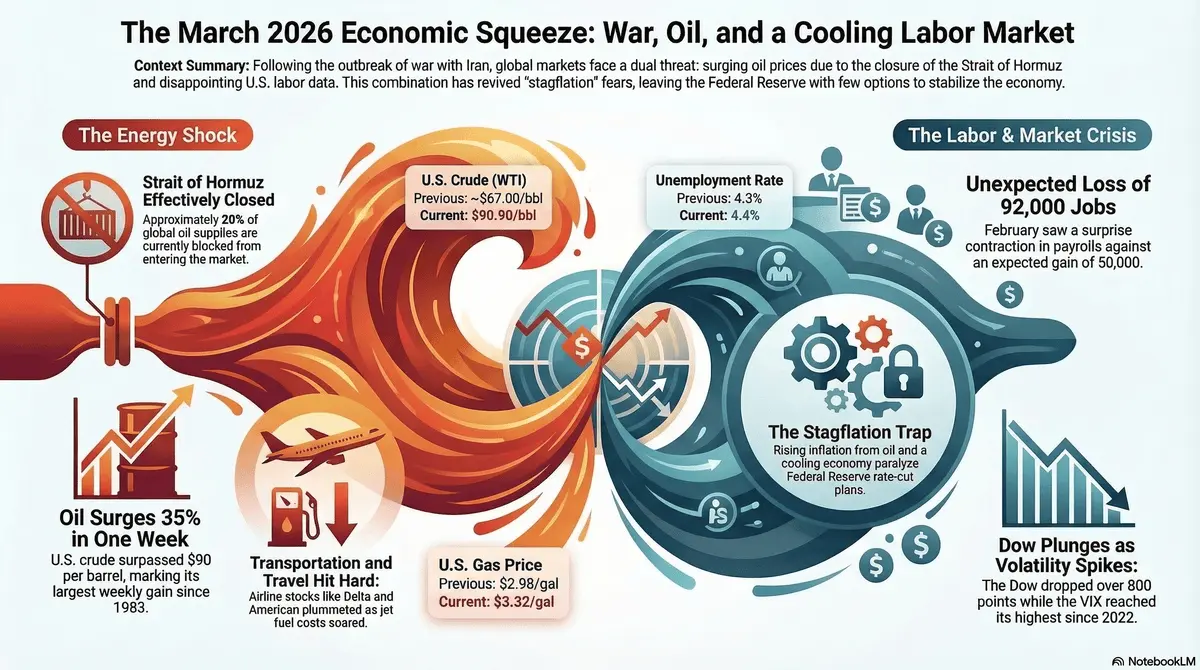
    New York/London — Global financial markets experienced a severe sell-off after crude oil prices spiked to their highest levels since 2023 amid the ongoing military conflict involving the United States, Israel, and Iran. This geopolitical shock coincided with an unexpectedly weak U.S. jobs report released on March 6, 2026, further raising fears of a stagnating economy. The dual pressures of soaring energy costs and rising unemployment have left investors deeply concerned about the prospect of stagflation.

    Below is a detailed breakdown of the economic and geopolitical factors driving the current market volatility.

    Context & Background

    The Geopolitical Catalyst The escalating war in the Middle East has severely disrupted global energy markets, driven by clashes involving the United States, Israel, and Iran. President Donald Trump has demanded the unconditional surrender of Iran, intensifying the conflict and prompting warnings from officials like Qatar‘s energy minister, Saad al-Kaabi, that oil could soon reach $150 per barrel.

    The Strait of Hormuz Bottleneck The primary driver of the oil shock is the effective closure of the Strait of Hormuz, a vital waterway through which roughly one-fifth of the world’s seaborne oil typically travels. Iran has achieved this disruption using cheap drone warfare rather than a traditional naval blockade, severely curtailing international shipping and energy exports.

    The Labor Market Setback Compounding the geopolitical crisis, the Bureau of Labor Statistics reported that U.S. nonfarm payrolls unexpectedly fell by 92,000 jobs in February, sharply contradicting economists’ expectations of job growth. The U.S. unemployment rate subsequently increased to 4.4%, a development that indicates a rapidly cooling domestic economy and a sudden shift away from previously strong job creation.

    The Federal Reserve’s Policy Dilemma The combination of high inflation driven by energy costs and a weakening job market has placed the Federal Reserve in a difficult position. While a softening labor market typically warrants interest rate cuts to stimulate growth, rising oil prices apply intense upward pressure on inflation, making it risky for policymakers like San Francisco Federal Reserve President Mary Daly to ease monetary policy.

    Q&A: Unpacking the Market Crisis

    Q: How is the disruption in the Middle East specifically inflating global energy costs?

    A: The conflict has paralyzed crucial maritime routes, causing severe supply bottlenecks that have driven U.S. crude prices above $90 per barrel.

    • Strait Blockade: The use of drone warfare by Iran has effectively halted tanker traffic through the Strait of Hormuz.
    • Export Stoppages: The war has halted Iranian gas exports to Asia, potentially sparking a bidding war between Europe and Asia for alternative energy sources.
    • Unprecedented Gains: U.S. crude oil posted a 35% weekly gain, representing the largest jump since futures trading began in 1983.

    Q: Why are financial markets reacting so negatively to the latest jobs report?

    A: The unexpected job losses signal that the U.S. economy may be deteriorating faster than anticipated, removing a key pillar of recent economic stability.

    • Payroll Contraction: Instead of the projected 50,000 to 59,000 job gain, the U.S. economy shed 92,000 jobs in February.
    • Rising Unemployment: The unemployment rate climbed from 4.3% to 4.4%, highlighting a broader softening of the labor pool.
    • Stagflation Fears: The simultaneous occurrence of job losses and soaring inflation creates the dreaded “stagflation” scenario, which equities historically struggle to navigate.

    Q: How are rising oil prices disproportionately impacting specific market sectors?

    A: Industries heavily reliant on fuel or discretionary consumer spending are bearing the brunt of the market sell-off.

    • Airlines and Cruises: Companies like Delta Air Lines, Southwest Airlines, and Royal Caribbean have seen significant stock drops due to spiking jet fuel and diesel costs.
    • Small-Cap Vulnerability: Smaller companies, tracked by the Russell 2000 index, are suffering heavy losses because they are highly sensitive to borrowing costs and domestic economic strength.
    • Banking Pressures: Financial institutions like Western Alliance Bancorp are tumbling as a steeper yield curve threatens to compress net interest margins and curb loan demand.

    Q: Why is the Federal Reserve struggling to respond effectively to these dual crises?

    A: Policymakers lack a single tool capable of simultaneously combating rising inflation and stimulating a shrinking job market.

    • Inflationary Pressures: Cutting interest rates would typically help the job market but could dangerously exacerbate the inflation caused by the 12% spike in oil prices.
    • Borrowing Costs: Keeping rates high to fight inflation will maintain expensive borrowing conditions for households and businesses, further grinding down the economy.
    • Policy Recalibration: Traders have pushed their expectations for rate cuts further into the summer, realizing the central bank is poorly positioned to add accommodation.

    Q: How are geopolitical leaders attempting to mitigate the shipping disruptions?

    A: Efforts are underway to financially and militarily protect maritime vessels, though markets remain skeptical of immediate success.

    • Reinsurance Program: The U.S. government has announced a $20 billion reinsurance facility to encourage oil tankers to move through the Strait of Hormuz.
    • Naval Escorts: President Donald Trump has expressed readiness to use the U.S. Navy to escort tankers, but analysts note the massive volume of traffic makes this highly challenging.
    • Market Reaction: Despite these interventions, the initiatives have had little calming effect on energy markets so far.

    Editorial Note & Transparency

    Verification Log:

    • Financial Market Data: Verified through reports from major trading indices (Dow Jones, S&P 500, Nasdaq) and oil futures tracking (Brent, WTI).
    • Economic Indicators: Sourced from the Bureau of Labor Statistics February nonfarm payrolls and unemployment report.
    • Geopolitical Statements: Cross-referenced statements from U.S. and Middle Eastern officials regarding the Strait of Hormuz and oil production.

    Compliance:

    • Privacy: This article respects user data under our Privacy Policy.
    • Transparency: No sponsored content influenced this reporting.

    Contact Us: For corrections or feedback, please email: news.desk@qnanews.com

  • Global Oil Trade Stalls as Conflict Effectively Closes Strait of Hormuz

    Global Oil Trade Stalls as Conflict Effectively Closes Strait of Hormuz

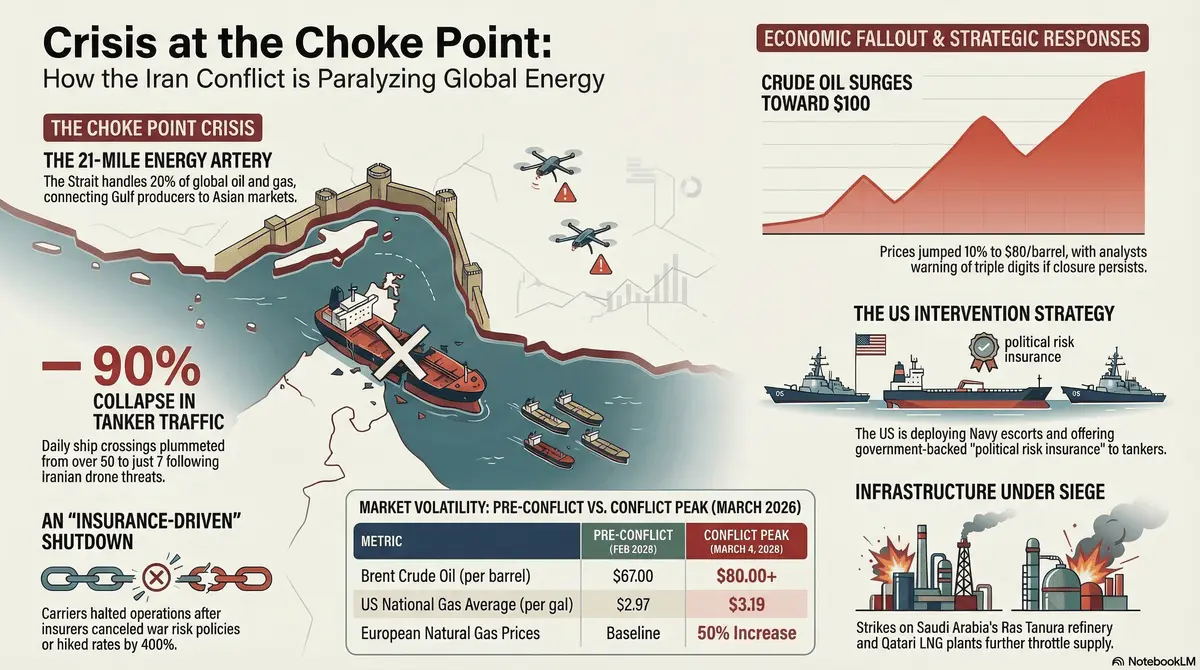
    Dubai/Washington — Escalating military conflict involving the United States, Israel, and Iran has brought shipping through the critical Strait of Hormuz to a near standstill, threatening global energy markets and supply chains. Commercial vessel traffic plummeted by roughly 90 percent following targeted drone strikes and maritime threats that began on February 28, 2026. In response, President Donald Trump has directed the United States Navy to escort tankers and offered federal insurance to mitigate soaring risks for global shippers.

    Below is a detailed breakdown of the conflict’s impact on energy supply, international shipping, and the broader global economy.

    Context & Background

    How did the closure of the strait occur? Rather than a traditional naval blockade, Iran effectively closed the Strait of Hormuz by deploying relatively inexpensive drones to attack nearby vessels and energy infrastructure. Following these strikes and explicit threats from Iranian officials to burn passing ships, major shipping companies and maritime insurers instituted an insurance-driven shutdown. This coverage gap forced over 150 vessels, including crucial liquefied natural gas (LNG) and oil tankers, to anchor outside the gulf or reroute entirely.

    Why is this waterway critical to global energy? The Strait of Hormuz is a narrow, 21-mile-wide passage connecting the Persian Gulf to the Gulf of Oman, through which approximately 20 percent of the world’s crude oil and seaborne gas passes daily. With limited alternative pipelines available in countries like Saudi Arabia and the United Arab Emirates, most fuel volumes exiting the region rely entirely on this marine choke point. Any disruption in this area triggers immediate volatility in global energy markets.

    Who are the key players in the economic response? Alongside the warring nations of Israel, Iran, and the United States, major global shipping conglomerates such as Maersk, MSC Group, and Hapag-Lloyd have paused regional operations. To counter the economic freeze, Donald Trump ordered the United States Development Finance Corporation to offer political risk insurance to shippers, aiming to reduce the financial threat of navigating a war zone. Additionally, the United States Navy is prepared to deploy destroyers to escort merchant vessels, echoing tactics used during the tanker wars of the 1980s.

    Q&A: Unpacking The Energy Shipping Crisis

    Q: How are these supply chain disruptions impacting global oil and natural gas prices?

    A: The sudden halt of maritime traffic and attacks on regional refineries have caused immediate, sharp increases in energy commodity costs.

    • Crude Oil Surge: Following the outbreak of hostilities, Brent crude prices jumped over 10 percent, reaching approximately $80 per barrel as traders reacted to the supply squeeze.
    • Natural Gas Spikes: Europe natural gas prices soared by more than 50 percent shortly after a drone strike forced the closure of QatarEnergy‘s Ras Laffan facility in Qatar.
    • Refining Bottlenecks: The attack on Saudi Aramco‘s Ras Tanura refinery in Saudi Arabia, which processes 550,000 barrels daily, further reduced the available output of refined fuels.

    Q: Why has the United States government stepped in to provide maritime insurance?

    A: Commercial insurers have either canceled coverage or drastically raised rates, making passage financially unviable for shipping companies without government intervention.

    • Skyrocketing Premiums: War risk insurance rates surged from 0.25 percent to 1.25 percent of a vessel’s total value, effectively pricing many operators out of the route.
    • Federal Backing: The United States Development Finance Corporation was mobilized to offer subsidized political risk insurance to ensure the continued free flow of goods and capital.
    • Logistical Hurdles: Despite this federal offer, industry experts warn that the agency’s finite budget and strict regulatory requirements may limit the immediate effectiveness of the program.

    Q: How does the conflict threaten domestic inflation and consumer costs in the United States?

    A: Rising crude oil prices typically translate to higher fuel costs at the pump, which in turn elevates transportation expenses across the broader economy.

    • Gasoline Price Hikes: The national average for gasoline recently reached $3.19 per gallon, with analysts projecting further increases as refiner margins absorb higher crude costs.
    • Supply Chain Inflation: Sustained energy inflation increases the cost of transporting goods by air, sea, and road, which can lead to higher prices for groceries and everyday retail items.
    • Interest Rate Pressures: If energy-driven inflation persists, the Federal Reserve may be forced to keep interest rates higher for a longer duration, impacting consumer loans and mortgage rates.

    Q: Why might the United States domestic oil industry benefit from this Middle Eastern instability?

    A: As the world’s largest producer of both oil and natural gas, the domestic energy sector stands to profit from elevated global market prices.

    • Production Margins: American shale oil producers, particularly those in the Permian Basin of Texas, face breakeven costs around $61 to $62 per barrel; current prices well above this threshold ensure high profitability.
    • Corporate Consolidation: Major non-national energy corporations like ExxonMobil and Chevron recently executed multi-billion-dollar acquisitions to expand their shale and offshore drilling operations, positioning them to capitalize on the supply vacuum.
    • Export Advantage: With Middle Eastern LNG supplies disrupted, American natural gas exporters can command higher premiums on the international market, especially from buyers in Europe.

    Q: How are regional allies and international bodies responding to the shipping crisis?

    A: Most major international shipping firms have halted operations, while regional actors attempt to mitigate infrastructure damage and logistics blockades.

    • Corporate Suspensions: Global leaders such as Maersk, CMA-CGM, and Emirates SkyCargo have suspended all non-essential bookings through the Strait of Hormuz.
    • Logistical Idling: Approximately 4 percent of global shipping tonnage is currently idle or waiting in ports across Oman and the United Arab Emirates.
    • Production Pauses: Producers like Iraq are being forced to shut down output at major oil fields because they lack the storage capacity and cannot export the product through the blockaded strait.

    Editorial Note & Transparency

    Verification Log:

    • News Agency Report: The Associated Press reporting on initial vessel traffic drops, oil prices, and government interventions.
    • Analytical Feature: The Guardian and NPR providing market analysis on drone tactics, natural gas spikes, and insurance barriers.
    • Economic Analysis: NBC News and regional financial op-eds detailing inflation risks, Federal Reserve impacts, and domestic shale oil profit margins.

    Compliance:

    • Privacy: This article respects user data under our Privacy Policy.
    • Transparency: No sponsored content influenced this reporting.

    Contact Us: For corrections or feedback, please email: news.desk@qnanews.com

  • Netflix Drops Bid for Warner Bros. Discovery as Paramount Skydance Poised for Acquisition

    Netflix Drops Bid for Warner Bros. Discovery as Paramount Skydance Poised for Acquisition

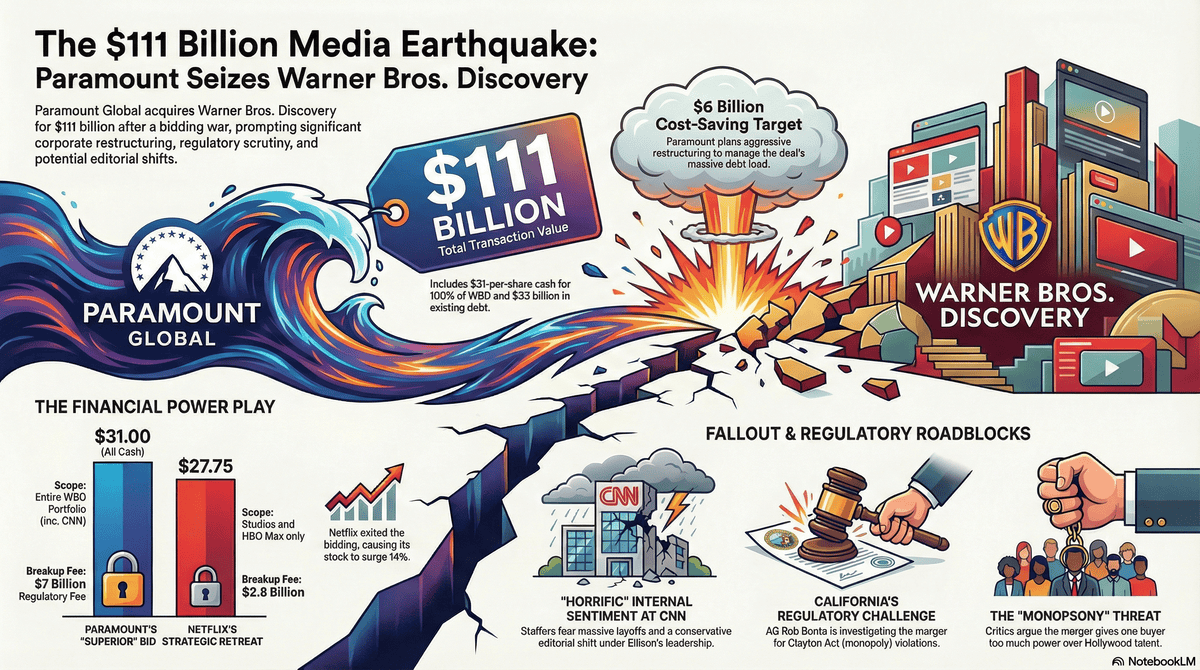
    Los Angeles/New YorkNetflix has unexpectedly withdrawn from the bidding war to acquire Warner Bros. Discovery, clearing the path for a massive $111 billion takeover by Paramount Skydance. Following regulatory meetings at the White House, Netflix co-CEOs Ted Sarandos and Greg Peters announced their decision to exit the deal on February 26, 2026, stating the revised transaction was no longer financially attractive. This sudden reversal has triggered immense corporate restructuring anxieties and shifted the future of the global entertainment landscape.

    Below is a detailed examination of the merger’s regulatory hurdles, political implications, and industry fallout.

    Context & Background

    How did this bidding war unfold? Following an initial $83 billion merger agreement between Netflix and Warner Bros. Discovery on December 5, Paramount Skydance escalated the competition with a sweetened $31-per-share all-cash offer. Warner Bros. Discovery CEO David Zaslav and the board indicated the new bid could constitute a superior proposal, prompting Netflix to walk away rather than overpay for the assets.

    Who are the key players in the prospective Paramount merger? The acquisition effort is being spearheaded by Paramount Skydance chief David Ellison, backed by his billionaire father Larry Ellison and a consortium of financing. They are navigating regulatory channels with the strategic help of Makan Delrahim, while facing fierce potential legal opposition from California Attorney General Rob Bonta.

    Why does this media consolidation matter? A combination of Paramount Skydance and Warner Bros. Discovery would drastically consolidate the entertainment industry, shrinking the field of major studios from five to four. Furthermore, it would place massive news operations like CNN and CBS News under the exact same corporate umbrella, raising significant concerns among journalists regarding narrative control, ideological shifts, and labor monopsonies.

    What are the political dimensions of the deal? Critics note that David Ellison maintains a close relationship with President Donald Trump, who has historically disparaged CNN. Media watchdogs and Democratic leaders like Senator Elizabeth Warren have warned that the consolidation could result in a Donald Trump-aligned ownership structure exerting partisan political influence over independent journalism.

    Q&A: Unpacking the Warner Bros. Discovery Acquisition

    Q: How did financial discipline factor into the decision by Netflix to withdraw?

    A: Netflix leadership determined that exceeding the $31-per-share price point would damage the company’s financial standing and negatively impact their accretion math.

    • Shareholder Response: Netflix stock had fallen over 18% since the initial deal announcement but surged by more than 10% after the withdrawal was made public.
    • Strategic Valuation: Co-CEOs Ted Sarandos and Greg Peters stated the acquisition was always a “nice to have” rather than a “must have” at any price.
    • Debt Avoidance: By bowing out, Netflix completely avoids the burden of assuming the roughly $33 billion in debt currently held on the books of Warner Bros. Discovery.

    Q: Why are regulators heavily scrutinizing the Paramount Skydance and Warner Bros. Discovery merger?

    A: The massive $111 billion transaction presents severe antitrust and labor concerns regarding market monopolization across multiple entertainment sectors.

    • Horizontal Consolidation: The merger would unite direct competitors in cable television, sports, and news, which potentially violates aspects of the Clayton Act aimed at preventing monopolies.
    • Labor Monopsony: Hollywood writers and talent have raised alarms that fewer studios will drive down wages, eliminate creative leverage, and decrease project competition.
    • State Intervention: California Attorney General Rob Bonta has explicitly stated the merger is not a done deal and initiated a vigorous state-level review to potentially seek a court order blocking the closure.

    Q: How will the acquisition potentially impact the operations and editorial direction of CNN?

    A: The network is bracing for severe ideological shifts and staff reductions under the new leadership of David Ellison.

    • Staff Panic: Inside CNN headquarters in New York, employees are reportedly experiencing “off the charts” panic regarding job security and structural changes.
    • Editorial Precedent: Staff point to CBS News, where Paramount Skydance installed Bari Weiss, resulting in a perceived rightward shift and attempts to appeal to conservative viewers.
    • Presidential Pressure: President Donald Trump has frequently targeted CNN, leading to profound fears that the new ownership might reshape the network to align with his political interests and establish a partisan media environment.

    Q: How is Paramount Skydance financing and structuring this massive acquisition?

    A: The $111 billion deal relies on a combination of expanded equity commitments, aggressive ticking fees, and assumption of existing corporate debt.

    • Per-Share Valuation: Paramount Skydance raised its all-cash offer to $31 per share to explicitly outbid the $27.75 per share agreement previously held by Netflix.
    • Penalty Fees: Paramount Skydance committed to paying the $2.8 billion breakup fee owed to Netflix, alongside a $7 billion regulatory termination fee if the deal fails.
    • Funding Sources: The consortium expanded financing commitments, leveraging $45.7 billion in equity that reportedly includes backing from foreign sovereign wealth funds. At this time, the exact identities of these foreign sovereign wealth funds remain unverified by official sources.

    Q: Why might international regulatory bodies take a different approach than United States enforcers?

    A: European regulators historically prioritize local market competition rather than broad global consolidation concerns when reviewing entertainment mergers.

    • Precedent Cases: Transactions like Amazon’s purchase of MGM and Disney’s acquisition of 21st Century Fox were approved in Europe with only minor regional conditions.
    • Geographic Scope: European authorities typically focus on requiring companies to sell off specific cable television assets where regional monopolies might form, allowing the overarching corporate merger to proceed.
    • Deal Timing: Paramount Skydance aims to close the deal swiftly upon receiving these relatively smoother foreign approvals, which puts immense pressure on domestic challengers to act quickly.

    Editorial Notes & Transparency

    Verification Log:

    • Financial Reporting: Analysis of stock performance, per-share valuations, and termination fee structures sourced from established financial media tracking the Netflix and Paramount Skydance bids.
    • Legal Documentation: Examination of state and federal antitrust strategies, including public statements from the California Department of Justice and Clayton Act frameworks.
    • Industry Publications: Internal memos, town hall accounts, and employee sentiment reports detailing the internal reactions at Warner Bros. Discovery and CNN.

    Compliance:

    • Privacy: This article respects user data under our Privacy Policy.
    • Transparency: No sponsored content influenced this reporting.

    Contact Us: For corrections or feedback, please email: news.desk@qnanews.com