Pretoria, South Africa — Astronomers using the MeerKAT radio telescope have discovered the most distant and luminous hydroxyl megamaser ever recorded. The findings, detailed in a pre-print study made available on March 2, 2026, reveal a powerful radio emission originating from a violent galaxy merger over eight billion light-years from Earth. The signal, amplified by a rare gravitational lensing effect, offers unprecedented insights into star formation and galaxy evolution when the universe was less than half its current age.
Below is a detailed breakdown of the astrophysical mechanisms, technological achievements, and future implications of this discovery.
Context & Background
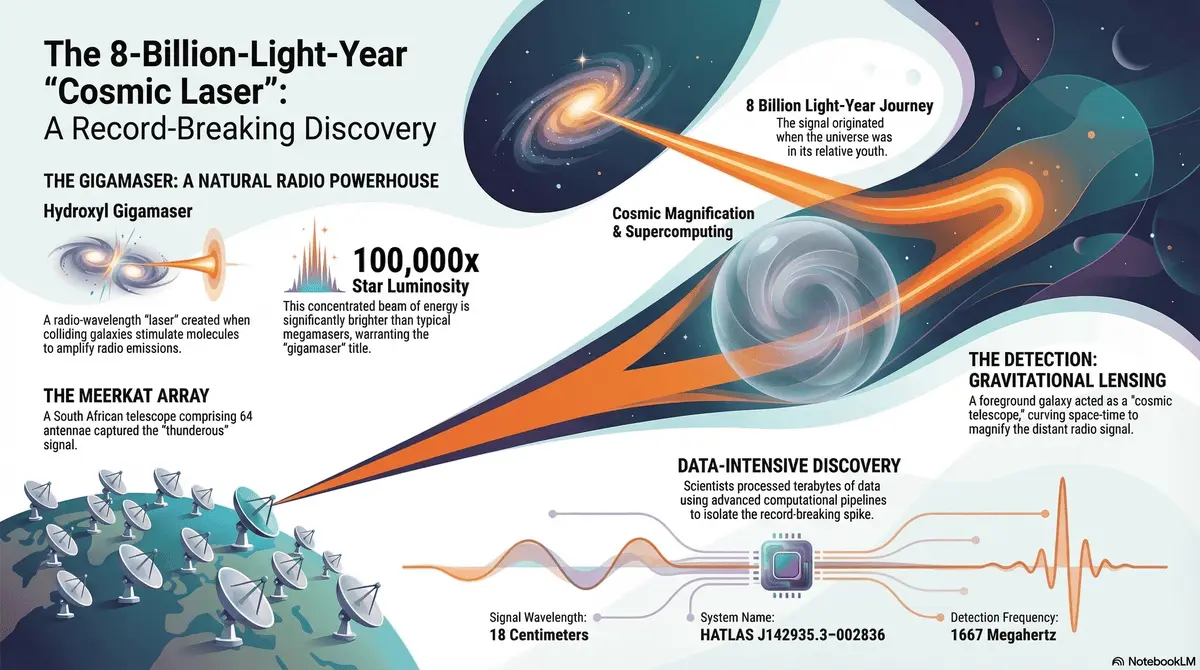
What is a Hydroxyl Gigamaser? A hydroxyl megamaser is a naturally occurring, highly focused beam of microwave radiation produced when hydroxyl molecules in gas-rich galaxies are stimulated by intense light. This specific emission, named HATLAS J142935.3–002836, is so exceptionally bright that it earns the ultra-rare classification of a gigamaser, shining roughly 100,000 times brighter than a typical star.
How the Discovery Unfolded The breakthrough was achieved by an international team led by Dr. Thato Manamela at the University of Pretoria, utilizing the MeerKAT radio telescope located in the Karoo region of South Africa. Researchers captured the booming 1667 megahertz signal while scanning the cosmos, relying on advanced computational pipelines developed by the Inter-University Institute for Data Intensive Astronomy to process terabytes of data.
The Role of Gravitational Lensing A crucial factor in this detection was strong gravitational lensing, a phenomenon theorized by Albert Einstein where the mass of a foreground galaxy curves local space-time. In this instance, a perfectly aligned foreground disk galaxy acted as a cosmic magnifying glass, significantly amplifying the radio waves before they reached Earth.
Why This Matters for Cosmic Evolution Observing a signal from eight billion light-years away allows astronomers to study the universe as it existed when it was less than half its current age. Because megamasers trace the most vigorous galaxy collisions and rapid black hole growth, finding these systems helps map the historical trajectory of cosmic evolution and star formation.
Q&A: Unpacking Cosmic Gigamasers
Q: How do galaxy collisions generate such powerful radio emissions?
A: Violent mergers between gas-rich galaxies create the extreme physical conditions necessary to stimulate molecular emissions on a massive scale.
- Gas Compression: The gravitational interaction between colliding galaxies intensely compresses vast clouds of interstellar gas.
- Starburst Triggering: This dense gas initiates a rapid burst of baby star formation, generating an intense far-infrared radiation field.
- Molecular Excitation: Photons from the newborn stars excite floating hydroxyl molecules, causing them to amplify radio emissions in a coherent 18-centimeter wavelength beam.
Q: Why is gravitational lensing essential for detecting this specific signal?
A: Without the magnification provided by an intervening celestial body, the radio waves from HATLAS J142935.3–002836 would likely be too faint for current telescopes to resolve clearly.
- Space-Time Curvature: A foreground disk galaxy’s immense mass warps the fabric of space-time around it.
- Magnification Effect: This warping bends the path of the background radio waves, acting like a cosmic magnifying glass that focuses the signal toward Earth.
- Signal Amplification: The lensing boosts the apparent luminosity of the maser, allowing instruments like the MeerKAT radio telescope to capture the otherwise imperceptible emission.
Q: How did the MeerKAT facility manage the immense volume of observational data?
A: The detection relied on a combination of sensitive hardware and highly sophisticated computational infrastructure.
- Antenna Array: The telescope utilized 62 of its 64 interconnected antennas to capture faint centimeter-wavelength signals over a targeted observation period.
- Algorithmic Processing: Terabytes of raw data were funneled through specialized software pipelines, such as Oxkat and CubiCal, to calibrate the signal and remove interference.
- Expert Support: Highly trained personnel and infrastructure supported by Prof. Roger Deane and the Inter-University Institute for Data Intensive Astronomy were critical in translating raw data into a measurable spectrum.
Q: Why are astronomers targeting hydroxyl megamasers to study the early universe?
A: These extremely bright emissions act as cosmic beacons that pinpoint the locations of the universe’s most extreme and transformative events.
- Merger Signposts: They exclusively appear in the dusty, dense centers of merging luminous and ultra-luminous infrared galaxies.
- Historical Snapshots: Because their light takes billions of years to reach Earth, observing them provides a direct look at the universe during a period of peak star formation.
- Evolutionary Markers: Tracking these masers helps scientists understand the mechanics of rapid galaxy evolution and the feeding cycles of supermassive black holes.
Q: How will this discovery influence the future of radio astronomy?
A: This milestone detection establishes a foundational methodology for upcoming, more expansive systematic surveys of the cosmos.
- Survey Expansion: Astronomers plan to transition from finding singular events to discovering hundreds or thousands of similar systems.
- Pipeline Refinement: The computational algorithms developed for this study are preparing the scientific community for next-generation data loads.
- Infrastructure Transition: This work serves as a direct precursor to the capabilities of the upcoming Square Kilometre Array, which will possess exponentially greater sensitivity and resolution. At this time, the exact operational limits of the fully completed Square Kilometre Array remain unverified by official sources.
Editorial Note & Transparency
Verification Log:
- Scientific Preprint: Findings sourced from a paper accepted for publication in the Monthly Notices of the Royal Astronomical Society Letters and available on arXiv.
- Institutional Statements: Commentary and technical details provided by representatives from the University of Pretoria and the Inter-University Institute for Data Intensive Astronomy.
- Astronomical Data: Direct observation metrics from the MeerKAT radio telescope regarding signal wavelength (1667 megahertz) and distance (8 billion light-years).
Compliance:
- Privacy: This article respects user data under our Privacy Policy.
- Transparency: No sponsored content influenced this reporting.
Contact Us: For corrections or feedback, please email: news.desk@qnanews.com