Washington/Pasadena — New research reveals that NASA’s Double Asteroid Redirection Test (DART) successfully altered the heliocentric orbit of the Didymos-Dimorphos binary asteroid system, while also providing visual evidence of material exchange between the two bodies. The intentional kinetic impact occurred on September 26, 2022, and long-term observational data now confirms the broader systemic changes. The mission was initially designed to test planetary defense mechanisms by altering the smaller moonlet’s local orbit, but analysis of stellar occultations and images has demonstrated significant momentum enhancement and surface evolution discoveries.
Below is a detailed examination of the DART mission’s orbital impacts and material exchange discoveries.
Context & Background
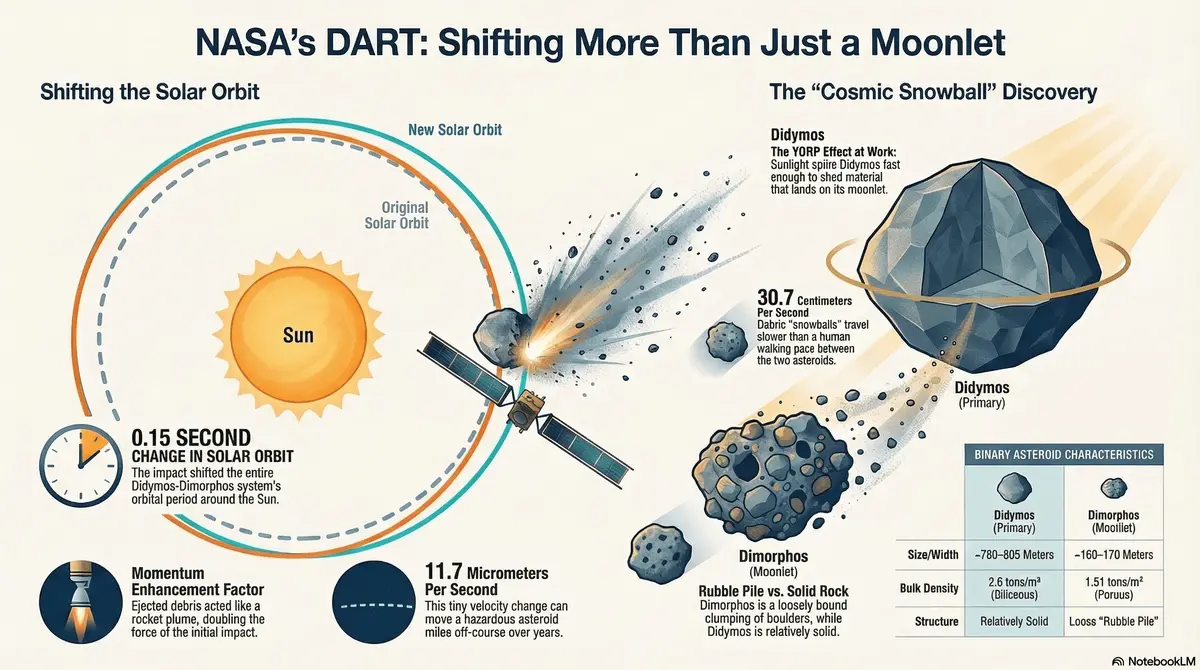
How did the DART mission affect the entire binary system? While NASA initially designed the spacecraft to shorten the local orbital period of the moonlet Dimorphos around its parent body Didymos, long-term data showed the impact also changed the entire system’s trajectory around the Sun. By analyzing stellar occultation data and ground-based astrometric measurements, a research team led by Rahil Makadia determined that the binary system’s solar orbital period changed by a fraction of a second.
What is the “cosmic snowball” phenomenon? Images from the mission revealed fan-shaped streaks on Dimorphos, providing the first visual proof that binary asteroids exchange material in what University of Maryland researcher Jessica Sunshine terms a cosmic snowball effect. These low-velocity impacts occur when sunlight accelerates the spin of the primary asteroid, causing loose rocks and dust to gently float toward and deposit onto its companion.
What role did the momentum enhancement factor play? When the spacecraft crashed into the asteroid, it blasted a massive plume of pulverized rock and debris into space, creating a momentum enhancement factor. This ejected material acted like an extra rocket plume, doubling the propulsive punch created by the spacecraft’s kinetic impact alone.
Why does this matter for planetary defense? This mission transitions planetary defense from theoretical computer models into practical, hands-on experience, proving that a kinetic impactor can effectively deflect celestial threats. Understanding the physical properties and orbital shifts of binary systems ensures humanity has viable techniques to redirect potentially hazardous objects detected far enough in advance.
Q&A: Unpacking DART Mission Discoveries
Q: How did scientists measure the minute change in the asteroid system’s heliocentric orbit?
A: Researchers utilized a combination of stellar occultations and extensive ground-based astrometric data to pinpoint the system’s exact trajectory changes over several years.
- Stellar Occultation: Astronomers measured the precise timing of when the asteroid passed in front of distant stars, causing the starlight to briefly blink out.
- Data Integration: The team analyzed 22 occultations between October 2022 and March 2025, combining them with nearly 6,000 ground-based radar and astrometric measurements spanning 29 years.
- Calculated Shift: This meticulous tracking revealed that the along-track velocity decreased by roughly 11.7 micrometers per second, shifting the solar orbital period by 0.15 seconds.
Q: Why was the momentum enhancement factor critical to the mission’s success?
A: The explosive thrust from the ejected debris significantly amplified the force of the spacecraft’s initial kinetic impact.
- Debris Plume: The impact blasted a huge cloud of rocky debris into space, carrying its own momentum away from the asteroid.
- Beta Parameter: Scientists calculated the momentum enhancement factor (beta) to be around two, indicating that the debris loss essentially doubled the push of the impact.
- Escape Velocity: A crucial fraction of the ejecta achieved escape velocity from the entire binary system, shoving the center of mass of the whole Didymos-Dimorphos pair.
Q: How did image processing lead to the discovery of material exchange between the asteroids?
A: Specialized techniques developed by researchers like Tony Farnham were required to remove visual distortions from the spacecraft’s final images, uncovering hidden patterns of material deposits.
- Lighting Corrections: Researchers had to remove shadows cast by boulders and lighting artifacts caused by the spacecraft’s direct approach angle.
- Fan-Shaped Streaks: After corrections, subtle, fan-shaped rays wrapping around Dimorphos emerged, matching models of low-velocity impacts.
- Source Tracing: By tracing these streaks back to an offset region near the moonlet’s edge, scientists confirmed the patterns were genuinely deposited material and not simply solar lighting effects.
Q: Why do the differing densities of the two asteroids surprise scientists?
A: Previous assumptions held that both bodies in the binary system would have equal densities, but calculations revealed a stark contrast that explains their formation.
- Primary Density: The primary body, Didymos, is relatively solid with a bulk density of around 2.6 tons per cubic meter, aligning with siliceous asteroid estimates.
- Moonlet Porosity: Dimorphos has a surprisingly low density of 1.51 tons per cubic meter, indicating it is essentially a fluffy, loosely bound “rubble pile” with empty voids.
- Formation Theory: This contrast supports the theory that the moonlet formed from porous, loose material shed by the rapidly spinning primary asteroid via the YORP effect.
Q: How will the upcoming Hera mission expand upon the DART mission’s findings?
A: The European Space Agency‘s upcoming mission will perform independent, in-situ measurements to confirm remote calculations and assess the collision’s aftermath.
- In-Situ Verification: The spacecraft will provide precise gravitational and physical data to refine the bulk density calculations of both asteroids.
- Crater Mapping: Scheduled to arrive in late 2026, the mission will map the impact crater on Dimorphos and examine its internal structure.
- Pattern Survival: At this time, whether the fan-shaped streak patterns survived the impact remains unverified by official sources.
Editorial Note & Transparency
Verification Log:
- Government Agency Report: Data from NASA and the Jet Propulsion Laboratory regarding the Double Asteroid Redirection Test orbital changes.
- Academic Journal: Research published in Science Advances on heliocentric orbital shifts and The Planetary Science Journal concerning material transport.
- University Press Release: Statements and laboratory findings from the University of Maryland detailing the cosmic snowball effect.
Compliance:
- Privacy: This article respects user data under our Privacy Policy.
- Transparency: No sponsored content influenced this reporting.
Contact Us: For corrections or feedback, please email: news.desk@qnanews.com