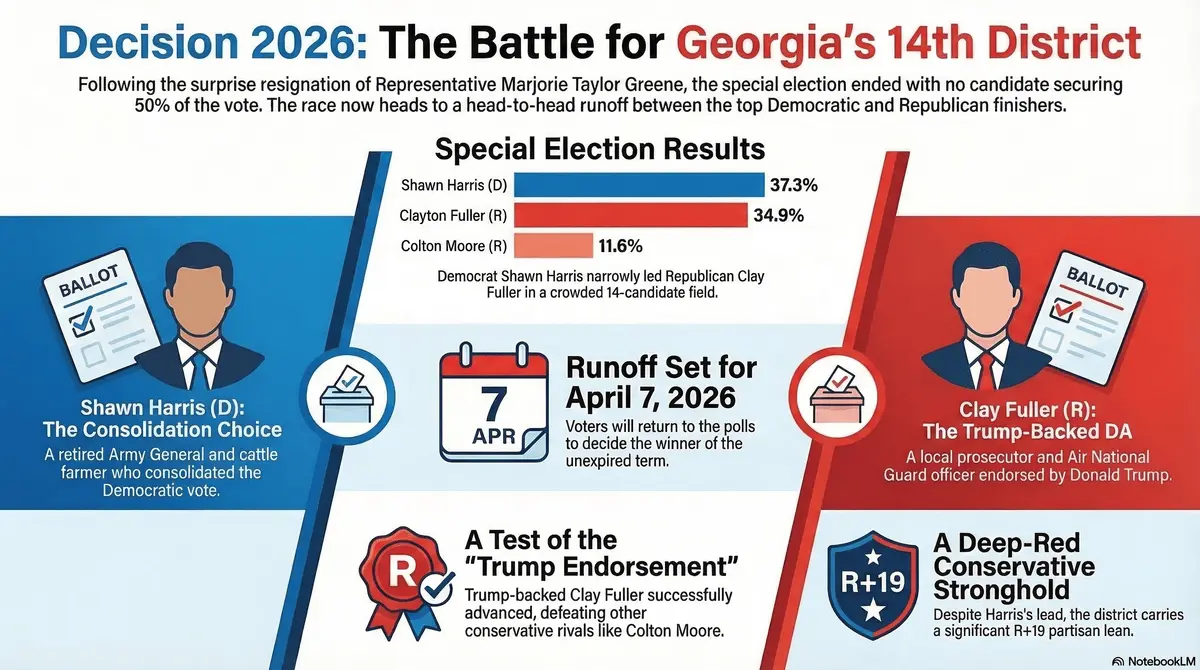
Rome, Georgia / Atlanta, Georgia — Democrat Shawn Harris and Republican Clayton Fuller are heading to a runoff election to fill the vacant seat previously held by former Representative Marjorie Taylor Greene. The general primary yielded no clear majority on March 10, 2026, triggering a head-to-head contest scheduled for April 7, 2026. The race is closely watched as a gauge of former President Donald Trump‘s political influence and could impact the narrow Republican majority in the U.S. House of Representatives.
Below is a detailed examination of the candidates, the district’s political landscape, and the broader implications of this race.
Context & Background
How did this vacancy occur? The seat for Georgia’s 14th Congressional District became vacant when Marjorie Taylor Greene resigned in January. Her departure followed a highly public break with Donald Trump over issues including foreign policy regarding Iran and the release of documents related to Jeffrey Epstein. This fracture ultimately created an open special election featuring a crowded field of 17 candidates spanning multiple parties.
Who are the key candidates? The runoff will feature Democrat Shawn Harris, a retired Army brigadier general and cattle farmer who previously challenged Marjorie Taylor Greene in 2024. He faces Republican Clayton Fuller, a local district attorney, Air National Guard officer, and former White House fellow who received a crucial endorsement from Donald Trump in February.
What is the historical significance of this district? The district, located in northwest Georgia, is heavily conservative and widely considered a safe Republican stronghold where Donald Trump carried 68 percent of the vote in 2024. Despite the deep-red demographics, Shawn Harris led the initial vote tally with over 37 percent of the vote due to the fragmentation of the conservative base across multiple candidates, including right-wing figure Colton Moore.
Why does this runoff matter? Beyond replacing a high-profile conservative figure, the outcome of this race will impact the narrow Republican majority in the House, which currently stands at 218 to 214 seats. Furthermore, it serves as a critical test of Donald Trump‘s endorsement power, particularly as Clayton Fuller seeks to unify the conservative electorate against a unified Democratic coalition in the coming weeks.
Q&A: Unpacking The Georgia Special Election
Q: How did the crowded primary field impact the election results?
A: The presence of numerous candidates splintered the conservative vote, allowing the leading Democrat to secure a slight plurality.
- Democratic Consolidation: Shawn Harris benefited from a unified Democratic base, capturing 37.3 percent of the vote as the primary candidate of his party.
- Republican Fragmentation: The inclusion of nine Republican candidates, such as former state senator Colton Moore, divided the majority conservative electorate, preventing any single Republican from breaking 50 percent.
- Runoff Trigger: Because no single candidate secured an outright majority on March 10, 2026, the top two vote-getters automatically advanced to the final contest.
Q: Why was Donald Trump’s endorsement crucial for Clayton Fuller?
A: The endorsement elevated Clayton Fuller above other conservative contenders by signaling official alignment with the MAGA movement.
- Endorsement Boost: Donald Trump publicly backed Clayton Fuller during a rally in Rome, Georgia, which the candidate subsequently described as “rocket fuel” for his campaign.
- Voter Alignment: Many constituents in the district look to Donald Trump for guidance, citing a desire for a representative who will firmly support his America First agenda rather than prioritizing personal celebrity.
- Candidate Differentiation: In a field where multiple candidates claimed loyalty to the former president, the official endorsement helped Clayton Fuller bypass hardline challengers and establish himself as the presumptive conservative choice.
Q: How is Shawn Harris attempting to flip a deep-red district?
A: Shawn Harris is leveraging a moderate platform and significant fundraising to appeal to a broad coalition of voters disillusioned with partisan extremes.
- Coalition Building: He aims to attract Democrats, independents, and moderate Republicans who are seeking a departure from the combative style of Marjorie Taylor Greene.
- Financial Advantage: His campaign has raised over $4.3 million, giving him a substantial financial edge over his opponents heading into the runoff.
- Focus on Local Issues: Shawn Harris is emphasizing practical economic concerns, such as the cost of groceries and living expenses, over national partisan grievances.
Q: Why did Marjorie Taylor Greene resign from this seat?
A: Her resignation followed escalating tensions and a public fracture with Donald Trump over various policy and political disagreements.
- Epstein Files Dispute: A significant breaking point was her criticism of Donald Trump‘s reluctance to release documents related to convicted sex offender Jeffrey Epstein.
- Foreign Policy Clashes: She vocally opposed the administration’s foreign policy actions, particularly concerning military strikes and potential conflict involving Iran.
- Primary Threat: Donald Trump eventually threatened to support a primary challenge against her, prompting her to step down in January to avoid a divisive intra-party battle.
Q: How does the voting system for overseas military personnel differ from the general electorate in this race?
A: Georgia employs ranked-choice voting for military and overseas voters to streamline the runoff process, despite Republican opposition to the system domestically.
- Instant Runoff Mechanism: Military voters submit a ranked-choice ballot that automatically reassigns their vote to their next preference if no candidate wins an outright majority, acting as an instant runoff.
- Logistical Necessity: This method ensures that military personnel deployed overseas have their votes counted within the federally mandated 45-day window without needing to wait for a second physical ballot.
- Political Controversy: While utilized effectively for overseas service members in Georgia, ranked-choice voting remains highly contested, with many Republican lawmakers actively pushing to ban its use for the general public.
Editorial Note & Transparency
Verification Log:
- Local & National Reporting: Coverage utilized from local affiliates (Local 3 News, WTVC) and national broadcasters (NPR, PBS News) to confirm election mechanisms and candidate statements.
- Election Data: Vote percentages and runoff confirmations sourced from the Associated Press Decision Team.
- Candidate Statements: Direct quotes and campaign strategies gathered from post-election watch parties and verified public appearances in Rome, Georgia.
Compliance:
- Privacy: This article respects user data under our Privacy Policy.
- Transparency: No sponsored content influenced this reporting.
Contact Us: For corrections or feedback, please email: news.desk@qnanews.com