Valparaiso/Santiago — Far-right leader Jose Antonio Kast was sworn in as Chile‘s president, marking the nation’s sharpest shift to the right since the end of military rule. The transfer of power from leftist Gabriel Boric took place on March 11, 2026, amidst rising public concern over violent crime and illegal immigration. The inauguration was attended by various international leaders, signaling a broader regional shift in political alliances.
Below is a detailed examination of Jose Antonio Kast‘s policy agenda and its geopolitical implications.
Context & Background
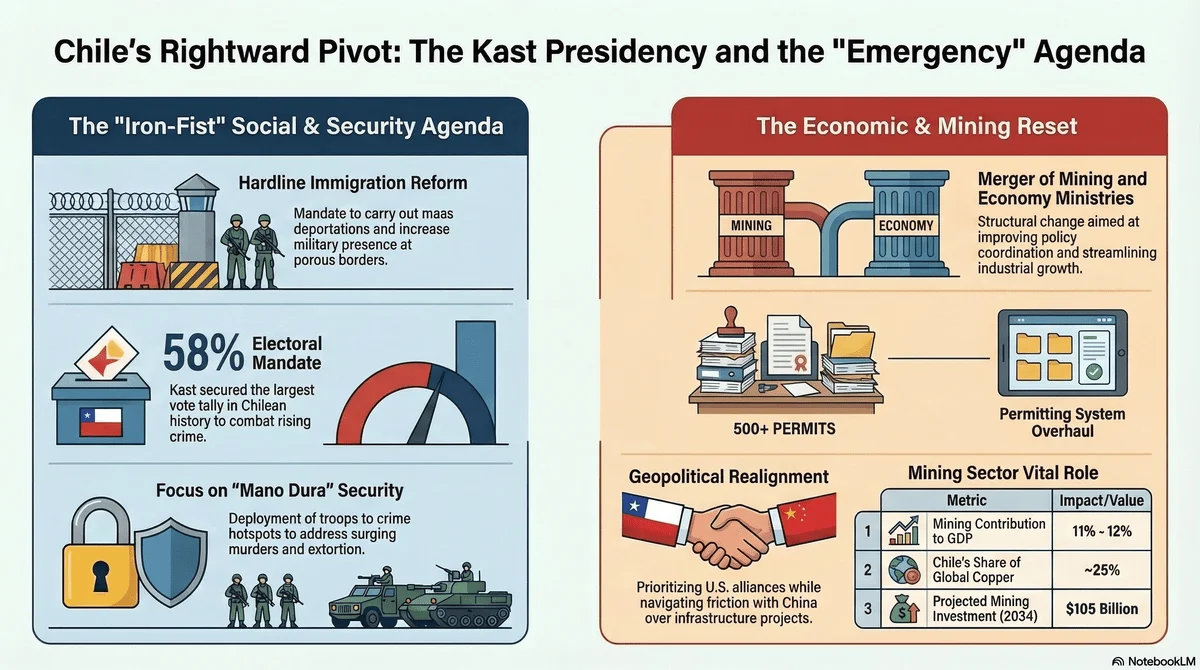
The Rise of Kast and the Republican Party Jose Antonio Kast capitalized on public dissatisfaction with the outgoing administration’s inability to manage crime and economic stagnation. His platform emphasizes a “mano dura” approach to security, including deploying military forces to borders and implementing mass deportations. This approach resonated with voters seeking a return to stability after years of political turbulence and constitutional debates.
Economic Strategy and the Mining Sector Chile, the world’s largest copper producer, faces a policy reset under the new administration, which aims to boost growth through deregulation and market-friendly policies. Jose Antonio Kast has merged the Ministry of Mining and the Ministry of Economy, appointing Daniel Mas to lead the portfolio in a move intended to streamline approvals but criticized for lacking technical expertise. The government hopes to accelerate investments in copper and lithium, despite concerns that declining ore grades and policy uncertainty could hinder immediate production increases.
Geopolitical Realignments and U.S. Influence The transition highlights shifting international dynamics, as Jose Antonio Kast actively aligns himself with United States President Donald Trump and conservative leaders across Latin America. Tensions have already flared over a proposed China-backed undersea fiber optic cable, which the United States views as a security threat, prompting diplomatic friction during the final days of Gabriel Boric‘s term. Jose Antonio Kast is expected to halt the project, navigating a delicate balance between Washington‘s security interests and Beijing‘s role as Chile‘s top trading partner.
Historical Echoes and Domestic Controversy The new president’s past defense of Augusto Pinochet‘s military dictatorship remains a highly polarizing issue within Chile. His cabinet appointments, which include two lawyers who previously defended Augusto Pinochet‘s rule, have sparked outcries from human rights organizations. Critics fear that the administration’s stringent security measures and conservative social policies may jeopardize civil liberties and human rights advancements made since 1990.
Q&A: Unpacking the Kast Administration
Q: How will the new administration balance diplomatic relations between the United States and China?
A: The government must carefully navigate competing pressures from its primary security ally and its largest trade partner.
- U.S. Security Alliances: Jose Antonio Kast has signaled strong alignment with Washington, participating in Donald Trump‘s “Shield of the Americas” alliance.
- Chinese Trade Dependence: China purchases the majority of Chile‘s bulk copper concentrate, making it an indispensable economic partner.
- Infrastructure Disputes: The administration is expected to cancel a controversial submarine fiber optic cable project to appease United States security concerns regarding China.
Q: Why is the merger of the mining and economy ministries drawing criticism from industry experts?
A: The consolidation prioritizes broad economic coordination over the specialized technical knowledge required for natural resource management.
- Leadership Experience: The appointment of agronomist Daniel Mas surprised the sector due to his lack of specific mining expertise.
- Permitting Complexities: The industry currently faces a cumbersome environmental assessment system, with a single project sometimes requiring over 500 permits before construction begins.
- Resource Non-renewability: Analysts warn that without specialist oversight, the unique challenges of declining ore grades and aging deposits may be mismanaged.
Q: How does Kast plan to address the perceived crisis in public security and immigration?
A: The administration intends to implement aggressive law enforcement tactics and stringent border controls.
- Military Deployment: Jose Antonio Kast plans to increase military presence at national borders and in specific crime hotspots.
- Mass Deportations: The government has vowed to deport large numbers of undocumented migrants, primarily targeting those from Venezuela.
- Police Empowerment: Proposed policies include expanding the authority and firepower of domestic police forces to combat organized crime.
Q: Why do critics argue that Kast’s cabinet appointments signal a regression in human rights?
A: Several key appointments have direct ties to the former military dictatorship and advocate for ultra-conservative social policies.
- Dictatorship Ties: The new ministers of defense and justice are lawyers who previously defended the rule of Augusto Pinochet.
- Social Conservatism: The incoming minister for women’s affairs is a vocal anti-abortion activist, raising alarms about reproductive rights.
- Historical Trauma: Relatives of the forcibly disappeared during the 1973 to 1990 regime fear that historical memory and justice initiatives are under threat.
Q: How might policy shifts impact Chile’s role in the global energy transition?
A: Regulatory reforms aim to accelerate the extraction of critical minerals, though structural limitations pose significant hurdles.
- Copper Production Constraints: Despite high global demand, output is hampered by aging mines and lower ore grades, making rapid production increases unlikely.
- Lithium Strategy Reversal: The new government may roll back previous state-centric lithium strategies to encourage greater private and foreign investment.
- Mineral Diversification: Chile is attempting to expand its mining base beyond copper and lithium to include 14 additional transition-critical minerals like cobalt and rare earth elements.
Editorial Note & Transparency
Verification Log:
- International Wire Reports: Sourced breaking news details regarding the inauguration ceremony and the attending international leaders.
- Economic Analysis Desks: Reviewed mining output projections, ministry restructuring impacts, and trade relations data.
- Political Science Journals: Cross-referenced historical context regarding past administrations and constitutional processes.
Compliance:
- Privacy: This article respects user data under our Privacy Policy.
- Transparency: No sponsored content influenced this reporting.
Contact Us: For corrections or feedback, please email: news.desk@qnanews.com