Lake Village/Kankakee — A series of severe supercell thunderstorms produced multiple destructive tornadoes and potentially record-breaking hail across the Midwestern United States, leaving two fatalities and extensive infrastructure damage. The intense weather system struck the region on Tuesday, March 10, 2026, completely leveling homes, snapping utility poles, and knocking out power for tens of thousands of residents. Search and rescue operations have now transitioned into recovery efforts as local authorities and federal agencies assess the widespread devastation.
Below is a detailed examination of the meteorological factors, structural impacts, and ongoing community recovery efforts.
Context & Background
How did this weather event develop? The destruction was fueled by a highly volatile atmospheric setup, characterized by a powerful cold front colliding with record-warm air surging from the Gulf of America. This collision generated severe supercell thunderstorms, which are rare but highly destructive rotational storms known for producing large hail and violent tornadoes. Furthermore, an 80 mph jet streak provided the necessary wind shear and atmospheric spin to sustain these violent twisters across state lines.
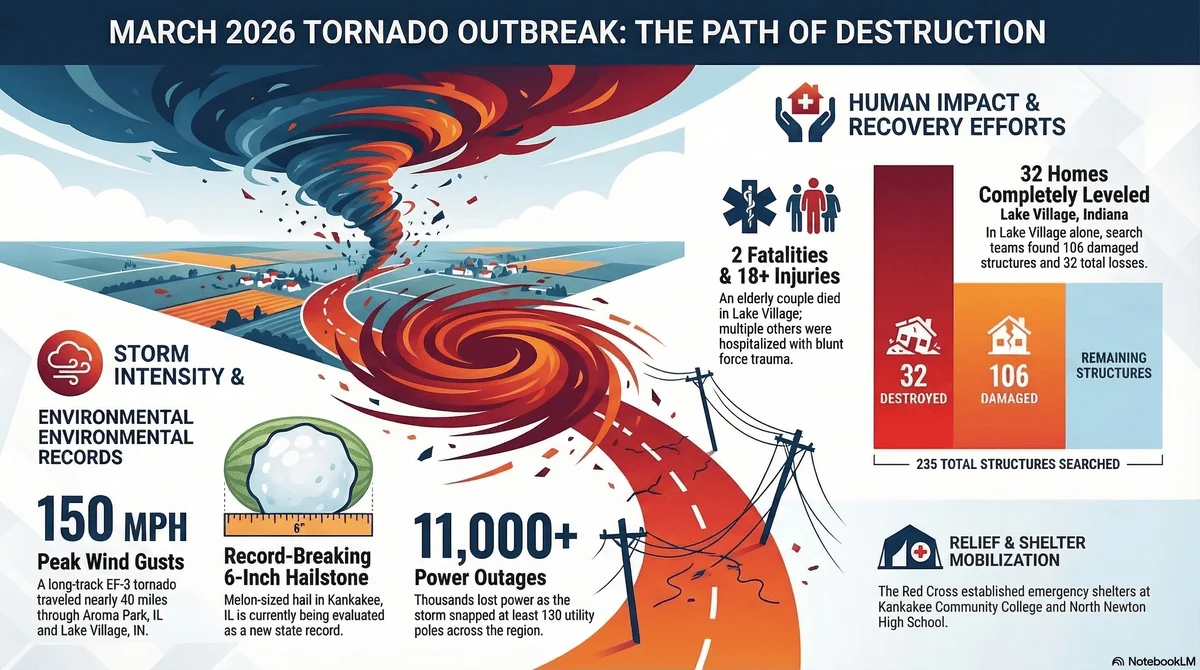
The hardest-hit communities The storm’s path of destruction heavily impacted Kankakee County, Illinois, and Newton County, Indiana. In Lake Village, Indiana, the tornado destroyed dozens of homes and claimed the lives of an elderly couple, Edward Kozlowski and Arlene Kozlowski. Meanwhile, the suburb of Aroma Park, Illinois, experienced an EF-3 tornado with winds reaching 150 mph, leaving significant property and environmental damage.
Potential record-breaking hail Alongside the tornadoes, the supercells produced exceptionally large hail that battered vehicles and buildings across the region. A massive 6-inch hailstone—roughly the size of a honeydew melon—was measured in Kankakee, Illinois, and is currently under evaluation by the National Weather Service. If officially verified, this will shatter the previous Illinois state record of 4.75 inches set in 2015.
Emergency response and recovery Local fire departments and emergency management agencies initiated immediate search and rescue operations, working through darkness and downed power lines. Shelters were rapidly established by the American Red Cross at locations like the North Newton High School and Kankakee Community College to assist displaced residents. Kankakee County also filed an emergency declaration with the state of Illinois to secure additional recovery resources.
Q&A: Unpacking Midwest Tornado Outbreak
Q: How did the atmospheric conditions lead to such a rare and severe tornado outbreak?
A: The severe weather was driven by a classic springtime meteorological clash combined with intense upper-level wind dynamics.
- Temperature Contrast: A powerful cold front interacted with unseasonably record-setting warm, moist air, creating massive atmospheric instability.
- Wind Shear Dynamics: An 80 mph jet streak passed overhead, creating significant wind shear that allowed the thunderstorms to rotate and develop into supercells.
- Storm Training: The storms exhibited “training” behavior, where multiple storm cells repeatedly move over the exact same geographical area, increasing the risk of flash flooding.
Q: Why was the tornado in Kankakee and Aroma Park particularly destructive?
A: The twister reached extreme wind speeds and maintained a long track through populated residential and commercial zones.
- EF-3 Intensity: Preliminary surveys indicate the tornado packed peak wind gusts of 150 mph, classifying it as a strong EF-3.
- Extended Path: The tornado tracked nearly 40 miles over the course of 90 minutes, beginning in Illinois and dissipating in Indiana.
- Infrastructure Impact: The high winds tore roofs off homes, collapsed basements, heavily damaged local schools like Bishop McNamara Catholic School, and snapped over 70 utility poles.
Q: How are local authorities and utility companies responding to the widespread infrastructure failure?
A: First responders and utility crews are coordinating massive debris removal and power restoration efforts across multiple counties.
- Power Grid Restoration: Companies like ComEd and NIPSCO deployed hundreds of crews to address the tens of thousands of power outages caused by severed lines and broken poles.
- Debris Management: Kankakee County initiated a structured debris removal plan, requiring residents to separate materials into categories like white goods, e-waste, and construction debris.
- Hazardous Materials: Emergency teams successfully secured at least seven hazardous materials incidents resulting from the storm damage in Lake Village, Indiana.
Q: How is the local community supporting the displaced residents and affected animals?
A: Grassroots volunteer efforts and regional partnerships have emerged to provide critical supplies and animal welfare support.
- Donation Centers: Local businesses and community centers are collecting water, clothing, tools, and hygiene products for families who lost their homes.
- Animal Rescue Operations: The Anti-Cruelty Society in Chicago absorbed several dogs from the Kankakee County Animal Control to free up shelter space for pets displaced by the disaster.
- Community Relief: Volunteers have established daily feeding stations for displaced neighbors and emergency crews working through the rubble.
Q: What are the long-term meteorological and insurance implications of the record-breaking hail?
A: The unprecedented hail size is expected to trigger widespread property claims and potential shifts in climate assessments.
- State Record Verification: The National Weather Service is currently measuring the 6-inch hailstone found in Kankakee, which is poised to break the previous Illinois record. At this time, the new state record remains unverified by official sources.
- Insurance Claim Surge: Restoration companies are already surveying extensive roof, siding, and vehicular damage, adding to the state’s soaring hail-related insurance claims.
- Climate Trends: Some scientific analyses suggest that accelerating climate change may increase the frequency of such large-scale hail events.
Editorial Note & Transparency
Verification Log:
- News Agency Reports: Details sourced from the Associated Press, CNN, and Fox Weather.
- Official Statements: Information corroborated by the National Weather Service, Newton County Sheriff’s Office, and local fire departments.
- Local Affiliates: On-the-ground reporting from ABC7 Chicago, FOX 32 Chicago, and the Chicago Sun-Times.
Compliance:
- Privacy: This article respects user data under our Privacy Policy.
- Transparency: No sponsored content influenced this reporting.
Contact Us: For corrections or feedback, please email: news.desk@qnanews.com