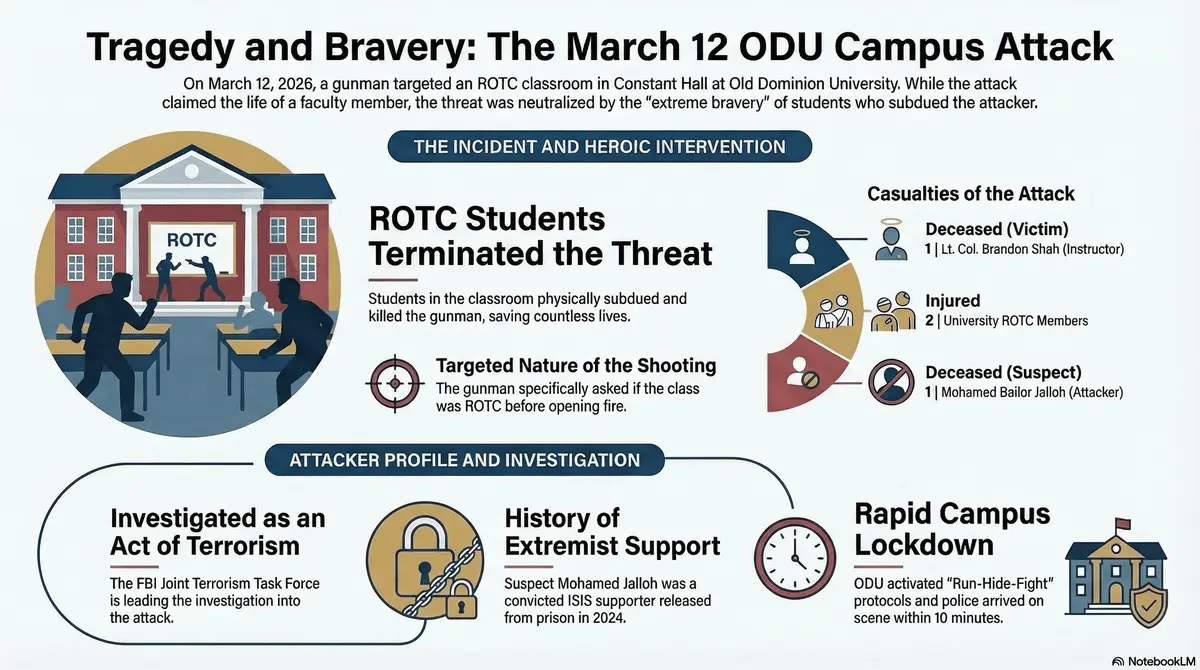
Norfolk, Virginia — A deadly shooting at Old Dominion University ended when students subdued the armed attacker, leading to two fatalities including the gunman. The incident occurred on the morning of March 12, 2026, when the suspect targeted a military science classroom. The Federal Bureau of Investigation has officially taken over the case, designating it as a potential act of terrorism due to the suspect’s criminal background and actions during the attack.
Below is a detailed examination of the attack, the suspect’s history, and the ongoing federal investigation.
Context & Background
How the Attack Unfolded Shortly before 11:00 a.m. on March 12, 2026, the assailant entered Constant Hall and explicitly asked if the room contained an ROTC class. After receiving confirmation, he shouted “Allahu Akbar” and opened fire, killing the instructor and wounding two others before students physically intervened. The students successfully disarmed and subdued the attacker, resulting in his death without the use of firearms.
The Key Players The suspect has been identified as Mohamed Bailor Jalloh, a 36-year-old former Army National Guard member. The deceased victim was identified as Lt. Col. Brandon Shah, a decorated military veteran, alumnus of Old Dominion University, and the targeted classroom’s military science instructor. Federal oversight is being led by Kash Patel, the FBI Director, and Dominique Evans, the FBI Special Agent in Charge, who have both praised the students’ rapid response.
Historical Significance of the Suspect’s Background Mohamed Bailor Jalloh previously pleaded guilty in 2016 to attempting to provide material support to the ISIS terrorist organization. He served a federal prison sentence and was released early in December 2024, which has raised significant questions regarding the federal monitoring of individuals convicted of terrorism-related offenses. The Joint Terrorism Task Force is now heavily involved in analyzing how this prior conviction relates to the current attack.
Why This Matters This incident highlights the ongoing vulnerabilities on college campuses and the evolving nature of domestic terrorism threats. It also emphasizes the critical role of bystander intervention in active shooter scenarios, as law enforcement officials credit the ROTC students with preventing a much larger mass casualty event.
Q&A: Unpacking The Old Dominion University Attack
Q: How was the attacker neutralized before law enforcement arrived on the scene?
A: The gunman was physically overpowered and killed by the students inside the classroom.
- Tactical Intervention: Several ROTC students in the targeted classroom immediately confronted and subdued Mohamed Bailor Jalloh after he opened fire.
- Cause of Death: While the FBI confirmed the suspect was not shot, one law enforcement source indicated the attacker was killed with a knife during the struggle.
- Casualty Prevention: Kash Patel stated that the rapid response of these students undoubtedly saved numerous lives by terminating the threat within minutes.
Q: Why is the Federal Bureau of Investigation treating this incident as an act of terrorism?
A: The designation stems from the suspect’s previous terror conviction and his explicit statements during the attack.
- Verbal Indicators: Dominique Evans reported that the suspect shouted a religious phrase associated with extremism immediately before opening fire on the classroom.
- Target Selection: The attacker specifically sought out a military-affiliated target, verifying that the room was an ROTC class before initiating the violence.
- Criminal History: Mohamed Bailor Jalloh had a prior federal conviction for attempting to support ISIS, making his actions part of a broader, recognized pattern of extremist behavior.
Q: How did the suspect’s prior conviction for terrorism support occur?
A: The suspect was arrested in 2016 following an undercover federal sting operation.
- Informant Contact: Mohamed Bailor Jalloh communicated with overseas ISIS members who connected him with an FBI confidential informant in the United States.
- Plotting Attacks: Court documents reveal he expressed a desire to conduct an attack similar to the 2009 shooting at Fort Hood, Texas.
- Weapon Procurement: The suspect was arrested after attempting to purchase an AR-15 assault rifle from a gun store in Virginia, which had been secretly rendered inoperable by authorities.
Q: Why was a convicted terrorism supporter released prior to the completion of his sentence?
A: The suspect was released early from federal custody in December 2024, though the exact legal mechanisms remain under scrutiny.
- Sentencing Discrepancy: Despite prosecutors requesting a 20-year sentence in 2017, a federal judge sentenced him to 11 years in prison with five years of supervised release.
- Early Release Status: He left the custody of the Federal Bureau of Prisons in December 2024, years before his full sentence or supervised release terms would have concluded.
- Unverified Circumstances: At this time, the exact administrative or legal reasoning for his early release remains unverified by official sources.
Q: How has the university and local government responded to the tragedy?
A: Officials have suspended operations and initiated widespread community support protocols.
- Campus Closures: Brian O. Hemphill canceled all classes and operations on the main campus through Friday, March 13, 2026, to allow for mourning and a thorough police investigation.
- Mental Health Support: The university deployed comprehensive counseling services, a 24/7 peer support community called Talk Campus, and established a Family Information Center at the Chartway Arena.
- State Mobilization: Abigail Spanberger mobilized state emergency resources to assist the university and the city of Norfolk, Virginia.
Editorial Note & Transparency
Verification Log:
- Law Enforcement Statements: Press conference transcripts and official statements from the Federal Bureau of Investigation and Norfolk Police Department regarding the suspect and investigation.
- University Communications: Official emergency alerts and public letters distributed by Old Dominion University leadership regarding campus closures and support services.
- Court Records: Federal sentencing documents and Department of Justice press releases documenting the suspect’s 2016 terrorism conviction and subsequent release.
Compliance:
- Privacy: This article respects user data under our Privacy Policy.
- Transparency: No sponsored content influenced this reporting.
Contact Us: For corrections or feedback, please email: news.desk@qnanews.com