Santa Barbara, California — The federal government has directed the immediate restart of a dormant offshore oil pipeline network, citing national security concerns amidst surging global oil prices. The directive was issued on Friday, March 13, 2026, utilizing emergency powers under the Defense Production Act to bypass state environmental regulations. The pipeline in question was responsible for a major oil spill in 2015, and its forced revival has sparked immediate legal threats from state officials and environmental advocates.
Below is a detailed examination of the federal mandate, the environmental pushback, and the broader geopolitical context.
Context & Background
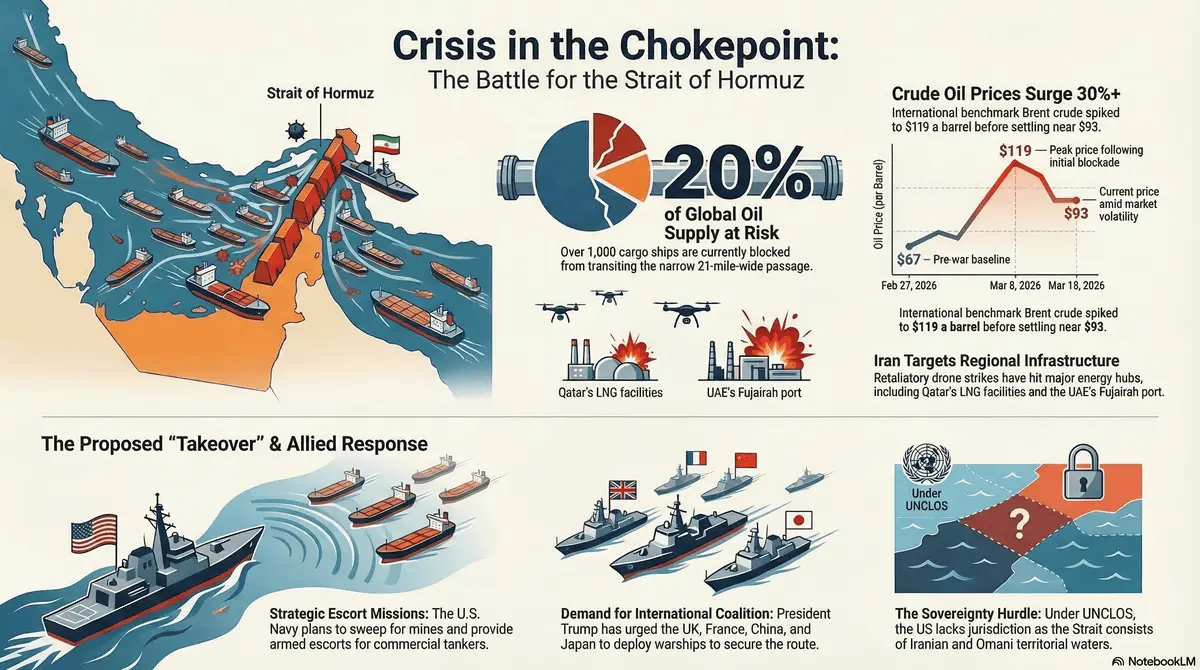
How did this start? The push to restart the offshore infrastructure follows an ongoing conflict with Iran that led to the closure of the Strait of Hormuz. This geopolitical crisis caused global oil and gas prices to skyrocket, prompting President Donald Trump to issue an executive order addressing supply disruption risks.
The key players The mandate was officially issued by U.S. Energy Secretary Chris Wright, directing Texas-based Sable Offshore Corp. to restore operations. In fierce opposition, California Governor Gavin Newsom and Attorney General Rob Bonta, along with organizations like the Center for Biological Diversity, have vowed to block the measure in court.
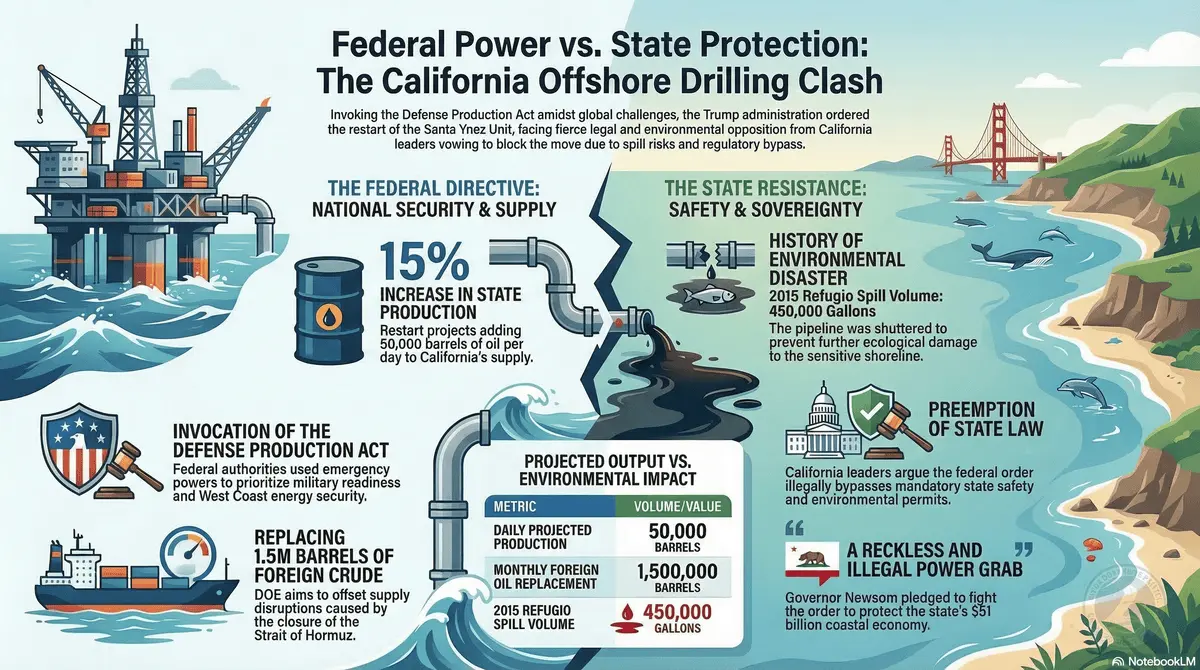
Historical significance The targeted infrastructure includes pipelines that ruptured in May 2015, spilling roughly 450,000 gallons of crude oil onto Refugio State Beach. That disaster killed hundreds of marine animals and led to a multi-million dollar settlement, making offshore drilling a highly sensitive issue for Santa Barbara County.
Why this matters Federal officials argue that restoring the pipeline is vital for West Coast military installations and domestic energy security, estimating it will replace 1.5 million barrels of foreign crude monthly. Conversely, state leaders assert that this action undermines local authority, violates California environmental laws, and risks another catastrophic spill without meaningfully lowering gas prices.
Q&A: Unpacking The Federal Pipeline Mandate
Q: Why did the federal government choose to invoke the Defense Production Act in this instance?
A: The administration utilized the Cold War-era law to assert federal authority over domestic energy supplies during an international crisis.
- National Security Imperative: Officials argue that the shutdown of the Strait of Hormuz threatened West Coast military installations, requiring a secure local energy source.
- Bypassing State Permitting: Invoking the Act attempts to preempt conflicting state environmental laws and ongoing court injunctions that previously stalled Sable Offshore Corp..
- Supply Stabilization: The Department of Energy claims the facility’s 50,000 barrel-per-day output will mitigate the 15 percent domestic supply disruption caused by foreign reliance.
Q: How do California officials plan to counter the federal order?
A: State leadership has uniformly denounced the directive and promised aggressive legal retaliation.
- Litigation Strategy: Governor Gavin Newsom announced that the state will take the administration and Sable Offshore Corp. back to court for defying multiple existing state-level injunctions.
- Regulatory Defense: Attorney General Rob Bonta is currently reviewing legal options to protect the state’s regulatory authority, having already sued the administration in January 2026 over pipeline oversight.
- Legislative Pushback: Congressional delegates, including Senator Alex Padilla, are actively opposing the move, accusing the federal government of prioritizing corporate enrichment over environmental safety.
Q: How do the pipeline’s past failures influence current environmental concerns?
A: Opponents highlight the pipeline’s history of critical failures and the lack of updated safety assessments.
- Previous Spills: The infrastructure includes the exact pipeline responsible for the devastating 2015 Refugio State Beach disaster, raising fears of a repeat incident.
- Bypassed Safeguards: Environmental advocates warn that the federal order forces the restart without proper adherence to California safety checks and coastal protection laws.
- Ecological Risk: A secondary rupture would heavily endanger sensitive coastal wildlife and severely impact the region’s $51 billion coastal economy.
Q: How does the geopolitical situation with Iran directly influence this domestic policy?
A: The conflict provided the catalyst and justification for declaring a domestic energy emergency.
- Price Shocks: A reported 10% spike in global oil prices followed the outbreak of war, creating political pressure to act on domestic fuel costs.
- Supply Chain Vulnerability: With the Strait of Hormuz closed, the federal government pointed to the heavy reliance on imported crude in California as a critical defense weakness.
- Political Maneuvering: Critics allege the administration is using the international conflict as a pretext to fulfill a long-standing goal of expanding offshore drilling.
Q: How quickly could oil production resume under this order?
A: While the company indicated a rapid response, actual timelines remain hindered by legal complexities.
- Company Estimates: Shortly after the order on Friday, March 13, 2026, Sable Offshore Corp. reportedly informed the Santa Barbara County Fire Chief that oil transportation would begin within 24 hours.
- Legal Hurdles: The timeline is complicated by conflicting federal and state court orders, and immediate emergency injunctions are expected from state prosecutors.
- Production Timeline: At this time, the exact date of resumed commercial production remains unverified by official sources.
Editorial Note & Transparency
Verification Log:
- Federal Directives: Statements from U.S. Energy Secretary Chris Wright regarding the Defense Production Act.
- State Responses: Official press releases and social media statements from California Governor Gavin Newsom and Attorney General Rob Bonta.
- Corporate Data: Production estimates and capacity reports regarding Sable Offshore Corp..
Compliance:
- Privacy: This article respects user data under our Privacy Policy.
- Transparency: No sponsored content influenced this reporting.
Contact Us: For corrections or feedback, please email: news.desk@qnanews.com