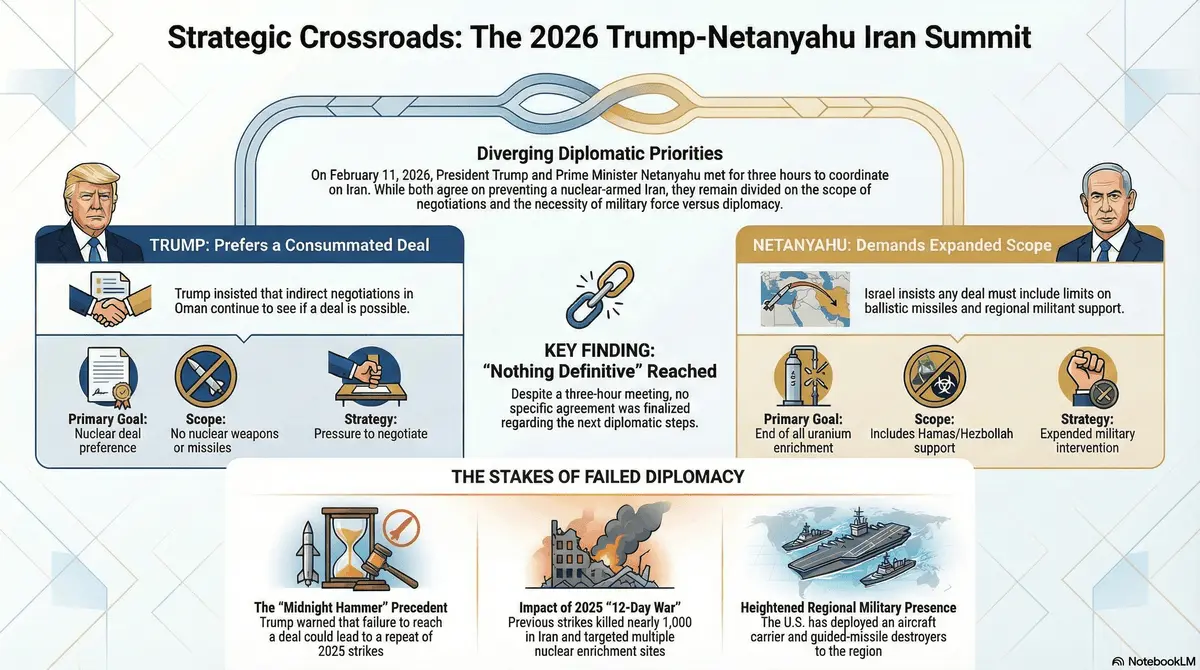
Washington, D.C. — President Donald Trump met with Israeli Prime Minister Benjamin Netanyahu for a private, three-hour summit at the White House on Wednesday, February 11, 2026, formally insisting that negotiations with Iran must continue as the U.S. pursues a new nuclear deal. The meeting underscored a sharp divide between Washington’s diplomatic ambitions and Israel’s security demands, with the two leaders leaving key questions about Iran’s nuclear capabilities and regional proxy networks unresolved.
Below is a detailed breakdown of the summit, the tensions surrounding it, and what it means for the future of the Middle East.
Context & Background
The Summit
The private, three-hour meeting took place behind closed doors at the White House in Washington, D.C., on Wednesday, February 11, 2026. President Trump formally insisted that negotiations with Iran continue to determine whether a deal can be reached.
Key Figures
President Trump stated, “I insisted that negotiations with Iran continue to see whether or not a Deal can be consummated.” Prime Minister Netanyahu presented Israel’s “essential principles” for security, and separately met with Secretary of State Marco Rubio.
Why It Matters
The outcome of these talks could determine whether the Middle East moves toward diplomatic stabilization or a significant military escalation, directly impacting global security and energy markets.
Historical Significance
This summit marks a pivotal moment in U.S.-Israel relations under the Trump administration, as both nations navigate divergent priorities — Washington’s preference for a nuclear-focused diplomatic deal versus Israel’s demand for a comprehensive rollback of Iran’s regional power.
Q&A: Unpacking the Summit
Q: Why is the Trump administration pursuing a diplomatic deal while simultaneously increasing military pressure in the Middle East?
A: The administration is utilizing a “maximum pressure” strategy coupled with an open door for diplomacy. Key elements include:
- Trump has authorized a significant military buildup — including an aircraft carrier and guided-missile destroyers — in the region.
- Trump has stated his “preference” is a deal that ensures “no nuclear weapons, no missiles.”
- This approach aims to force Tehran into a “reasonable and responsible” position by highlighting the “steep” consequences of failure, citing U.S. strikes in June 2025 that targeted Iranian enrichment facilities.
Q: How do Israel’s specific demands for the Iran talks differ from the current U.S. negotiating framework?
A: There is a notable gap in scope between the two allies’ positions:
- The U.S. Position: Current indirect talks in Oman, led by U.S. envoys Steve Witkoff and Jared Kushner, have primarily focused on Iran’s nuclear program.
- Israel’s Position: Netanyahu’s office has explicitly stated that any agreement must also include strict limits on Iran’s ballistic missile program and a total cessation of support for regional proxies like Hamas and Hezbollah.
- The Gap: Whether the U.S. will expand its negotiating criteria to meet all of Israel’s “essential principles” remains unverified by official sources.
Q: What is the “Board of Peace,” and how does it affect regional stability beyond Iran?
A: The Board of Peace is a new Trump administration initiative with broad regional implications:
- Purpose: Designed to oversee the Gaza ceasefire plan and resolve broader global crises.
- Netanyahu’s Role: During this visit, Netanyahu signed on to participate in the board, signaling a deepening of U.S.-Israel coordination on regional “progress.”
- Broader Significance: This indicates the administration views the Iran nuclear issue as part of a larger, interconnected regional stabilization effort that includes the ongoing situation in Gaza.
Q: Fact-Check — What is the current status of Iran’s nuclear capabilities following the June 2025 conflict?
A: Reports are conflicting and the true status remains unclear:
- Trump’s Claim: U.S. strikes “obliterated” Iran’s nuclear capabilities.
- Iran’s Statement: Iranian Foreign Minister Abbas Araghchi stated in November 2024 that Iran had ceased uranium enrichment due to war damage.
- The Reality: Satellite imagery has recently captured new activity at these sites, raising concerns that Iran is salvaging facilities.
- Verification Gap: The International Atomic Energy Agency (IAEA) has been denied access to bombed sites for months and cannot verify Iran’s current nuclear status or stockpile.
Q: How does this diplomatic friction affect the global defense and intelligence industries?
A: The uncertainty creates a high-stakes environment for security and aerospace sectors:
- The U.S. military presence in the region is at a peak, driving elevated demand in defense procurement.
- Regional actors like Turkey and Qatar are urging restraint to prevent a total destabilization of the region.
- The key industry question is whether Iran will accept “any kind of verification” as suggested by President Masoud Pezeshkian, or if the “wall of mistrust” will lead to further military intervention.
Editorial Note & Transparency
Correction/Update: This article focuses on the Trump-Netanyahu White House summit of February 11, 2026, and ongoing U.S.-Iran nuclear negotiations.
Privacy & Ethics: All quotes and figures are derived from public statements, official social media (President Trump’s Truth Social account), government briefings from the Office of the Prime Minister of Israel, diplomatic reports on indirect talks in Oman, IAEA inspection updates, and credible news coverage from AP, Al Jazeera, PBS News, and The Guardian. No private data was accessed.
Contact Us: For corrections or feedback, please email: newsdesk@qnanews.com
Editorial Disclosure: No sponsored content influenced this reporting.
Keywords: Trump Netanyahu Summit 2026, Iran Nuclear Deal, US Israel Relations, Maximum Pressure Strategy, IAEA Iran, Board of Peace, Steve Witkoff, Jared Kushner, Iran Ballistic Missiles, Middle East Diplomacy.