Category: International Relation

  • Why US Intelligence Fears China’s ‘Secret’ Nuclear Tests, Explained

    Why US Intelligence Fears China’s ‘Secret’ Nuclear Tests, Explained

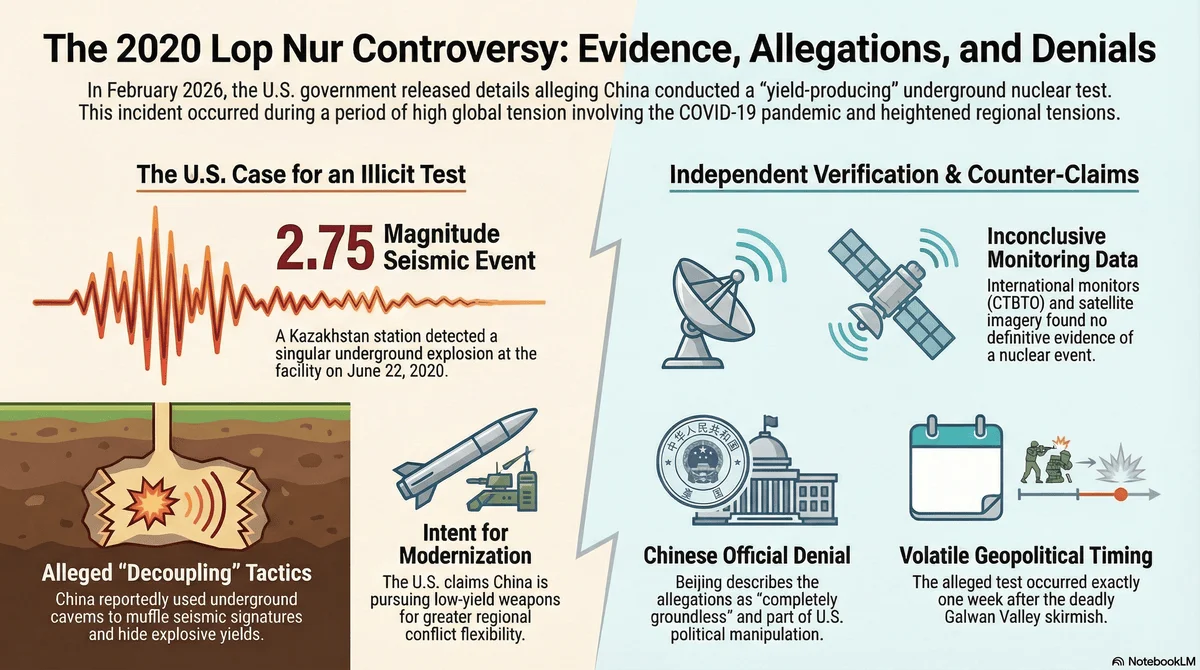
    Washington/Beijing — The United States has formally accused China of conducting a covert “yield-producing” nuclear test in 2020, violating the voluntary global moratorium on nuclear testing. The alleged incident took place on June 22, 2020, at China’s Lop Nur nuclear test site in the northwestern Xinjiang region.

    Below is a detailed examination of the evidence, competing claims, and the geopolitical implications of this explosive accusation.

    Context & Background

    The Accusation – US Assistant Secretary Christopher Yeaw claims seismic data indicates a “singular explosion” consistent with a nuclear test. The core evidence is a seismic signal detected by a remote station in Kazakhstan, recording a magnitude 2.75 event originating from Lop Nur. Yeaw states this is “consistent with what you would expect from a nuclear explosive test” and unlikely to be an earthquake.

    The Denial – Chinese Foreign Ministry spokesperson Lin Jian has categorically rejected the allegations as “completely groundless” and “political manipulation,” maintaining that China has adhered to its testing moratorium.

    Regional Concerns – Indian Member of Parliament Manish Tewari raised concerns linking the test’s timing to the Galwan Valley clash (just one week prior) and the COVID-19 pandemic, questioning whether a nation dealing with a pandemic would prioritize “alleged nuclear activities” over containment.

    The Stakes – This accusation threatens to trigger a new global arms race. U.S. officials have signaled they may resume American nuclear testing “on an equal basis” in response, potentially ending decades of nuclear restraint.

    Q&A: Unpacking the Evidence and Implications

    Q: The U.S. claims to have evidence of a test. What specifically does the data show, and is it conclusive?

    A: The evidence is contested and remains unverified by independent international bodies.

    • U.S. Evidence: A seismic signal detected by a Kazakhstan station showing a magnitude 2.75 event from Lop Nur, described as “consistent with what you would expect from a nuclear explosive test.”
    • CTBTO Position: The Comprehensive Nuclear-Test-Ban Treaty Organization confirmed their sensors detected “two very small seismic events, 12 seconds apart” but stated the data was insufficient to confidently attribute it to a nuclear explosion.
    • Independent Analysis: Seismologist Ben Dando of NORSAR noted that while wave ratios were consistent with an explosion, the signal was weak and recorded at only one station, making definitive confirmation impossible.
    • Data Discrepancy: The U.S. describes a “singular explosion” while the CTBTO reports “two very small seismic events” 12 seconds apart. The USGS recorded a magnitude 4.1 earthquake that day, but its epicenter was 200 kilometers away from the test site.

    Q: If China did test a weapon, how did they attempt to hide it from the world?

    A: U.S. officials allege China utilized a technique known as “decoupling.”

    • The Technique: Detonating a nuclear device suspended inside a massive underground cavern—often a salt dome—rather than embedding it tightly in rock.
    • How It Works: The cavern acts as a muffler, allowing the explosive force to reverberate within the hollow space, significantly reducing the seismic shockwaves that travel through the earth.
    • Strategic Purpose: This would theoretically allow a country to test low-yield weapons without triggering the global monitoring stations designed to detect larger blasts.

    Q: Beyond the technical “how,” why would China risk breaking the moratorium now?

    A: Analysts point to China’s rapid nuclear modernization program and strategic needs.

    • Arsenal Expansion: The Pentagon estimates China’s arsenal has grown to over 500 warheads, with a goal of 1,000 by 2030.
    • Miniaturization: China may be seeking to miniaturize warheads to fit multiple weapons on a single missile (MIRV technology).
    • Low-Yield Development: There is speculation that China seeks “tactical” or low-yield nuclear weapons for flexible options in regional conflicts.
    • Data Scarcity: Unlike the U.S., which conducted over 1,000 tests before the 1992 moratorium, China conducted only 45. They have significantly less historical data to rely on for computer simulations.

    Q: How does this alleged event resonate in the specific context of India and regional security?

    A: The timing has raised significant alarms in India.

    • Timing Correlation: Member of Parliament Manish Tewari highlighted that June 22, 2020, fell just one week after the deadly Galwan Valley clash between Indian and Chinese troops.
    • Strategic Posture: Tewari questioned whether a nation where COVID-19 originated would prioritize “alleged nuclear activities” over pandemic containment, suggesting a disturbing strategic posture during a global crisis.
    • Signal of Dominance: This link suggests that if the test occurred, it might have been intended as a subtle signal of dominance during a period of heightened border tension.

    Q: What are the geopolitical consequences if the U.S. acts on these allegations?

    A: The primary consequence is the potential collapse of the global testing moratorium.

    • U.S. Response: President Donald Trump has stated the U.S. would consider testing “on an equal basis” with China and Russia.
    • Official Position: U.S. officials have indicated they are prepared to resume low-yield testing if necessary to correct an “intolerable disadvantage.”
    • Global Impact: This could end decades of nuclear restraint and encourage other nuclear-armed nations to resume live explosive testing, triggering a new global arms race.

    Editorial Note & Transparency

    Verification Log:

    • Official Government Statements: U.S. State Department (Christopher Yeaw, Thomas DiNanno); Chinese Foreign Ministry (Lin Jian).
    • International Monitoring Data: Comprehensive Nuclear-Test-Ban Treaty Organization (CTBTO).
    • Satellite & Expert Analysis: Center for Strategic and International Studies (CSIS); NORSAR (Ben Dando); Carnegie Endowment for International Peace (Tong Zhao).
    • Legislative Commentary: Statements from Indian Parliament Member Manish Tewari.

    Compliance:

    • Privacy: This article respects user data under our Privacy Policy.
    • Transparency: No sponsored content influenced this reporting.

    Contact Us: For corrections or feedback, please email: newsdesk@qnanews.com

  • Trump Insists on Iran Deal After 3-Hour Netanyahu Summit

    Trump Insists on Iran Deal After 3-Hour Netanyahu Summit

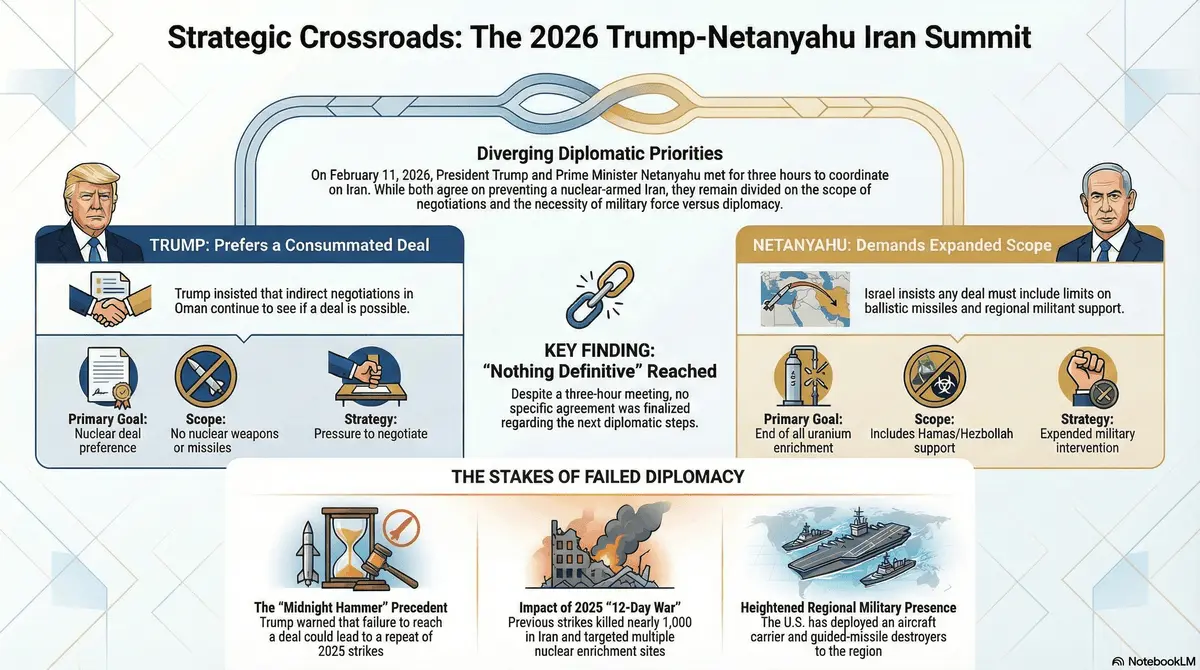
    Washington, D.C. — President Donald Trump met with Israeli Prime Minister Benjamin Netanyahu for a private, three-hour summit at the White House on Wednesday, February 11, 2026, formally insisting that negotiations with Iran must continue as the U.S. pursues a new nuclear deal. The meeting underscored a sharp divide between Washington’s diplomatic ambitions and Israel’s security demands, with the two leaders leaving key questions about Iran’s nuclear capabilities and regional proxy networks unresolved.

    Below is a detailed breakdown of the summit, the tensions surrounding it, and what it means for the future of the Middle East.

    Context & Background

    The Summit

    The private, three-hour meeting took place behind closed doors at the White House in Washington, D.C., on Wednesday, February 11, 2026. President Trump formally insisted that negotiations with Iran continue to determine whether a deal can be reached.

    Key Figures

    President Trump stated, “I insisted that negotiations with Iran continue to see whether or not a Deal can be consummated.” Prime Minister Netanyahu presented Israel’s “essential principles” for security, and separately met with Secretary of State Marco Rubio.

    Why It Matters

    The outcome of these talks could determine whether the Middle East moves toward diplomatic stabilization or a significant military escalation, directly impacting global security and energy markets.

    Historical Significance

    This summit marks a pivotal moment in U.S.-Israel relations under the Trump administration, as both nations navigate divergent priorities — Washington’s preference for a nuclear-focused diplomatic deal versus Israel’s demand for a comprehensive rollback of Iran’s regional power.

    Q&A: Unpacking the Summit

    Q: Why is the Trump administration pursuing a diplomatic deal while simultaneously increasing military pressure in the Middle East?

    A: The administration is utilizing a “maximum pressure” strategy coupled with an open door for diplomacy. Key elements include:

    • Trump has authorized a significant military buildup — including an aircraft carrier and guided-missile destroyers — in the region.
    • Trump has stated his “preference” is a deal that ensures “no nuclear weapons, no missiles.”
    • This approach aims to force Tehran into a “reasonable and responsible” position by highlighting the “steep” consequences of failure, citing U.S. strikes in June 2025 that targeted Iranian enrichment facilities.

    Q: How do Israel’s specific demands for the Iran talks differ from the current U.S. negotiating framework?

    A: There is a notable gap in scope between the two allies’ positions:

    • The U.S. Position: Current indirect talks in Oman, led by U.S. envoys Steve Witkoff and Jared Kushner, have primarily focused on Iran’s nuclear program.
    • Israel’s Position: Netanyahu’s office has explicitly stated that any agreement must also include strict limits on Iran’s ballistic missile program and a total cessation of support for regional proxies like Hamas and Hezbollah.
    • The Gap: Whether the U.S. will expand its negotiating criteria to meet all of Israel’s “essential principles” remains unverified by official sources.

    Q: What is the “Board of Peace,” and how does it affect regional stability beyond Iran?

    A: The Board of Peace is a new Trump administration initiative with broad regional implications:

    • Purpose: Designed to oversee the Gaza ceasefire plan and resolve broader global crises.
    • Netanyahu’s Role: During this visit, Netanyahu signed on to participate in the board, signaling a deepening of U.S.-Israel coordination on regional “progress.”
    • Broader Significance: This indicates the administration views the Iran nuclear issue as part of a larger, interconnected regional stabilization effort that includes the ongoing situation in Gaza.

    Q: Fact-Check — What is the current status of Iran’s nuclear capabilities following the June 2025 conflict?

    A: Reports are conflicting and the true status remains unclear:

    • Trump’s Claim: U.S. strikes “obliterated” Iran’s nuclear capabilities.
    • Iran’s Statement: Iranian Foreign Minister Abbas Araghchi stated in November 2024 that Iran had ceased uranium enrichment due to war damage.
    • The Reality: Satellite imagery has recently captured new activity at these sites, raising concerns that Iran is salvaging facilities.
    • Verification Gap: The International Atomic Energy Agency (IAEA) has been denied access to bombed sites for months and cannot verify Iran’s current nuclear status or stockpile.

    Q: How does this diplomatic friction affect the global defense and intelligence industries?

    A: The uncertainty creates a high-stakes environment for security and aerospace sectors:

    • The U.S. military presence in the region is at a peak, driving elevated demand in defense procurement.
    • Regional actors like Turkey and Qatar are urging restraint to prevent a total destabilization of the region.
    • The key industry question is whether Iran will accept “any kind of verification” as suggested by President Masoud Pezeshkian, or if the “wall of mistrust” will lead to further military intervention.

    Editorial Note & Transparency

    Correction/Update: This article focuses on the Trump-Netanyahu White House summit of February 11, 2026, and ongoing U.S.-Iran nuclear negotiations.

    Privacy & Ethics: All quotes and figures are derived from public statements, official social media (President Trump’s Truth Social account), government briefings from the Office of the Prime Minister of Israel, diplomatic reports on indirect talks in Oman, IAEA inspection updates, and credible news coverage from AP, Al Jazeera, PBS News, and The Guardian. No private data was accessed.

    Contact Us: For corrections or feedback, please email: newsdesk@qnanews.com

    Editorial Disclosure: No sponsored content influenced this reporting.

    Keywords: Trump Netanyahu Summit 2026, Iran Nuclear Deal, US Israel Relations, Maximum Pressure Strategy, IAEA Iran, Board of Peace, Steve Witkoff, Jared Kushner, Iran Ballistic Missiles, Middle East Diplomacy.