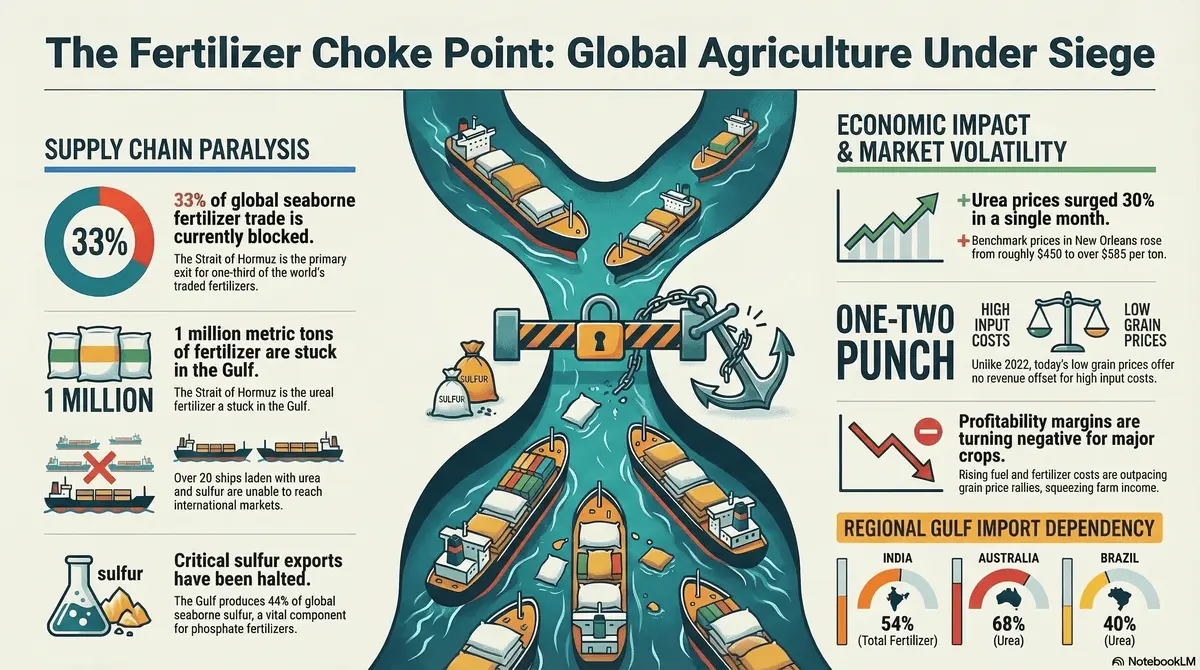
Washington/Tokyo — The escalating military conflict in the Middle East has effectively closed the Strait of Hormuz, trapping nearly a million metric tons of fertilizer in the Persian Gulf and sending global agricultural markets into turmoil. The de facto closure, which began following strikes on February 28, 2026, has caused urea and sulfur prices to skyrocket worldwide. Farmers and economists warn this disruption threatens spring planting seasons and risks triggering a severe global food inflation crisis.
Below is a detailed examination of the global fertilizer supply shock and its cascading agricultural impacts.
Context & Background
Origins of the Supply Shock The crisis stems from the recent military engagements involving the United States, Israel, and Iran, which led to the shutdown of the Strait of Hormuz. Because approximately one-third of the world’s seaborne fertilizer trade typically passes through this narrow waterway, the conflict has stranded dozens of cargo vessels. The restricted flow of nitrogen fertilizers has prompted agricultural industry leaders to petition President Donald Trump for maritime escorts.
The Vulnerability of Global Agriculture Modern farming relies heavily on synthetic fertilizers to maintain crop yields and prevent widespread food scarcity. The Persian Gulf region accounts for 43% of seaborne urea exports and 44% of seaborne sulfur, the latter being a crucial ingredient for manufacturing phosphate fertilizers globally. Deprived of these essential inputs, agricultural sectors face a critical shortfall just as the spring planting season approaches in the Northern Hemisphere.
Comparisons to Historical Disruptions Agricultural economists draw direct parallels to the 2022 supply shock caused by Russia invading Ukraine, but warn the current scenario poses unique financial dangers to producers. Unlike the previous crisis where elevated grain prices offset rising input costs, the Persian Gulf is not a major grain exporter, meaning farm revenues will not rise to match surging expenses. Consequently, farmers face compressed profit margins that could trigger widespread bankruptcies.
Q&A: Unpacking The Fertilizer Crisis
Q: How does the blockage of the Strait of Hormuz specifically disrupt fertilizer production in other countries?
A: The blockage cuts off critical chemical feedstocks and energy supplies needed by fertilizer manufacturers located outside the Middle East.
- Natural Gas Dependencies: Producers in India, Bangladesh, and Pakistan have been forced to halt operations due to severed natural gas supplies from Qatar.
- Sulfur Shortages: The Gulf produces nearly half of the world’s seaborne sulfur, which is mandatory for converting phosphate rock into usable phosphate fertilizer globally.
- Market Concentration: With alternatives limited by tariffs on Morocco and Russia, and suspended exports from China, the concentration risk surrounding Gulf supplies creates an inescapable supply bottleneck.
Q: Why are domestic agricultural markets in the United States feeling the impact of a Middle Eastern blockade?
A: Despite strong domestic production, the United States remains integrated into global commodity pricing and imports specific critical components from the Gulf.
- Price Transmission: Even though the United States produces about three-quarters of the fertilizer it consumes, global supply constraints drive up domestic benchmark prices, with urea in New Orleans rising over 25% since the conflict began.
- Import Reliance: Approximately 17% of American urea consumption and 20% of phosphate consumption transit the Strait of Hormuz, primarily from Saudi Arabia, Qatar, and Oman.
- Logistical Delays: Farmers in states like California and Georgia, who are ahead of schedule for planting, are facing immediate product shortages as shipments taking up to 30 days remain stalled. At this time, the deployment of naval escorts for commercial fertilizer shipments remains unverified by official sources.
Q: How are rising input costs expected to impact global food security?
A: The surging cost of agricultural inputs will likely suppress crop yields and drive severe food inflation, disproportionately harming poorer nations.
- Yield Reductions: High fertilizer prices force farmers to apply fewer nutrients to their fields, directly reducing the output of nitrogen-intensive staple crops like maize and rice.
- Retail Inflation: Agricultural economists, including Joseph Glauber, warn that retail food prices will soar as the increased costs of both fertilizer and the diesel fuel needed for farming are passed on to consumers.
- Vulnerable Populations: Regions like Sub-Saharan Africa, where over 90% of fertilizer is imported, face extreme risks of food scarcity and worsened poverty.
Q: Why are agricultural experts warning that the current situation may be more financially damaging to farmers than the 2022 market shock?
A: The lack of a corresponding surge in grain prices means farmers must absorb higher production costs without increased revenue.
- No Revenue Offset: In 2022, export disruptions in the Black Sea caused wheat and corn prices to rally significantly, buffering the financial blow of high fertilizer costs.
- Margin Compression: Currently, with commodity crops like corn near $4.00 per bushel and soybean margins already negative, elevated input prices will directly erode farm profitability.
- Market Volatility: As noted by Kansas farmer Adam Baldwin, the rapid escalation of fertilizer prices is vastly outpacing marginal gains in commodity crops, eliminating potential profits.
Q: Why does the lack of alternative transportation routes exacerbate the commodity crisis in the Persian Gulf?
A: Existing regional infrastructure and security protocols are heavily skewed toward high-value energy exports, leaving agricultural commodities trapped.
- Priority of Oil: Pipelines designed to bypass the Strait of Hormuz, such as those built by Saudi Arabia to the Red Sea, accommodate oil and gas rather than ammonia or urea.
- Escort Preferences: Naval protections and risk-tolerant commercial shippers prioritize lucrative energy products over lower-value agricultural fertilizers.
- Overland Limitations: While wealthy nations like Kuwait or Bahrain can afford expensive overland or air freight for consumer food imports, bulk commodities like fertilizer cannot be economically rerouted via these methods.
Editorial Note & Transparency
Verification Log:
- News Reports: Regional and national broadcast reports detailing the physical shipment delays and domestic farmer concerns.
- Economic Analyses: Market data from agricultural institutes regarding commodity pricing, historical comparisons, and trade dependencies.
- Geopolitical Commentary: Expert assessments on international shipping bottlenecks and the strategic impacts of the Strait of Hormuz closure.
Compliance:
- Privacy: This article respects user data under our Privacy Policy.
- Transparency: No sponsored content influenced this reporting.
Contact Us: For corrections or feedback, please email: news.desk@qnanews.com