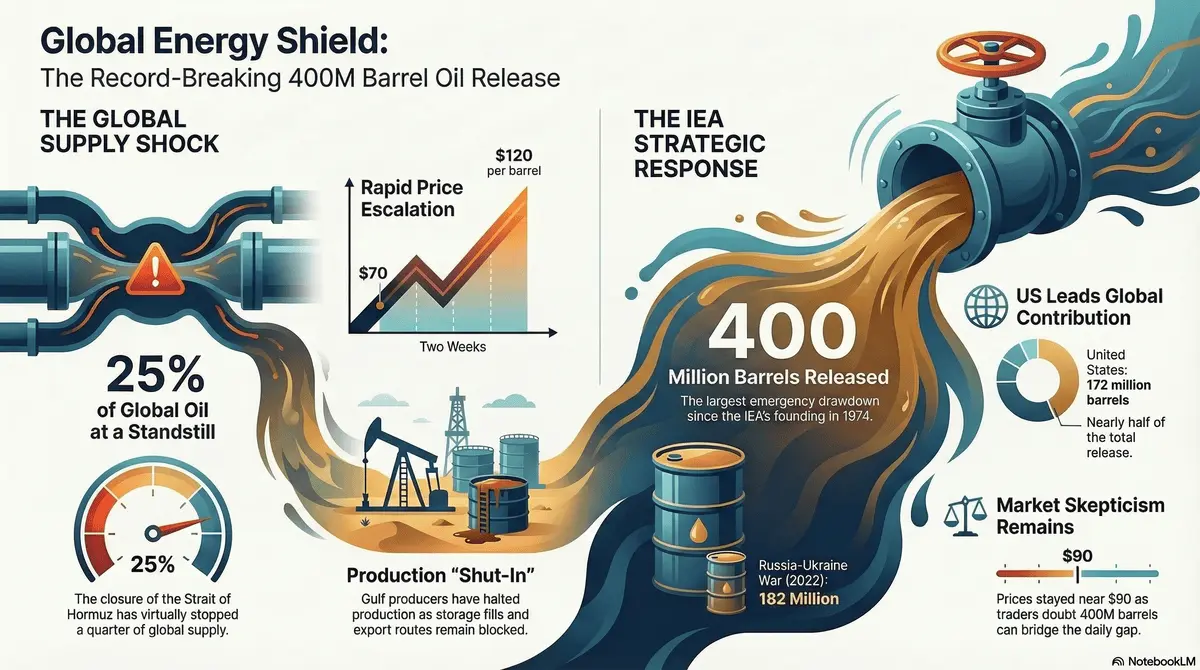
Paris/Washington — The International Energy Agency has coordinated an unprecedented release of emergency crude oil stockpiles to stabilize global markets disrupted by the ongoing war in the Middle East. The unanimous decision by 32 member nations was finalized on March 11, 2026, pledging to introduce 400 million barrels into the global supply. This intervention is the largest in the agency’s history, driven by severe transit restrictions in the Strait of Hormuz.
Below is a detailed examination of the historic oil release and its economic implications.
Context & Background
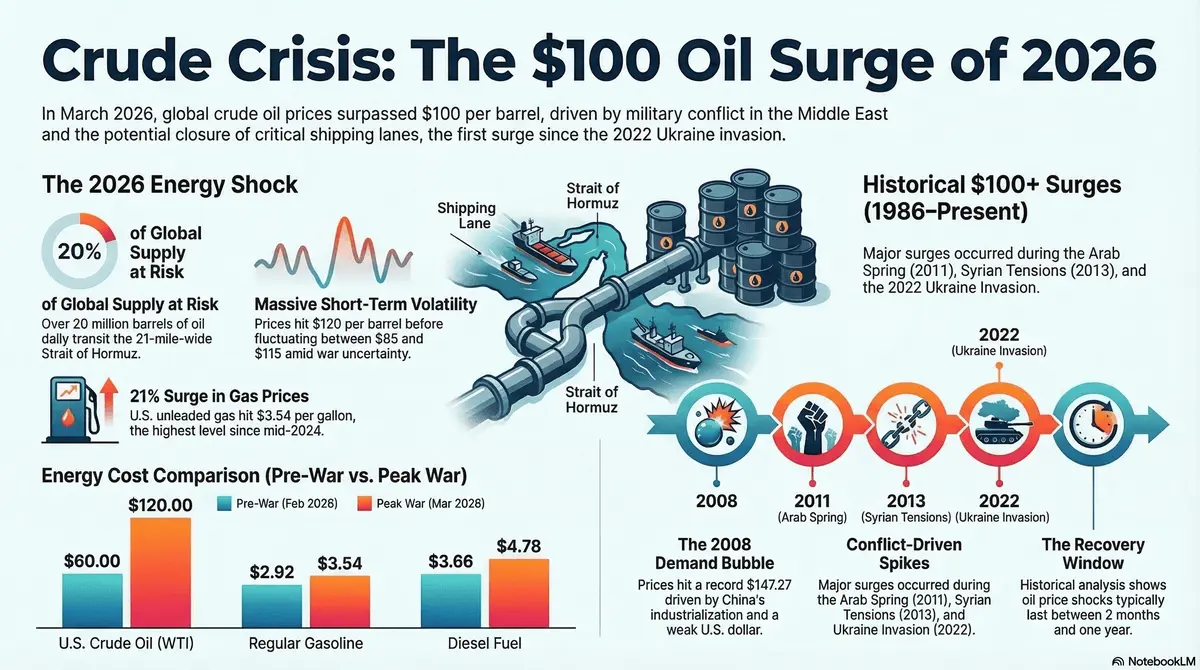
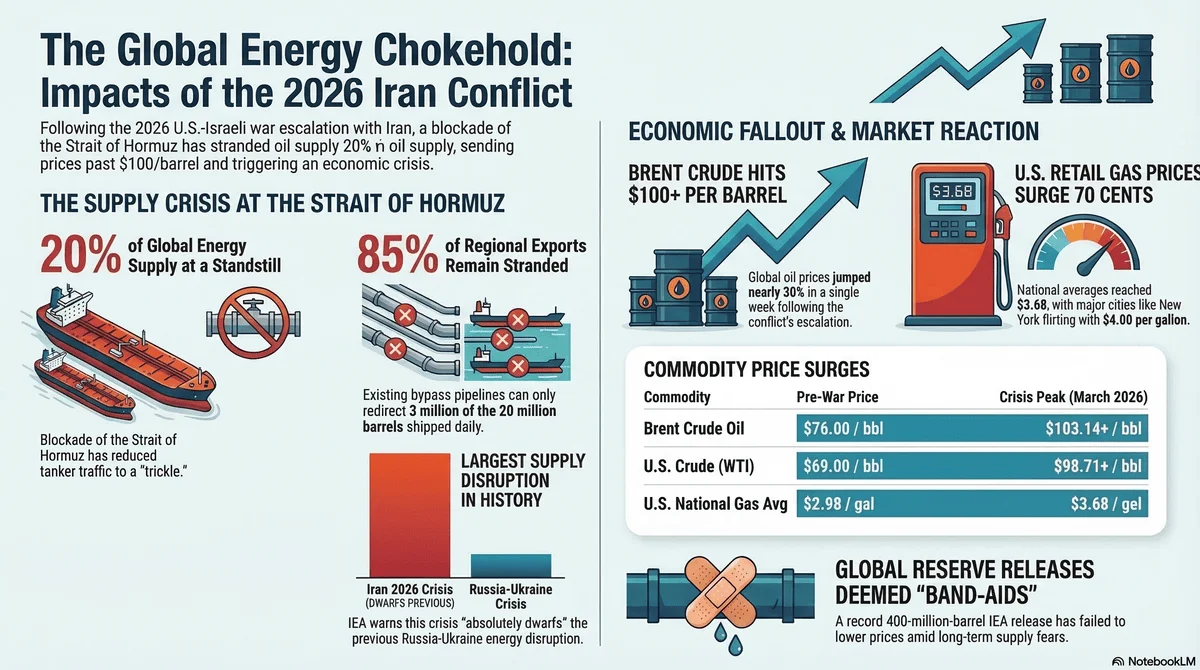
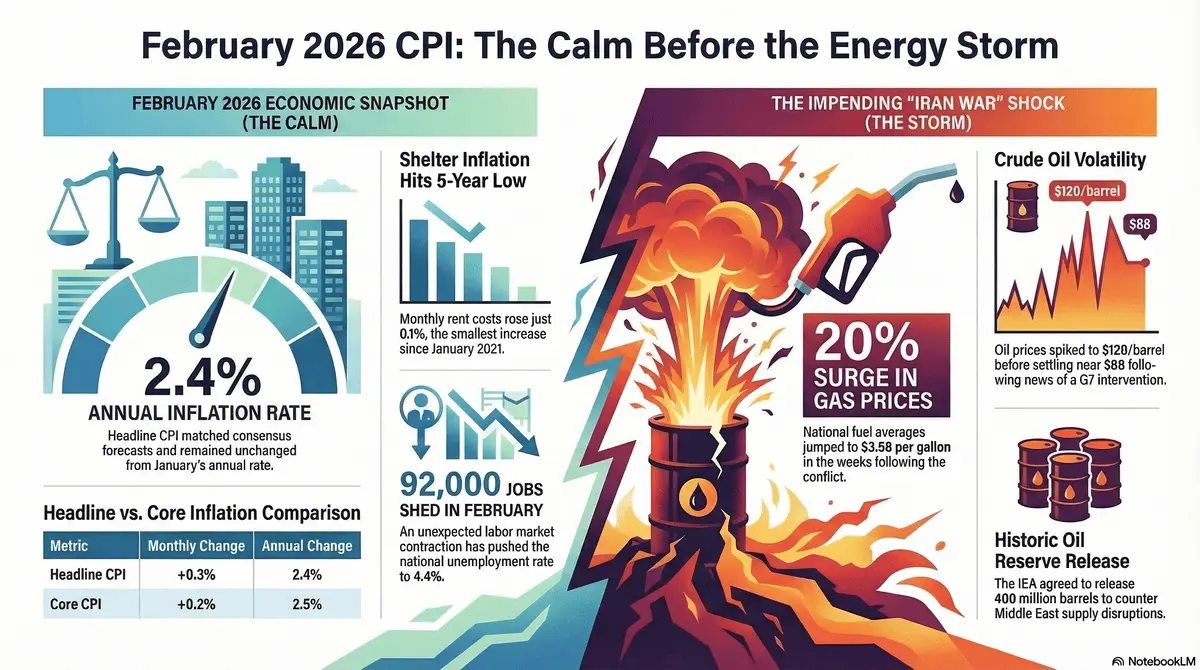
What precipitated the emergency reserve release? The coordinated release follows the outbreak of the United States–Israel war with Iran that began on Feb. 28, 2026. Since the conflict initiated, Iran has effectively blocked the Strait of Hormuz, halting the flow of oil tankers through a critical maritime bottleneck that handles roughly 20 to 25 percent of the world’s daily oil supply. Consequently, global benchmark Brent crude oil surged to nearly $120 a barrel, prompting the International Energy Agency to intervene.
The role of the International Energy Agency The International Energy Agency, headquartered in Paris, was established in 1974 following the Arab oil embargo to protect consumer nations from supply disruptions. Under current agreements, the 32 member nations are required to hold emergency stockpiles equal to 90 days of net imports. Collectively, these members control approximately 1.2 billion barrels in government reserves, with an additional 600 million barrels held by the industry.
Historical significance of the intervention This marks only the sixth time the International Energy Agency has authorized a coordinated stock release. The volume of 400 million barrels is more than double the previous record of 182 million barrels released in 2022 following Russia‘s invasion of Ukraine. Executive Director Fatih Birol emphasized that the scale of current market challenges is unprecedented, necessitating this monumental collective action.
Contributions from major nations While the release is a collective effort, the United States will contribute the largest portion by tapping 172 million barrels from its Strategic Petroleum Reserve. Other significant commitments include South Korea offering 22.46 million barrels and the United Kingdom contributing 13.5 million barrels. Germany, Austria, and Japan have also confirmed their participation in the historic drawdown.
Q&A: Unpacking The Oil Reserve Release
Q: How will the logistics of the oil release affect the timeline of market stabilization?
A: The physical delivery of the stockpiled oil faces significant logistical hurdles, meaning market relief will not be immediate.
- Delivery Estimates: Energy analysts suggest it will take between 60 to 90 days for the newly released oil to meaningfully enter the market.
- United States Timeline: The Department of Energy stated that the delivery of the 172 million barrels from the United States will commence next week and take roughly 120 days to complete.
- Refining Capacity: Producers will make the crude available for refineries to order, but a shortage of global refining capacity may further slow the conversion to usable fuel products.
- Pipeline Constraints: Experts note that distribution is physically limited by pipeline capacity, which restricts how quickly the oil can flow from reserves to end-users.
Q: Why have initial market reactions shown skepticism toward the price relief efforts?
A: Despite the historic announcement, crude oil prices actually rose following the confirmation of the reserve release.
- Volume Deficit: Analysts argue the release, equivalent to roughly three or four days of global supply, only closes a fraction of the 20 million barrels per day deficit caused by the Strait of Hormuz closure.
- Finite Strategy: Stockpile releases are one-time solutions, prompting fears about future buffer capacity if the war continues for an extended period.
- Transit Centrality: Industry leaders acknowledge that reserves cannot structurally substitute the resumption of regular transit through the currently blockaded waterways.
Q: How has the war fundamentally disrupted regional oil production beyond shipping?
A: The inability to export oil via traditional maritime routes has triggered severe operational bottlenecks for major Middle Eastern producers.
- Storage Exhaustion: Nations like Iraq, Kuwait, and the United Arab Emirates have been forced to cut production because they are running out of physical storage space for their crude.
- Infrastructure Damage: Iran, Israel, and the United States have executed strikes on energy-related infrastructure, including refineries and fuel tanks, further exacerbating regional supply constraints.
- Alternative Routes: Producers are attempting to redirect some exports, such as utilizing a pipeline across Saudi Arabia to the Red Sea, but these alternatives lack the capacity to replace the primary maritime route.
Q: Why does the United States maintain the largest stockpile despite being a net exporter?
A: The United States holds massive reserves to shield its economy from global price volatility, despite its robust domestic production.
- Regulatory Exemption: As a net exporter, the United States is technically exempt from the International Energy Agency mandate requiring 90 days of reserve imports.
- Market Vulnerability: Because oil is globally priced, the United States remains vulnerable to international price spikes, necessitating the 715-million-barrel capacity Strategic Petroleum Reserve for economic buffering.
- Refill Challenges: Previous administrations, including those of Donald Trump and Joe Biden, have attempted to refill the reserve, but underground salt cavern damage has hindered replenishment efforts.
Q: How might the ongoing conflict necessitate future energy rationing?
A: Prolonged hostilities could exhaust emergency stockpiles, leading governments to consider restricting energy use for non-essential consumers.
- Depletion Risks: At this time, the exact date when current reserve levels will reach critical depletion points remains unverified by official sources, but prolonged conflict threatens the global buffer.
- Natural Gas Shortages: The reserve release does not address the 20 percent slump in liquid natural gas supplies, a market the International Energy Agency describes as “very challenging”.
- Priority Distribution: Former BP strategy head Nick Butler stated that the United Kingdom might need to implement rationing to guarantee that priority users receive necessary supplies.
Editorial Note & Transparency
Verification Log:
- Government Statements: Announcements from the International Energy Agency and the United States Department of Energy regarding the reserve release volume and timeline.
- Market Data: Pricing benchmarks for Brent and West Texas Intermediate crude oil sourced from financial and commodities reporting.
- Expert Analysis: Commentary from energy analysts and university researchers regarding logistical constraints and market impacts.
Compliance:
- Privacy: This article respects user data under our Privacy Policy.
- Transparency: No sponsored content influenced this reporting.
Contact Us: For corrections or feedback, please email: news.desk@qnanews.com