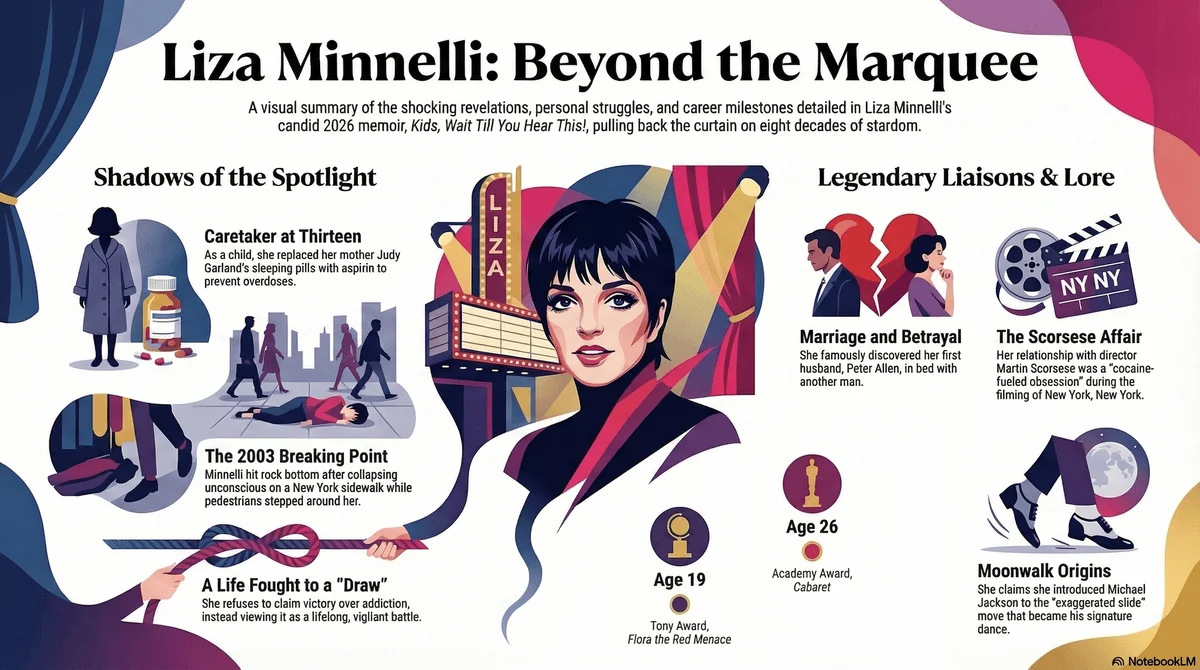
New York — Entertainment icon Liza Minnelli has released a highly anticipated memoir that provides unprecedented insight into her personal and professional life. The book, titled Kids, Wait Till You Hear This!, was officially published on March 10, 2026. The text offers candid reflections on her substance abuse struggles, high-profile marriages, and complex relationships with the Hollywood elite.
Below is a detailed breakdown of the memoir’s most significant revelations.
Context & Background
What prompted the creation of this memoir? Liza Minnelli decided to write her own story after growing frustrated with inaccurate portrayals of her life and family in films and miniseries. Additionally, a humiliating incident at the 2022 Academy Awards, where she felt misrepresented, served as a catalyst for taking control of her narrative. She wanted to share her truth with the public that has supported her throughout her EGOT-winning career.
The historical significance of her relationships The memoir chronicles Liza Minnelli‘s interactions with some of the most influential figures in entertainment history, including her mother Judy Garland, director Martin Scorsese, and singer Frank Sinatra. These relationships highlight the intersection of creative brilliance and destructive behaviors, particularly concerning substance abuse within the industry during the 1970s and 1980s.
Why this matters for public perception By openly discussing her battles with addiction and multiple stints in rehabilitation, Liza Minnelli aims to destigmatize substance use disorders and relapse. Her transparent accounts of passing out on a New York sidewalk and receiving interventions from peers like Elizabeth Taylor serve as a testament to the realities of the disease, demonstrating that recovery is a continuous struggle even for privileged celebrities.
Q&A: Unpacking The Memoir’s Revelations
Q: How does Liza Minnelli characterize her affair with Martin Scorsese and its impact on their careers?
A: Liza Minnelli describes the relationship as a destructive, drug-fueled obsession that blurred professional and personal boundaries.
- Creative Rationalization: Martin Scorsese allegedly claimed that cocaine enhanced his creative output on the set of New York, New York in 1977, though Liza Minnelli views this as a symptom of substance abuse.
- Professional Fallout: The personal turmoil ultimately impacted their professional collaboration, leading Liza Minnelli to fire Martin Scorsese from directing her Broadway show, The Act.
- Lingering Resentment: The fallout from the affair had lasting consequences, culminating in a tense encounter at the 2014 Oscars where Martin Scorsese refused to interact with her.
Q: Why did the 2022 Academy Awards appearance deeply upset Liza Minnelli?
A: The event was perceived as a humiliating orchestration by Lady Gaga that undermined Liza Minnelli‘s autonomy and physical presentation.
- Wheelchair Mandate: Minutes before presenting, Liza Minnelli was allegedly told she must use a wheelchair instead of her requested director’s chair, with Lady Gaga insisting on this condition.
- Cognitive Testing: Lady Gaga reportedly subjected Liza Minnelli to a backstage memory quiz, questioning her about the film they were celebrating.
- Public Misrepresentation: The physical positioning in the low wheelchair made it difficult for Liza Minnelli to read the teleprompter in Los Angeles, falsely projecting an image of severe mental and physical decline.
Q: How did Judy Garland’s addiction shape Liza Minnelli’s childhood and adult life?
A: The severe addiction forced Liza Minnelli into a premature caretaking role that left lasting psychological triggers.
- Reversed Roles: By the age of thirteen, Liza Minnelli acted as a nurse and psychiatrist, secretly replacing her mother’s dangerous medication with aspirin to prevent overdoses.
- Trauma Responses: The volatile nature of Judy Garland‘s behavior left Liza Minnelli with a lifelong trauma trigger related to screaming voices.
- Financial Instability: The family frequently faced financial crises, forcing them to sneak out of hotels wearing multiple layers of clothing to avoid unpaid bills.
Q: Why does the memoir portray the marriage to David Gest as uniquely exploitative?
A: Liza Minnelli alleges that David Gest deliberately manipulated her finances and isolated her from her support systems.
- Financial Drain: David Gest reportedly gained access to her accounts and spent her concert earnings extravagantly while attempting to sell her valuable Andy Warhol art collection.
- Isolation Tactics: The memoir claims he acted as a gatekeeper during their 2002 marriage, screening her phone calls and effectively keeping her as a prisoner to control her interactions.
- Physical Altercations: The relationship devolved into toxic hostility, with Liza Minnelli admitting that his behavior triggered physical fights between them.
Q: How did Frank Sinatra’s touring demands affect Liza Minnelli’s well-being?
A: Touring with Frank Sinatra in 1988 exacerbated her exhaustion and compromised her ongoing battle with alcoholism.
- Sleep Deprivation: Frank Sinatra abhorred being alone after performances and would allegedly lock his dressing room door, forcing Liza Minnelli and Sammy Davis Jr. to stay awake until dawn.
- Environmental Triggers: The mandatory late-night gatherings occurred in dressing rooms filled with alcohol, heavily testing Liza Minnelli during a period when she was struggling with her sobriety.
- Dictatorial Scheduling: The entire tour operated strictly on Frank Sinatra‘s volatile moods and schedules, leaving his co-stars powerless to establish their own boundaries.
Editorial Note & Transparency
Verification Log:
- Primary Source: Excerpts from Kids, Wait Till You Hear This! by Liza Minnelli.
- News Outlets: Reporting from The Hollywood Reporter, The Guardian, and People Magazine.
- Review Materials: Reviews compiled by Playbill regarding the memoir’s release on March 10, 2026.
Compliance:
- Privacy: This article respects user data under our Privacy Policy.
- Transparency: No sponsored content influenced this reporting.
Contact Us: For corrections or feedback, please email: news.desk@qnanews.com