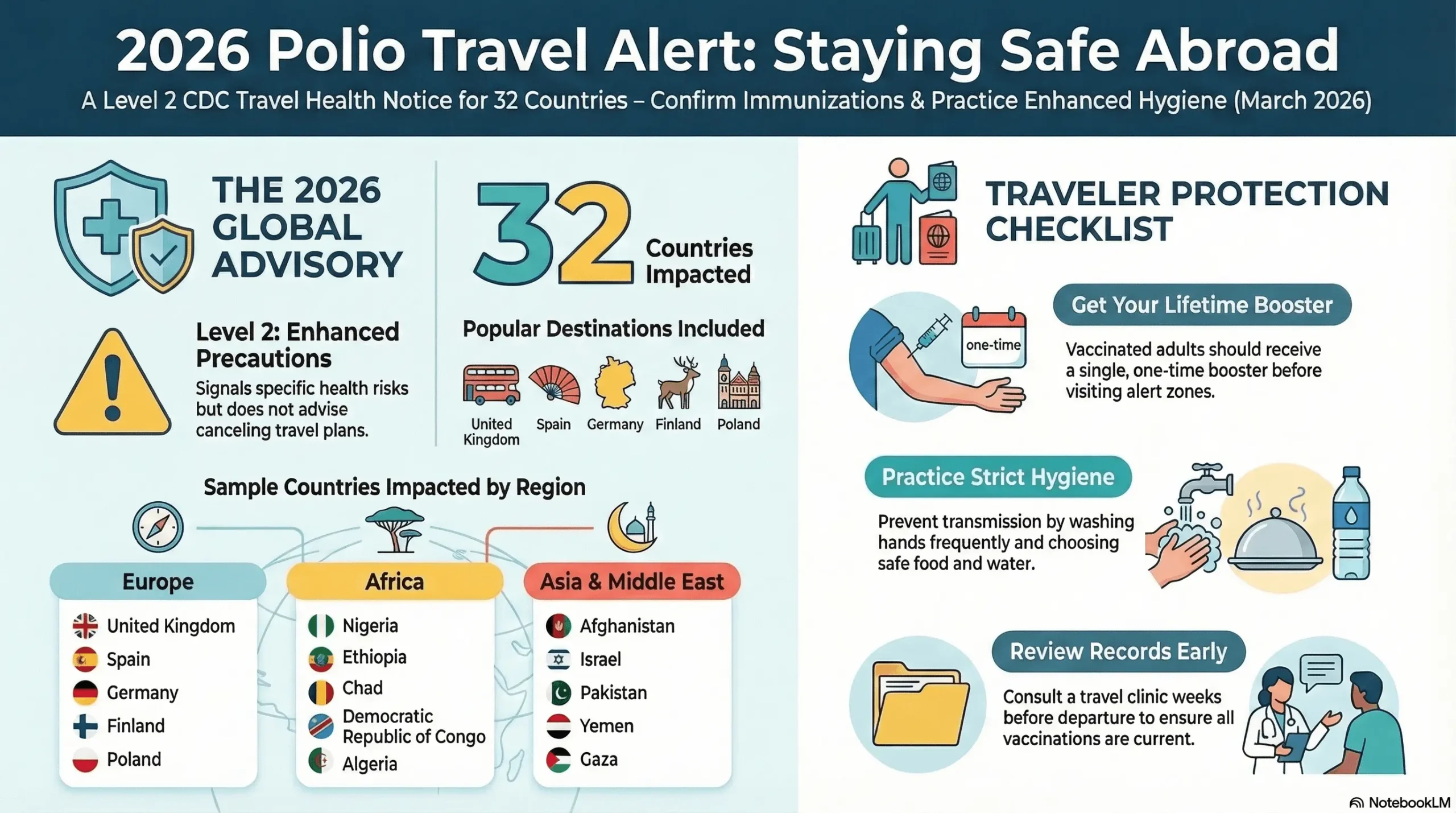
Atlanta — The U.S. Centers for Disease Control and Prevention has issued a Level 2 global travel health notice urging travelers to practice enhanced precautions due to circulating poliovirus across thirty-two nations. The agency published this alert on March 6, 2026, ahead of the busy spring and summer travel seasons. Officials emphasize that while travel does not need to be canceled, individuals should ensure their polio vaccinations are up to date before departing.
Below is a detailed breakdown of the travel advisory and public health guidelines.
Context & Background
What triggered this advisory? The advisory addresses rising global concerns over the circulation of both wild and vaccine-derived poliovirus in regions spanning Europe, Africa, and the Middle East. Surveillance systems have detected the virus in wastewater and isolated clinical cases, prompting the U.S. Centers for Disease Control and Prevention to elevate the risk level to ensure travelers do not inadvertently contract or spread the disease.
The historical significance of the disease Polio is a highly contagious disease that primarily affects the nervous system and can cause lifelong paralysis or death, most famously affecting figures like U.S. President Franklin Delano Roosevelt. Before the widespread implementation of vaccines in the 1950s, the virus caused tens of thousands of paralytic cases annually. Today, ongoing global eradication campaigns have nearly eliminated the disease, making any resurgence a critical public health priority.
Why vaccination status matters now While the United States has eliminated wild poliovirus, the virus remains highly mobile due to international travel and can quickly exploit gaps in community immunity. The U.S. Centers for Disease Control and Prevention strongly recommends that adults who completed their childhood series receive a single, lifetime inactivated polio vaccine (IPV) booster before visiting affected countries. This precaution protects individual travelers and prevents the reintroduction of the virus into domestic populations with lower immunization coverage.
Q&A: Unpacking Polio Travel Advisory
Q: How does the poliovirus spread in environments with varying levels of sanitation infrastructure?
A: The virus primarily transmits through the fecal-oral route, spreading rapidly when contaminated matter interacts with food or water sources.
- Transmission Vectors: Individuals can contract the virus by touching contaminated surfaces or consuming compromised water and food.
- Asymptomatic Shedding: Approximately 95 percent of infected individuals display no symptoms but can still shed the virus in their feces, silently fueling community transmission.
- Hygiene Mitigation: Health experts mandate meticulous handwashing and the use of alcohol-based sanitizers to interrupt these transmission chains.
Q: Why are highly developed nations like Germany, Spain, and the United Kingdom included on this specific advisory list?
A: These European countries have detected traces of the virus through wastewater surveillance or isolated cases rather than experiencing widespread clinical outbreaks.
- Surveillance Detection: Advanced sewage testing in these nations has successfully identified circulating poliovirus despite their strong overall vaccination coverage.
- Importation Risk: The high volume of international travelers moving between regions with different health profiles introduces the virus into local wastewater systems.
- Precautionary Inclusion: Inclusion on the list acts as a preemptive warning for travelers to maintain vigilance, regardless of a destination’s overall economic status.
Q: How will this Level 2 alert impact the broader travel and tourism industry during the upcoming spring season?
A: Travel industry analysts expect an increase in passenger inquiries regarding health requirements but do not foresee mass cancellations.
- Traveler Skepticism: Some frequent cruisers and travelers have publicly expressed skepticism and stated they will not alter their upcoming European itineraries.
- Industry Response: Major airlines and tour operators are advising clients to actively monitor official health guidance and verify their vaccination records before departure.
- Insurance Implications: Certain travel insurance providers may require policyholders to strictly follow destination health advisories to maintain valid coverage.
Q: How do the clinical symptoms of a polio infection typically manifest in an unvaccinated individual?
A: When symptoms do appear, they initially mimic common viral infections before potentially escalating to severe neurological complications.
- Initial Presentation: Symptomatic individuals often experience flu-like indicators, including fever, fatigue, nausea, and stiffness in the neck or back.
- Severe Complications: In fewer than 1 percent of cases, the virus invades the nervous system, leading to permanent muscle paralysis.
- Fatal Outcomes: The infection can result in death if the virus severely paralyzes respiratory muscles or infects the brain.
Q: Why is there growing concern about potential outbreaks within the United States despite historical eradication?
A: Waning vaccine coverage in specific domestic pockets has created vulnerabilities that can be exploited by imported cases.
- Recent Precedents: In 2022, a young adult in Rockland County, New York, contracted paralytic polio without traveling internationally, proving the virus can circulate locally.
- Vaccine Hesitancy: Rising opposition to mandatory immunizations has expanded the population of susceptible individuals, raising fears of localized epidemics.
- Asymptomatic Spread: Because the virus spreads silently, a single infected international traveler can trigger transmission chains in under-immunized American communities.
Editorial Note & Transparency
Verification Log:
- Medical Advisory Source: The U.S. Centers for Disease Control and Prevention travel notices and official medical guidelines regarding poliovirus transmission and vaccination protocols.
- News Syndication: Published reports from major media outlets detailing the global spread of the virus and the public’s reaction to the advisory.
- Historical Data: Public health records documenting the historical impact of the virus prior to widespread vaccination efforts.
Compliance:
- Privacy: This article respects user data under our Privacy Policy.
- Transparency: No sponsored content influenced this reporting.
Contact Us: For corrections or feedback, please email: news.desk@qnanews.com