Lexington/College Station — Recent scientific investigations have revealed how irregular sleep patterns directly contribute to neurodegenerative conditions like Alzheimer’s disease. Emerging data analyzed up through March 11, 2026, emphasizes that disrupted circadian rhythms and a lack of restorative sleep stages actively accelerate brain aging and trigger neuroinflammation.
Below is a detailed examination of the mechanisms linking sleep to cognitive health and potential future interventions.
Context & Background
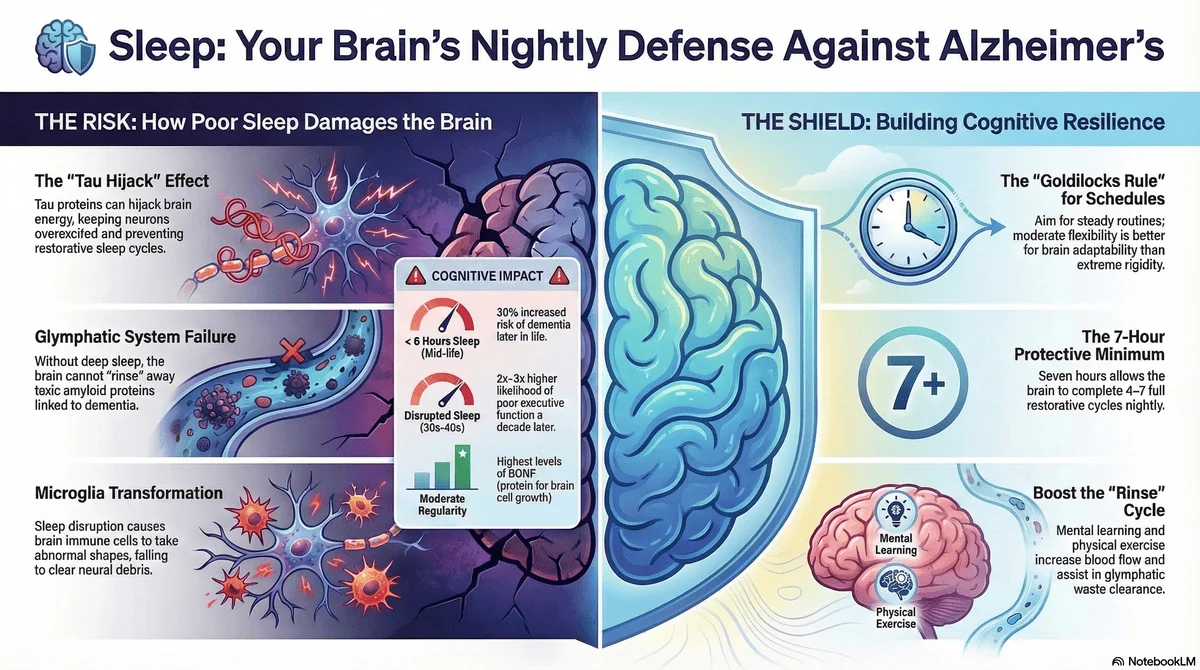
The Biological Mechanisms of Restorative Sleep Achieving genuinely restorative rest relies heavily on deep sleep and Rapid Eye Movement (R.E.M.) sleep, both of which are critical for long-term cognitive health. During these phases, the brain regulates hormones and utilizes the glymphatic system to flush out metabolic waste, including the amyloid proteins often implicated in dementia. Furthermore, R.E.M. sleep is vital for processing emotions and consolidating new memories gathered during waking hours.
How Toxic Proteins Hijack Brain Energy A significant driver of Alzheimer’s disease is the accumulation of the tau protein, which researcher Shannon Macauley at the University of Kentucky notes can hijack the brain’s energy supply. Instead of generating normal energy from glucose, the brain produces glutamate, an excitatory neurotransmitter that keeps neurons overactive and prevents individuals from achieving deep, restorative sleep. This creates a cyclical deterioration where poor sleep worsens Alzheimer’s pathology, and the pathology further disrupts sleep.
The Role of Microglia and Inflammation When circadian rhythms are consistently disrupted, microglia—the brain’s essential immune cells—begin to shift from their normal protective state into a stress-primed, inflammatory state. Research led by Karienn Souza at Texas A&M University demonstrates that this transformation impairs the immune cells’ ability to clear cellular debris, creating an environment where toxic proteins can accumulate and accelerate the onset of cognitive decline.
The Goldilocks Rule for Sleep Consistency Scientists tracking sleep regularity have identified an inverted U-shaped curve concerning the production of brain-derived neurotrophic factor (BDNF), a protein crucial for neural adaptability and resilience. Both highly irregular sleep patterns and overly strict, rigid sleep schedules result in lower BDNF levels, suggesting the brain requires moderate consistency coupled with slight daily flexibility to optimize long-term cognitive health.
Q&A: Unpacking Sleep and Dementia Risk
Q: How do deficiencies in specific sleep phases physically damage long-term brain function?
A: Lacking adequate deep and R.E.M. sleep prevents the brain from executing vital restorative processes, leading to toxic waste accumulation and severe memory impairment.
- Glymphatic Clearance Failure: Insufficient deep sleep restricts the brain’s glymphatic system from flushing out metabolic waste, allowing dementia-linked amyloid proteins to build up over years.
- Memory Processing Deficits: Without adequate R.E.M. sleep, the brain loses its primary mechanism for storing and updating new information or processing emotional experiences.
- Executive Function Impact: Individuals who experience heavily disrupted sleep in their 30s and 40s are two to three times more likely to test lower in executive function and processing speeds a decade later.
Q: Why does the early accumulation of tau protein result in clinical insomnia?
A: Tau tangles disrupt normal brain metabolism, forcing neurons into an overexcited state that actively prevents the central nervous system from initiating deep sleep.
- Metabolic Hijacking: Abnormally building tau redirects the brain’s standard glucose supply away from normal energy production.
- Glutamate Overproduction: This rerouted fuel creates excess glutamate, a neurotransmitter that continuously stimulates neurons and keeps the brain on high alert.
- Early Warning Sign: Because this metabolic hijacking occurs before tau fully clumps into tangles, severe insomnia often precedes clinical Alzheimer’s symptoms by many years.
Q: How does chronic circadian disruption alter the brain’s natural immune defenses?
A: Irregular sleep schedules force the brain’s primary immune cells into an abnormal structural state that promotes harmful inflammation rather than cellular repair.
- Morphological Changes: Normal, tree-like microglia physically change into abnormal, stressed shapes when subjected to a disrupted circadian rhythm.
- Debris Accumulation: These altered immune cells lose their efficiency and fail to properly filter out damaged cells, allowing toxins to build up in neural tissue.
- Inflammatory Cascade: This structural shift turns the microglia into an inflammatory force, meaning the brain’s defense system inadvertently attacks its own tissue over time.
Q: How are researchers attempting to repair damaged microglial cells to prevent cognitive decline?
A: Scientists are developing targeted therapies using microscopic particles derived from stem cells to deliver corrective anti-inflammatory signals directly to the brain’s immune system.
- Extracellular Vesicles: Researchers developed stem cell-derived extracellular vesicles to act as a therapeutic messaging system for compromised microglia.
- Targeted Payload Delivery: These tiny particles carry proteins and signaling molecules specifically designed to stabilize erratic immune behavior.
- Inflammation Reversal: The goal is to prevent the microglia from taking abnormal shapes and force them to return to their standard job of safely clearing neural debris.
Q: How might the insomnia medication suvorexant be utilized to slow the progression of Alzheimer’s disease?
A: Initial clinical trials led by Brendan Lucey at Washington University in St. Louis suggest that this common sleeping pill can rapidly reduce the concentration of specific harmful proteins in the central nervous system.
- Beta-Amyloid Reduction: Participants who took suvorexant for two nights demonstrated a 10 to 20 percent decrease in beta-amyloid levels within their cerebrospinal fluid.
- Tau Protein Alteration: The medication also temporarily reduced the accumulation of hyperphosphorylated tau proteins for up to 24 hours.
- Clinical Limitations: At this time, the long-term efficacy of suvorexant as a preventative Alzheimer’s treatment remains unverified by official sources, and researchers caution that sleeping pills carry risks of dependence and reduced deep sleep quality.
Editorial Note & Transparency
Verification Log:
- Scientific Journals: Research drawn from published studies on tau protein metabolism, microglial morphology, and BDNF regulation mapping sleep patterns to cognitive decline.
- University Research: Data cross-referenced from ongoing trials at Texas A&M University, the University of Kentucky, and University of California–San Diego.
- Medical Reports: Analysis of experimental treatments involving stem cell-derived extracellular vesicles and pharmaceutical interventions like suvorexant.
Compliance:
- Privacy: This article respects user data under our Privacy Policy.
- Transparency: No sponsored content influenced this reporting.
Contact Us: For corrections or feedback, please email: news.desk@qnanews.com