New York/New Jersey — Health and environmental agencies are monitoring a rapidly expanding mass mortality event affecting wild birds, predominantly Canada geese, suspected to be driven by Highly Pathogenic Avian Influenza. The crisis escalated dramatically over the past month, with thousands of dead birds reported by March 8, 2026. State officials have issued widespread advisories as they work to contain the environmental contamination and protect public health.
Below is a detailed examination of the suspected bird flu outbreak and its regional impact.
Context & Background
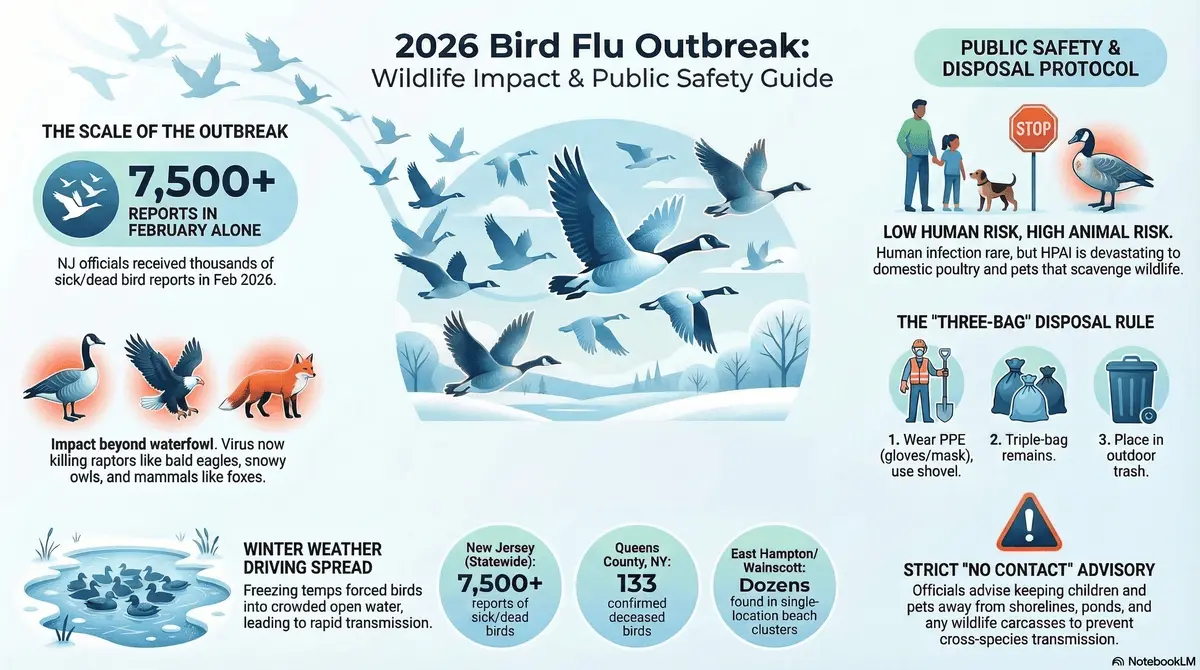
How did this outbreak escalate so rapidly? The recent surge in bird mortalities is heavily influenced by harsh winter weather patterns across New Jersey and New York. As open water sources froze, migrating flocks of Canada geese and other waterfowl were forced into tightly concentrated, unfrozen areas, which accelerated the transmission of the virus in crowded environments. Additionally, widespread snow cover severely limited natural foraging opportunities, leaving the birds with compromised immune functions and heightened susceptibility to infection.
Which species are most affected? While Highly Pathogenic Avian Influenza primarily circulates among waterfowl like Canada geese and snow geese, the current strain is demonstrating significant cross-species transmission capabilities. Wildlife experts, including Kevin Hynes of the New York State Department of Environmental Conservation and Dr. Patrick Connelly of the New Jersey Department of Environmental Protection, note that the virus is increasingly killing raptors such as bald eagles and red-tailed hawks, as well as scavenging mammals including red foxes, bobcats, and raccoons. Grace DeNatale, a hospital supervisor at the Evelyn Alexander Wildlife Refuge, also reported confirming the virus in bufflehead and hooded merganser populations.
What is the risk to human and pet health? The Centers for Disease Control and Prevention maintains that the current risk to the general public’s health remains strictly low, as human infections are exceptionally rare. However, officials strongly advise pet owners to keep domestic animals away from dead wildlife, as cross-species transmission is possible if pets consume or interact with infected carcasses. Local veterinarians, such as Dr. Jonathan Turetsky, underscore the importance of maintaining hygiene around bird feeders to prevent further spread.
How are local authorities responding? Municipalities spanning from Salem County, New Jersey to East Hampton, New York have issued safety advisories, coordinated carcass removals, and in some cases, temporarily closed public parks to limit human exposure. The New York State Department of Environmental Conservation and the New Jersey Department of Environmental Protection have established dedicated online reporting portals and hotlines, urging residents to report clusters of dead birds rather than attempting to dispose of them independently without protective equipment.
Q&A: Unpacking the Avian Influenza Crisis
Q: HOW does the Highly Pathogenic Avian Influenza virus transmit among wild bird populations?
A: The virus primarily spreads through heavy environmental contamination in shared wetland habitats.
- Fecal and Salivary Shedding: Infected waterfowl shed high viral loads into the water and onto the surrounding land through their excrement and saliva.
- Environmental Persistence: In cold winter temperatures, the shed virus can remain viable and infectious in the environment for extended periods.
- Secondary Predation: Birds of prey, such as hawks and owls, frequently contract the illness when they prey upon or scavenge the infected carcasses of smaller birds.
Q: WHY are winter weather patterns exacerbating the wildlife mortality rate?
A: Freezing temperatures have drastically altered wildfowl behavior and degraded their physiological resilience.
- Habitat Compression: Ice formations on lakes and ponds have forced massive flocks into the few remaining patches of open water, creating high-density congregations.
- Nutritional Deficits: Extensive snow and ice cover have severely limited natural foraging opportunities, leaving migrating birds weakened and malnourished.
- Immunological Stress: The combination of intense cold and lack of food inherently degrades the immune response of the birds, facilitating rapid viral spread.
Q: WHY are mammals increasingly contracting this specific viral strain?
A: Scavenging behaviors place certain mammalian predators in direct contact with highly concentrated viral loads.
- Dietary Exposure: Mammals such as foxes, raccoons, and bobcats frequently scavenge the carcasses of deceased geese, directly ingesting infected tissues.
- Cross-Species Vulnerability: While primarily an avian virus, HPAI demonstrates the capacity to infect mammals through direct, high-dose exposure via the gastrointestinal or respiratory tracts.
- Transmission Mechanics: At this time, mammal-to-mammal transmission in the wild remains unverified by official sources.
Q: HOW should residents safely manage the discovery of dead wildlife on private property?
A: Proper disposal requires strict adherence to environmental and health guidelines to prevent secondary contamination.
- Protective Equipment: Individuals must wear disposable gloves, masks, and eye protection before initiating any removal process.
- Contact Avoidance: Shovels or other extended implements must be utilized to prevent any direct physical contact with the carcass or its bodily fluids.
- Secure Disposal: Carcasses should be triple-bagged in heavy-duty contractor bags and secured in outdoor trash receptacles to protect sanitation workers and prevent scavenging by local wildlife.
Q: HOW is the agricultural sector potentially impacted by wild bird infections?
A: Proximity between wild, migrating flocks and commercial poultry creates severe economic and biosecurity risks for farmers.
- Spillover Infections: Free-flying infected wild waterfowl can introduce the virus to domestic flocks, which lack natural immunity.
- Depopulation Protocols: Because there is no cure for the disease, entire commercial operations—including chickens and turkeys—must be fully depopulated to halt the spread upon a single confirmed detection.
- Biosecurity Breaches: The virus can be inadvertently tracked into poultry enclosures via contaminated soil on footwear, vehicles, or equipment.
Q: WHY are official testing procedures pivoting away from testing deceased Canada geese?
A: The overwhelming volume of goose mortalities has forced environmental agencies to strategically reprioritize their diagnostic resources.
- Established Baselines: Because HPAI is already known to be circulating widely among regional waterfowl, testing every deceased goose is no longer diagnostically necessary.
- Resource Allocation: Agencies are redirecting limited testing efforts toward raptors and wildlife species not yet confirmed to carry the virus in the region.
- Presumptive Diagnoses: Officials now advise the public to operate under the assumption that large clusters of deceased waterfowl are highly likely to be HPAI positive and proceed with standard safety protocols.
Editorial Note & Transparency
Verification Log:
- Government Directives: Environmental safety guidelines and disposal protocols from state conservation departments.
- Wildlife Health Reports: Field observations and necropsy data from wildlife pathologists and local veterinarians.
- Public Health Advisories: Risk assessments from the Centers for Disease Control and Prevention regarding cross-species transmission.
Compliance:
- Privacy: This article respects user data under our Privacy Policy.
- Transparency: No sponsored content influenced this reporting.
Contact Us: For corrections or feedback, please email: news.desk@qnanews.com