Oxford/Cambridge — Astronomers have discovered that the exoplanet L 98-59 d represents an entirely new class of planetary body characterized by a global magma ocean and a sulfur-rich atmosphere. This finding was formally detailed in a study published on March 16, 2026. The research challenges existing planetary classification models and offers unprecedented insights into the evolution of small, low-density worlds. Below is a detailed examination of the planet’s unique composition, atmospheric chemistry, and broader astronomical significance.
Context & Background
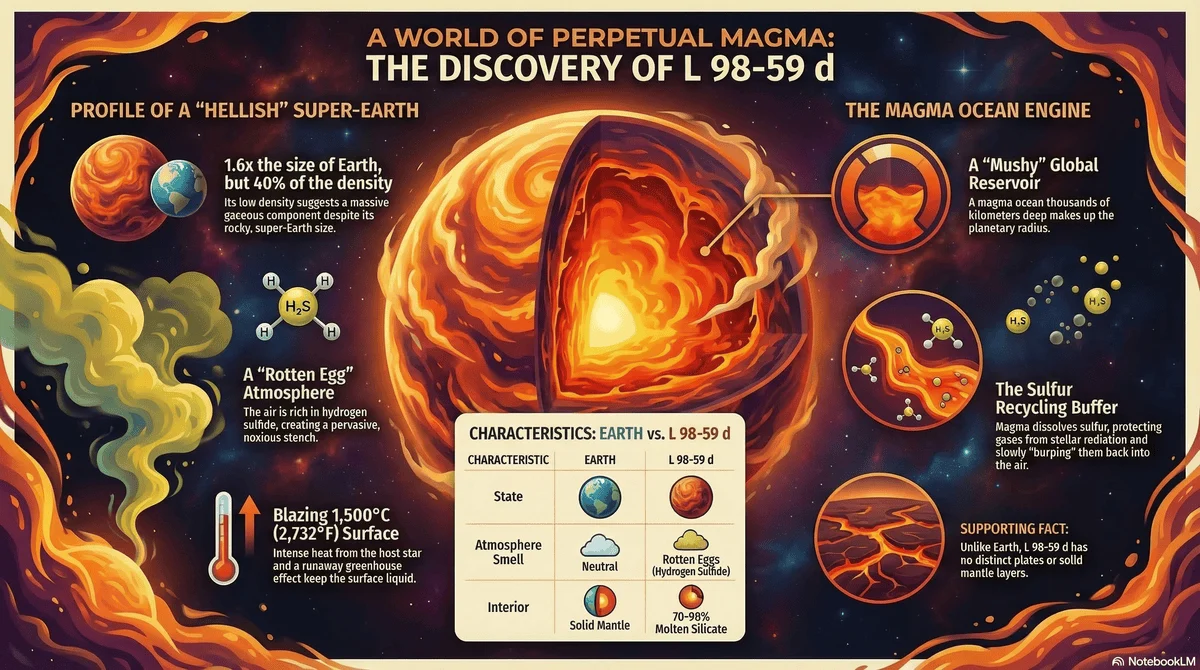
A New Planetary Classification The exoplanet L 98-59 d, located 35 light-years from Earth in the constellation Volans, defies the traditional classifications of gas dwarfs and water worlds. Instead, it has been categorized as a completely new type of planet with a thick hydrogen-rich envelope and a deep, permanent magma ocean. This discovery highlights that the current categories astronomers use to describe small planets are likely too simplistic.
The Core Discoveries Using data from the James Webb Space Telescope combined with nearly 900 computer simulations, researchers reconstructed the planet’s nearly 5-billion-year history. They determined that the world is in a molten, mushy state lacking a solid crust, with surface temperatures reaching up to 1,900 degrees Celsius. The intensely hot, volatile-rich atmosphere is heavily concentrated with hydrogen sulfide, a toxic gas known for smelling like rotten eggs.
The Key Players The groundbreaking study was led by Harrison Nicholls from the University of Oxford, in collaboration with colleagues including Raymond Pierrehumbert and Richard Chatterjee from the University of Leeds. Their work utilized advanced computer models to simulate various planetary processes and effectively turn back the clock on the planet’s evolution, allowing them to probe interior mechanisms that cannot be directly observed.
Historical Significance All rocky planets, including Earth and Mars, began their lifespans with global magma oceans that eventually solidified. L 98-59 d is uniquely significant because it functions as a preserved snapshot of this early evolutionary stage, having maintained its molten state for nearly five billion years due to immense atmospheric pressure and tidal heating.
Q&A: Unpacking Exoplanet L 98-59 d
Q: How does L 98-59 d sustain a permanent global magma ocean after billions of years?
A: The planet remains in a continuous molten state due to a combination of intense tidal heating from its host star and the insulating properties of a thick, runaway greenhouse atmosphere.
- Tidal Forces: Neighboring planets and the host star exert gravitational kneading, generating immense internal friction and heat.
- Runaway Greenhouse Effect: A dense atmospheric layer traps stellar heat efficiently, preventing the planet’s surface from cooling enough to solidify.
- Viscosity Thresholds: The mantle remains highly viscous and fluid, acting as a single deep, mushy layer without a distinct crust, upper mantle, or lower mantle structure.
Q: Why does the planet possess such an unusually high concentration of sulfur in its atmosphere?
A: The vast magma ocean acts as a deep internal reservoir that continuously traps, stores, and slowly degasses sulfur-bearing compounds over billions of years.
- Chemical Dissolution: Unlike solid planets that quickly shed volatile gases, sulfur dissolves readily into the molten silicate melt of the magma ocean.
- Continuous Degassing: As parts of the deep interior slowly cool and crystallize, the magma releases sulfur back into the atmosphere, replenishing what escapes into space.
- Photochemical Reactions: Ultraviolet light from the red dwarf star hits the upper atmosphere, interacting with water vapor to convert hydrogen sulfide into sulfur dioxide in situ.
Q: How did the planet evolve to become significantly less dense than Earth?
A: Despite having a diameter over 60% greater than Earth, the planet’s extremely low bulk density results from a combination of a small metallic core and a massive envelope of light, volatile gases.
- Volatile Endowment: The planet formed with large quantities of volatile gaseous materials, significantly exceeding the hydrogen volume of early Earth.
- Thermal Contraction: Over geologic time, the planet likely shrank from a larger sub-Neptune size as it cooled and lost a portion of its atmosphere to stellar radiation.
- Small Core Structure: The metallic core is relatively small, with the magma ocean comprising 70% to 90% of the planetary interior radius.
Q: Why are astronomers proposing a new classification system based on this discovery?
A: The unique characteristics of L 98-59 d directly contradict the standard binary models of small exoplanet formation, which previously categorized such worlds as either gas dwarfs or water-rich ocean planets.
- Categorical Defiance: The planet’s low density, high sulfur content, and lack of a solid core-mantle-crust structure do not align with established gas dwarf or water world frameworks.
- Radius Valley Placement: L 98-59 d sits perfectly within a theoretical size gap known as the radius valley, offering a new evolutionary path where planets remain molten rather than stripping down to bare rock.
- Future Identification: Establishing a new sulfur-rich magma-ocean category provides a framework to properly classify dozens of similar exoplanets expected to be identified by upcoming space missions like Ariel and PLATO.
Q: How were researchers able to determine the internal composition of a planet 35 light-years away?
A: Scientists coupled direct atmospheric readings from space telescopes with an extensive array of physical computer simulations to reverse-engineer the planet’s evolutionary history.
- Spectral Analysis: The James Webb Space Telescope measured starlight filtered through the planet’s atmosphere to precisely identify the presence of hydrogen sulfide and sulfur dioxide.
- Predictive Modeling: The research team ran nearly 900 separate computer models, tracing various starting conditions over five billion years to see which produced the exact density and atmospheric profile observed today.
- Process Elimination: Only a very narrow range of simulated scenarios—specifically those involving a permanent magma ocean protecting a volatile-rich interior—managed to successfully match the telescope data.
Editorial Note & Transparency
Verification Log:
- Peer-Reviewed Journal: Verified publication in Nature Astronomy confirming the data and simulations regarding L 98-59 d.
- Academic Institution Records: Verified researcher affiliations with the University of Oxford, University of Leeds, and Massachusetts Institute of Technology.
- Observatory Data: Cross-referenced findings from the James Webb Space Telescope regarding atmospheric spectrum analysis.
Compliance:
- Privacy: This article respects user data under our Privacy Policy.
- Transparency: No sponsored content influenced this reporting.
Contact Us: For corrections or feedback, please email: news.desk@qnanews.com