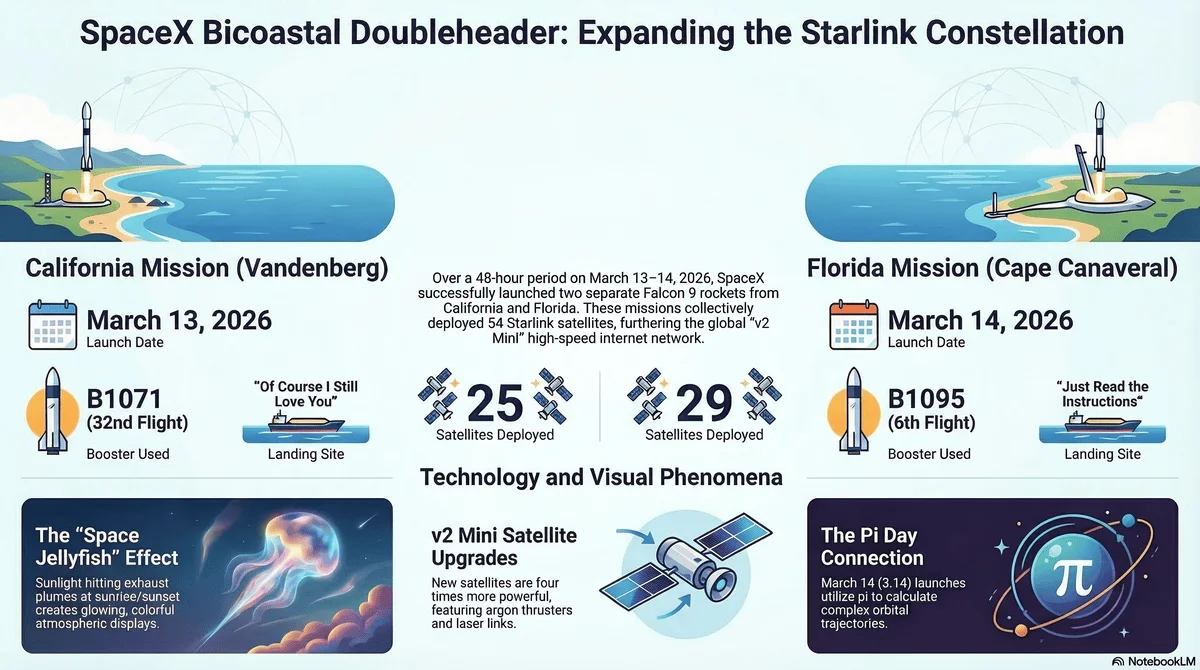
Cape Canaveral/Vandenberg Space Force Base — SpaceX successfully completed two separate Falcon 9 rocket missions from opposite coasts of the United States, deploying a total of 54 Starlink satellites into low Earth orbit. The consecutive missions took place on March 13, 2026, and March 14, 2026, demonstrating the company’s rapid operational turnaround. Both rockets utilized recycled first-stage boosters that safely returned to ocean-based drone ships shortly after liftoff.
Below is a detailed examination of the operational, technological, and visual aspects of these recent launches.
Context & Background
The Scale of the Starlink Constellation The ongoing launches are designed to expand the Starlink network, a mega-constellation of satellites intended to provide global broadband internet access, particularly in rural and underserved areas. Following these dual launches, the total number of active satellites in the network approached 10,000, according to astronomer Jonathan McDowell of the Harvard-Smithsonian Center for Astrophysics. These high-frequency deployments are crucial for reducing network congestion and improving overall data throughput for consumers and enterprise users.
Advancements in Satellite Technology Recent payloads, including the satellites launched during these missions, feature the V2 Mini optimized design. These upgraded units are significantly more powerful than previous iterations, utilizing high-tech gear such as advanced antennas, super-fast laser links, and efficient argon thrusters. This technological shift allows the spacecraft to perform more intensive data-handling operations while consuming less fuel.
The Mechanics of Reusability A core component of the SpaceX operational model is rocket reusability, which significantly lowers the cost of reaching orbit. The March 13, 2026 launch from California utilized a booster designated B1071, which was completing its 32nd flight. The subsequent March 14, 2026 launch from Florida relied on booster B1095, marking its sixth flight. Both boosters successfully landed on autonomous drone ships positioned in the Pacific Ocean and Atlantic Ocean.
The Visual Phenomenon of the Space Jellyfish Missions launching in the pre-dawn or immediate post-sunset hours frequently create a unique atmospheric display known colloquially as a “space jellyfish”. This occurs when a rocket releases exhaust gases into the thinner air of the upper atmosphere while the sun, positioned just below the horizon, illuminates the expanding plume. Although cloudy conditions obscured this effect during the March 14, 2026 launch, it remains a heavily anticipated visual event for residents near Cape Canaveral and Vandenberg Space Force Base.
Q&A: Unpacking Bicoastal Launch Operations
Q: How do the V2 Mini satellites enhance the overall capability of the Starlink network?
A: The upgraded satellites introduce substantial performance improvements and efficiency gains over older models.
- Antenna and Laser Upgrades: The inclusion of advanced antennas and super-fast laser links allows the network to handle significantly more data and improve internet speeds.
- Propulsion Efficiency: The transition to argon thrusters enables the satellites to perform orbital maneuvers while consuming less fuel.
- Cellular Integration: The new technology supports direct-to-cell initiatives, which aim to eventually allow standard mobile devices to connect directly to the satellite network in areas lacking traditional cellular coverage.
Q: Why does SpaceX maintain such a high frequency of rocket launches?
A: A tight launch cadence is economically and operationally necessary to maintain competitive advantages and build out the mega-constellation.
- Cost Amortization: Regular launches lower the per-unit overhead costs and generate steady cash flow from active satellite subscriptions.
- Network Capacity: Frequent deployments add necessary bandwidth to the network, reducing user congestion during peak hours and accommodating a growing subscriber base.
- Market Pressure: Maintaining rapid, reliable access to space forces market competitors to either lower their own prices or narrow their operational scope.
Q: How are the Falcon 9 first-stage boosters recovered after deploying their payloads?
A: The boosters utilize automated navigation and propulsion systems to return to Earth and land on specialized maritime vessels.
- Stage Separation: Approximately two and a half minutes into the flight, the first stage detaches from the upper stage of the rocket.
- Targeted Landing: The booster descends back through the atmosphere and utilizes engine burns to touch down on autonomous spaceport drone ships.
- Maritime Recovery Vessels: During the recent missions, the boosters landed on the ships Of Course I Still Love You in the Pacific Ocean and Just Read the Instructions in the Atlantic Ocean.
Q: Why are launches conducted from both California and Florida?
A: Utilizing multiple coastal launch facilities allows for diverse orbital trajectories and increased launch frequencies.
- Southern Trajectories: Vandenberg Space Force Base in California is geographically suited for launching payloads into polar or high-inclination orbits over the open ocean.
- Northeastern Trajectories: Cape Canaveral in Florida is optimal for launching toward the east or northeast to capitalize on the rotation of the Earth for equatorial and mid-inclination orbits.
- Operational Flexibility: Operating dual pads prevents launch bottlenecks and allows the company to support commercial, military, and internal payload schedules simultaneously.
Q: How does the space jellyfish effect materialize in the sky?
A: The phenomenon relies on a specific alignment of the rocket’s exhaust plume and the sun’s position relative to the observer.
- Atmospheric Expansion: As the rocket reaches the upper atmosphere, the lower air pressure causes its exhaust gases to expand outward rapidly.
- Solar Illumination: If the launch occurs shortly before sunrise or after sunset, the sun is situated below the observer’s horizon but is still able to strike the high-altitude exhaust plume.
- Visual Spectacle: The illuminated gases create a glowing, bulbous shape in the twilight sky that resembles a jellyfish, visible for hundreds of miles.
Editorial Note & Transparency
Verification Log:
- News Reports: Details regarding the dual launches, payload configurations, and dates were cross-referenced using regional outlets like Florida Today and the Santa Maria Times.
- Technical Analysis: Information on satellite capabilities and rocket reusability was sourced from industry monitors like Spaceflight Now and astronomer Jonathan McDowell.
- Meteorological Data: Weather conditions and atmospheric explanations were verified through local meteorological reporting and aerospace analyses.
Compliance:
- Privacy: This article respects user data under our Privacy Policy.
- Transparency: No sponsored content influenced this reporting.
Contact Us: For corrections or feedback, please email: news.desk@qnanews.com