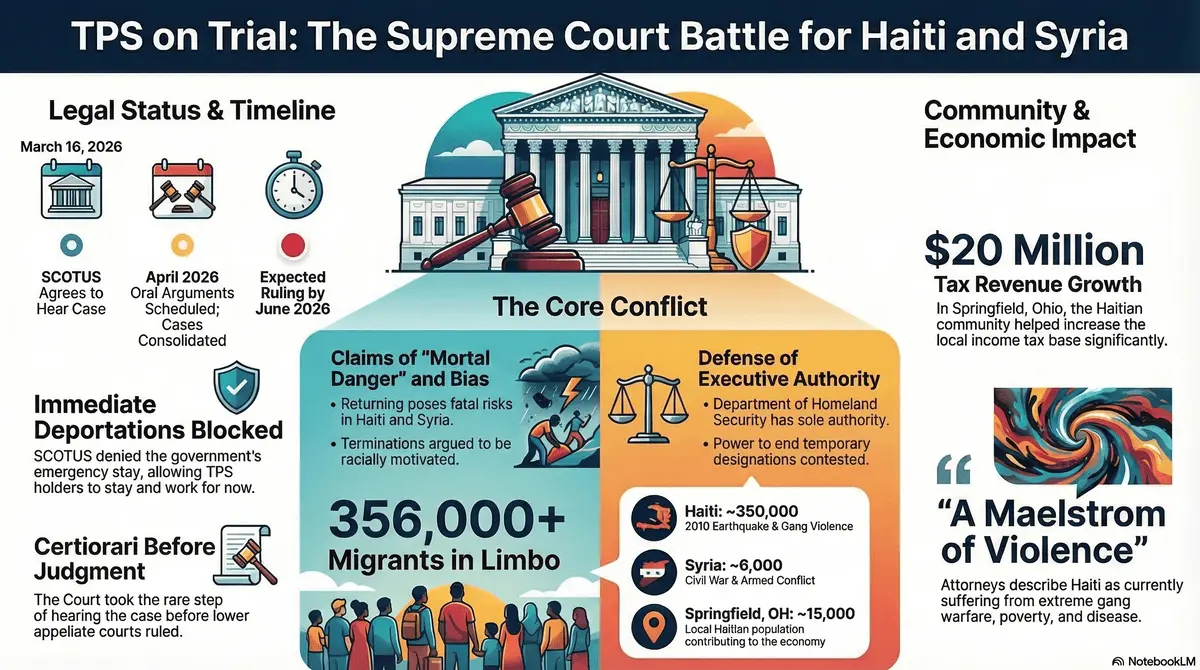
Washington, D.C. / Springfield, Ohio — The U.S. Supreme Court has temporarily blocked the Donald Trump administration from immediately deporting hundreds of thousands of migrants holding Temporary Protected Status, while simultaneously agreeing to expedite hearings on the matter. On March 16, 2026, the justices issued an unsigned order deferring the government’s emergency requests and scheduling oral arguments for the final week of April 2026. The consolidated cases will determine whether the executive branch possesses unchecked authority to terminate humanitarian protections for approximately 350,000 migrants from Haiti and 6,000 from Syria.
Below is a detailed breakdown of the legal arguments, community impacts, and political stakes surrounding the Temporary Protected Status litigation.
Context & Background
Historical significance of the program The Temporary Protected Status program was established by Congress in 1990 to prevent the deportation of individuals to nations experiencing armed conflict, natural disasters, or other extraordinary and temporary conditions. Haiti was initially designated for the program in 2010 following a catastrophic earthquake, while Syria was added in 2012 due to the severe civil war under President Bashar al-Assad. The program allows designated foreign nationals to legally live and work in the United States, though it does not provide a direct path to citizenship.
How did this start? During his second term, President Donald Trump and his administration have moved to terminate the designations for multiple countries, arguing that conditions have improved and that the program has been extended for too long. Former Department of Homeland Security Secretary Kristi Noem announced late last year that the administration intended to end protections for Haiti and Syria, prompting immediate lawsuits from affected individuals and advocacy groups. Lower courts in Washington, D.C. and New York subsequently blocked these terminations, leading the Justice Department to appeal directly to the Supreme Court.
The key players U.S. Solicitor General John Sauer is leading the legal effort for the administration, arguing that the judicial branch is unlawfully interfering with executive immigration policy. On the opposing side, attorneys for the migrants point to decisions by judges like U.S. District Judge Ana Reyes, who ruled that the administration failed to follow the Administrative Procedure Act and acted with potential hostility toward nonwhite immigrants. Furthermore, local leaders from Springfield, Ohio, have emerged as vocal advocates for the migrants, submitting amicus briefs emphasizing the economic vitality brought by the Haitian community to their region.
Why this matters for local communities The potential mass deportation of over 350,000 individuals carries profound economic and social implications for municipalities across the United States. In Springfield, Ohio, officials report that the influx of Haitian workers has revitalized the local economy, significantly expanding the municipal tax base. Conversely, human rights experts warn that forcing individuals to return to Haiti or Syria would place them in “mortal danger” due to rampant gang violence, political instability, and ongoing sectarian conflict.
Q&A: Unpacking Temporary Protected Status Litigation
Q: How does the Trump administration justify its push to bypass lower courts in this litigation?
A: The administration argues that standard appellate processes allow lower courts to persistently undermine the executive branch’s inherent authority over national immigration policy.
- Executive Authority Claim: Solicitor General John Sauer asserts that the Department of Homeland Security possesses the exclusive power to evaluate and terminate humanitarian programs without judicial interference.
- National Interest Harms: The administration views ongoing injunctions from district judges as an unsustainable cycle of interference that inflicts specific harms on foreign relations and the national interest.
- Judicial Precedent Alignment: The government points to previous Supreme Court interventions that allowed the termination of protections for Venezuelan migrants as the appropriate legal standard that lower courts are currently defying.
Q: Why did lower court judges initially block the administration’s termination of these protections?
A: Federal judges determined that the administration likely violated procedural laws and failed to properly assess the safety conditions in the affected countries.
- Statutory Violations: Judge Ana Reyes ruled that former DHS Secretary Kristi Noem failed to adequately consult with the State Department and other agencies, directly violating the Administrative Procedure Act.
- Inadequate Assessment: The only documented consultation regarding Haiti was a brief three-sentence email exchange that did not meaningfully address the ongoing violence and humanitarian crisis.
- Improper Motivations: The court cited derogatory public statements made by President Donald Trump and Kristi Noem as evidence that the termination was improperly motivated by racial animus.
Q: How would the sudden termination of protections impact municipalities like Springfield, Ohio?
A: Local leaders warn that mass deportations would trigger severe economic decline and destabilize communities that have become reliant on the immigrant workforce.
- Economic Contraction: The sudden removal of thousands of workers would harm local businesses, with the city’s income tax base having recently expanded by $20 million due directly to the immigrant population.
- Demographic Reversal: Haitian residents are credited with reversing decades of severe population decline in small cities and rural counties that were previously struggling.
- Family Destabilization: Deportations could result in thousands of U.S.-citizen children being separated from their families and left without legal guardians.
Q: Why do human rights advocates argue that returning migrants to Haiti and Syria poses a severe threat to their lives?
A: Both nations are currently experiencing extreme levels of violence, political collapse, and humanitarian emergencies that make safe repatriation impossible.
- Haitian Instability: The United Nations reports that Haiti is facing catastrophic conditions driven by rampant gang warfare, kidnappings, and a total breakdown of essential public services.
- Syrian Conflict: Syria remains highly volatile following the recent ouster of President Bashar al-Assad, with ongoing sectarian violence, arbitrary detentions, and extrajudicial killings continuing to plague the region.
- Federal Travel Warnings: The U.S. State Department actively warns citizens against traveling to Haiti, grimly advising those who do to leave DNA samples behind for the identification of their remains.
Q: How does the Supreme Court’s approach to this case differ from its recent handling of the Venezuela litigation?
A: Unlike previous instances, the Supreme Court opted for an expedited review of the merits rather than immediately granting the administration’s request for an emergency deportation stay.
- Denial of Immediate Relief: The justices refused to instantly lift the protections for Haitian and Syrian migrants, allowing them to legally remain in the United States while the broader case proceeds.
- Expedited Argument Schedule: The court utilized a rare procedural move to bypass the appellate courts and schedule oral arguments for April 2026, with a decision expected by June 2026.
- Evidentiary Distinctions: Legal experts suggest the differing approach may stem from a more robust factual record demonstrating the administration’s failure to properly evaluate country conditions in Haiti and Syria, compared to the unique diplomatic complexities of the Venezuelan situation.
Editorial Note & Transparency
Verification Log:
- Cable News Network: Fox News coverage detailing the Supreme Court’s decision to schedule oral arguments and refuse the immediate stay of protections.
- Legal Analysis Publication: SCOTUSblog analysis providing detailed breakdowns of the filings by Solicitor General John Sauer and attorneys for the Haitian migrants.
- Local Public Broadcasting: Ideastream Public Media reporting on the mobilization of faith and community leaders from Springfield, Ohio.
Compliance:
- Privacy: This article respects user data under our Privacy Policy.
- Transparency: No sponsored content influenced this reporting.
Contact Us: For corrections or feedback, please email: news.desk@qnanews.com