Mexico City — The body of notorious cartel leader Nemesio Oseguera Cervantes, known as “El Mencho,” has been returned to his family following a fatal military operation in Jalisco. The leader of the Jalisco New Generation Cartel succumbed to injuries sustained during the raid on February 25, 2026. His death has triggered a surge of cartel violence across the country and raised security concerns for international travelers.
Below is a detailed examination of the military operation, the cartel leader’s final days, and the broader security implications for the region.
Context & Background
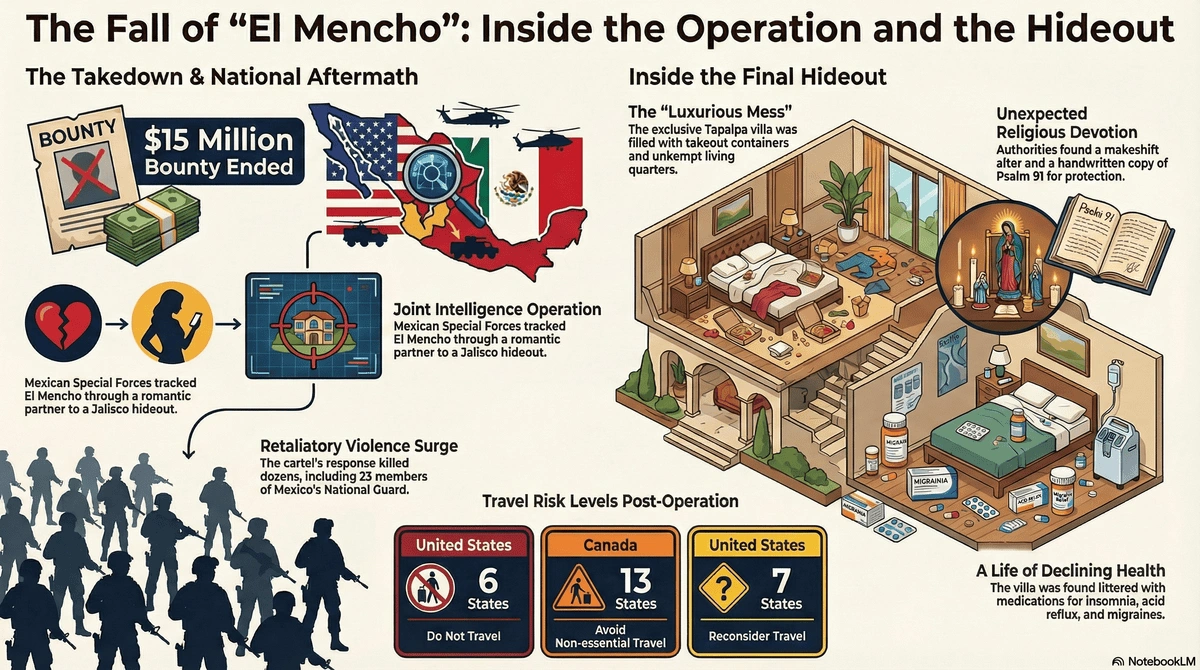
How did the military operation unfold? The raid was the culmination of intensified bilateral cooperation between United States and Mexico authorities. Security forces tracked one of Nemesio Oseguera Cervantes‘s romantic partners to a secluded villa in a Tapalpa mountainside community. Upon being ambushed by Mexican special forces, the cartel leader was wounded while attempting to flee and died while being transported to Mexico City.
Who was Nemesio Oseguera Cervantes? Commonly known as “El Mencho,” he was the head of the powerful Jalisco New Generation Cartel, and carried a $15 million U.S. bounty on his head. For nearly two decades, he maintained a remarkably low profile while directing a highly organized criminal network known for extreme violence and extensive narcotics trafficking infrastructure.
What was found at his final hideout? Authorities discovered a luxurious but chaotic environment littered with takeout containers and medications for conditions like insomnia, migraines, and cellular health. The home also revealed deep religious devotion, featuring makeshift altars dedicated to Catholic figures like the Virgin of Guadalupe and Saint Jude Thaddeus, alongside a handwritten copy of Psalm 91.
How has the cartel reacted to his death? The operation immediately sparked intense retaliatory violence across numerous Mexican states, resulting in the deaths of dozens of individuals, including 25 members of Mexico‘s National Guard. The cartel has effectively declared war against the government of President Claudia Sheinbaum, prompting roadblocks and heightened security alerts.
Q&A: Unpacking The Cartel Leadership Decapitation
Q: How did intelligence agencies ultimately locate such an elusive criminal figure?
A: Authorities successfully bypassed his primary security protocols by monitoring his personal relationships.
- Digital Tracking: Intelligence operatives identified a man close to one of his girlfriends and tracked her movements to a getaway in Tapalpa.
- Bilateral Cooperation: Mexico‘s Defense Ministry utilized complementary intelligence provided by United States authorities through a counter-cartel task force.
- Asset Vulnerability: The cartel leader’s reliance on his romantic partners created logistical footprints that investigators exploited to pinpoint the gated community hideout.
Q: Why was religious iconography so prominent in the cartel leader’s hideout?
A: Religious artifacts provide a psychological framework for individuals involved in high-risk criminal enterprises.
- Popular Religiousness: Experts like Fabián Acosta Rico explain this as a transactional faith where individuals seek divine protection from immediate physical danger rather than spiritual salvation.
- Criminal Patronage: Figures like Saint Jude Thaddeus have a recognized following among marginalized groups and criminals in Mexico, who invoke them for survival in violent lifestyles.
- Cartel Culture Precedents: This synchronization of violence and faith mirrors past cartel figures, such as Édgar Valdez Villarreal, who was also deeply devoted to Catholic imagery.
Q: How will this high-profile death impact the organizational structure of the cartel?
A: The removal of the founding leader introduces significant operational instability and retaliatory posturing within the cartel’s hierarchy.
- Succession Dynamics: At this time, the exact identity of the cartel’s next leader remains unverified by official sources.
- Foreign Network Monitoring: Homeland Security officials are actively surveilling the cartel’s United States-based trafficking corridors for signs of coercion, violence, or debt-collection activities as factions reorganize.
- Regional Retaliation: The immediate wave of violence, including roadblocks and armed confrontations, signifies a fragmented but heavily armed network lashing out against state forces.
Q: How does the resulting violence affect international tourists planning to visit Mexico?
A: While localized violence has surged, travel safety largely depends on the specific destination and traveler preparedness.
- Geographic Isolation: Major tourist hubs like Cancun and Tulum are situated over 1,200 miles away from the epicenter of the violence in Jalisco.
- Government Advisories: Both the United States State Department and Global Affairs Canada have lifted brief shelter-in-place orders but maintain specific advisories warning against travel to certain high-risk states.
- Risk Mitigation: Security experts advise tourists to remain within major resort zones, travel in pairs, and register with their respective government embassy programs before arriving.
Q: Why did authorities return the body to the family amid such a volatile security situation?
A: The transfer of remains followed standard legal and forensic verification protocols despite the ongoing conflict.
- Forensic Confirmation: Mexico‘s attorney general’s office conducted rigorous genetic testing to definitively match the remains before authorizing the release.
- Legal Compliance: The state fulfilled its obligation to return the remains to relatives who formally requested them.
- Operational Secrecy: At this time, the exact location of the handover and the specific identities of the relatives who received the body remains unverified by official sources.
Editorial Notes & Transparency
Verification Log:
- News Agency Reports: Verified timelines and official statements from CBS News, Reuters, and the Associated Press regarding the military operation and subsequent fallout.
- Government Advisories: Cross-referenced travel and security warnings issued by the U.S. State Department and Global Affairs Canada.
- Expert Commentary: Integrated analysis from religious studies researchers and international travel security experts to provide contextual depth.
Compliance:
- Privacy: This article respects user data under our Privacy Policy.
- Transparency: No sponsored content influenced this reporting.
Contact Us: For corrections or feedback, please email: news.desk@qnanews.com