Washington, D.C./Tehran — U.S. President Donald Trump has demanded the unconditional surrender of Iran as joint U.S. and Israeli military operations enter their seventh day. The conflict, which began on February 28, 2026, has seen extensive airstrikes against Iranian infrastructure and retaliatory missile launches across the region. As the conflict widens, reports indicate intelligence sharing between Russia and Iran, while Israel expands its bombardment into Lebanon.
Below is a detailed examination of the ongoing U.S.-Israeli military campaign and regional fallout.
Context & Background
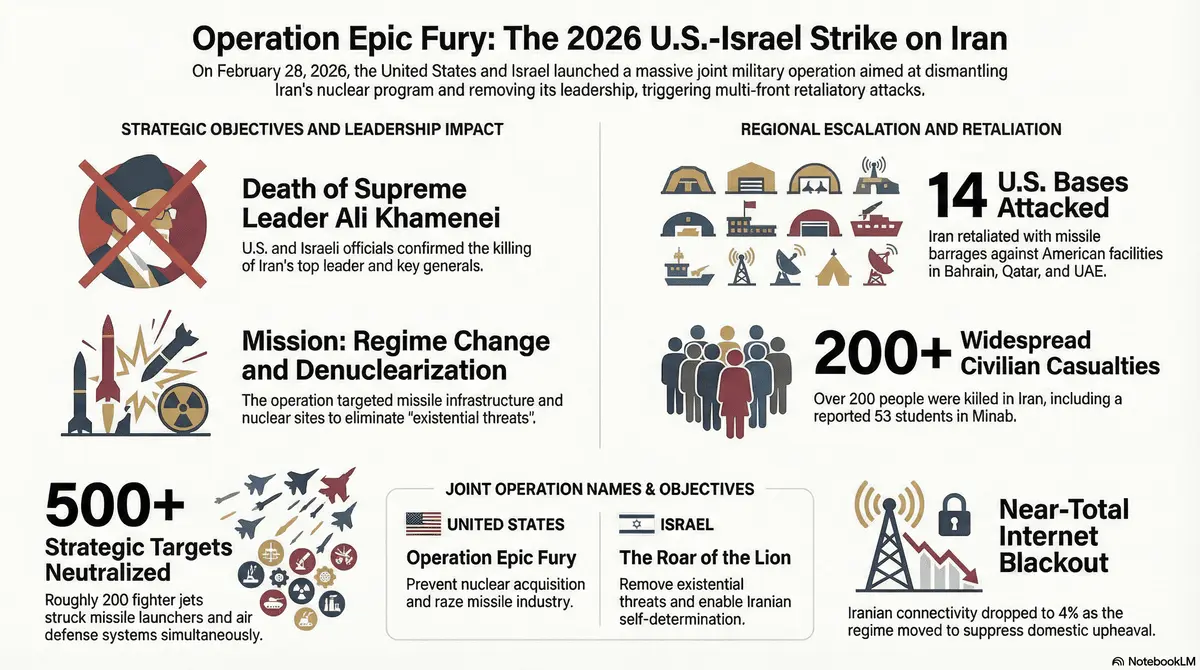
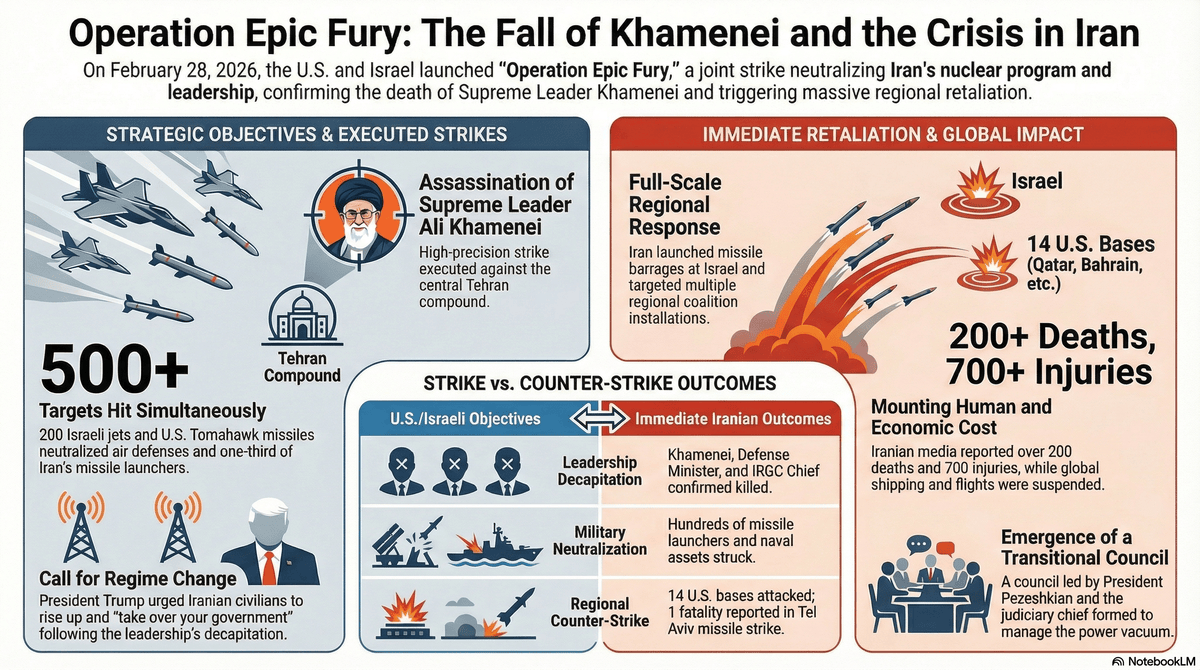
The Catalyst and Leadership Decapitation The joint U.S. and Israeli military operation commenced with strikes that killed Iranian Supreme Leader Ayatollah Ali Khamenei and numerous top-tier officials. This initial strike incapacitated a significant portion of the Islamic Revolutionary Guard Corps (IRGC) leadership and plunged the Iranian government into a succession crisis.
Regional Retaliation and Gulf Vulnerability In response to the bombardment, Iran launched waves of drones and ballistic missiles targeting U.S. installations and allied nations across the Persian Gulf. Countries such as Kuwait, Qatar, the United Arab Emirates, and Bahrain have intercepted numerous projectiles, though some attacks have resulted in civilian casualties and damage to infrastructure.
Expanding Fronts in Lebanon Concurrently, the Israel Defense Forces (IDF) have initiated a massive bombing campaign in Beirut and southern Lebanon, targeting the Iranian proxy group Hezbollah. This has triggered a humanitarian crisis, displacing more than 300,000 Lebanese civilians as evacuation orders are issued across heavily populated areas.
Russian Involvement and Geopolitical Shifts Intelligence sources report that Russia is providing tactical information to Iran to assist in targeting U.S. positions in the Middle East. This development marks the direct involvement of a major nuclear-armed adversary, complicating the geopolitical landscape and potentially straining U.S. military resources.
Q&A: Unpacking The US-Iran Conflict
Q: How is the United States defining its endgame for the conflict?
A: The U.S. strategy currently centers on the total capitulation of the Iranian government and the installation of favorable leadership.
- Leadership Change: President Donald Trump insists the U.S. must have a role in selecting Iran’s next leader, explicitly rejecting figures like Mojtaba Khamenei.
- Strategic Demands: The administration demands “unconditional surrender,” which officials define as the point when Iran ceases to pose a threat to the U.S. and its allies.
- Economic Objectives: Donald Trump has drawn comparisons to Venezuela, suggesting a post-war scenario where the U.S. and a new Iranian regime cooperate on oil production.
Q: Why are U.S. military officials considering the deployment of ground forces?
A: While primarily an air campaign, strategic considerations regarding nuclear security and regime stability have prompted internal discussions about a limited ground presence.
- Nuclear Securitization: A primary concern is securing Iran’s enriched uranium stockpiles, particularly at facilities like Isfahan, which would require a complex ground operation to extract or neutralize.
- Special Operations: Military experts suggest small contingents could be inserted to target deeply buried assets that cannot be destroyed by aerial bombardment alone.
- Regime Transition: Ground troops could potentially be utilized to facilitate the transition to a new U.S.-backed government in the event of a total regime collapse.
Q: How has the joint U.S.-Israeli air campaign impacted Iran’s military infrastructure?
A: The bombardment has severely degraded Iran’s defensive and offensive capabilities across multiple domains.
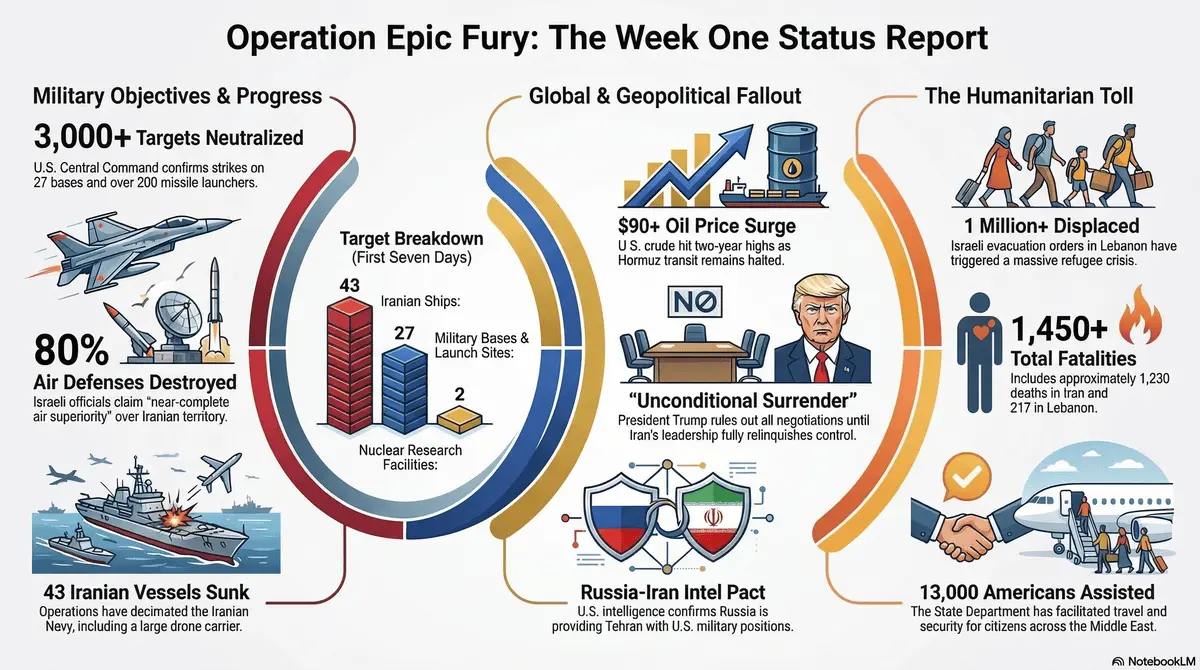
- Naval Destruction: U.S. Central Command reports that 43 Iranian naval vessels, including a massive drone carrier, have been heavily damaged or destroyed.
- Air Defense Neutralization: Israeli officials claim to have achieved near-complete air superiority, estimating that over 80% of Iran’s air defense systems have been eradicated.
- Command Infrastructure: Deeply buried command centers, including a multi-street underground bunker in Tehran intended for the Supreme Leader, have been dismantled by precision strikes.
Q: Why has the conflict triggered a significant humanitarian and diplomatic crisis?
A: The scale of the bombardments and the geographic spread of the retaliatory strikes have caused mass civilian displacement and international alarm.
- Civilian Casualties: Over 1,200 people have been killed in Iran, and investigations are ongoing regarding a suspected U.S. strike on an Iranian girls’ school that resulted in high civilian casualties. At this time, U.S. culpability for the school strike remains unverified by official sources.
- Mass Displacement: In Lebanon, aggressive Israeli evacuation orders and airstrikes have forced over 300,000 residents to flee their homes, prompting warnings of a looming humanitarian disaster from the United Nations.
- Evacuation Operations: The U.S. State Department has organized charter flights to evacuate nearly 24,000 American citizens stranded across the Middle East amidst widespread airspace closures.
Q: How are global markets and defense industries reacting to the prolonged hostilities?
A: The war has caused immediate disruptions in energy markets and spurred a rapid expansion in defense manufacturing.
- Oil Price Surge: Benchmark crude oil prices have surged past $90 per barrel due to disruptions in the Strait of Hormuz and fears that Gulf exporters may shut down production.
- Munitions Production: Following meetings at the White House, major U.S. defense contractors have agreed to quadruple the production of high-tier “exquisite class” weaponry to replenish stockpiles.
- Regional Destabilization: Persistent drone and missile attacks on commercial hubs like Dubai and Riyadh threaten the broader economic stability of the Persian Gulf region.
Editorial Note & Transparency
Verification Log:
- International News Agencies: Consolidated field reports from major global news networks documenting the geopolitical fallout.
- Government Press Releases: Official statements from the White House, the U.S. Department of Defense, and the Israel Defense Forces regarding military objectives and operational progress.
- Regional Observers: Think tank analyses and international monitoring groups detailing the economic and humanitarian impacts in the Middle East.
Compliance:
- Privacy: This article respects user data under our Privacy Policy.
- Transparency: No sponsored content influenced this reporting.
Contact Us: For corrections or feedback, please email: news.desk@qnanews.com