Washington/Tehran — Reports indicate that military and intelligence planners in the United States and Israel are allegedly exploring strategies to destabilize Iran from within by exploiting historical ethnic tensions and supporting regional separatist groups. As the regional conflict escalated following intense strikes on March 4, 2026, discussions surrounding internal fragmentation as an alternative to a full-scale ground invasion have gained prominent attention. This evolving strategy aims to leverage minority grievances to overwhelm the central government, though international analysts warn it carries profound risks of sparking uncontrollable regional warfare.
Below is a detailed examination of the ethnic dynamics, strategic calculations, and potential regional impacts of this approach.
Context & Background
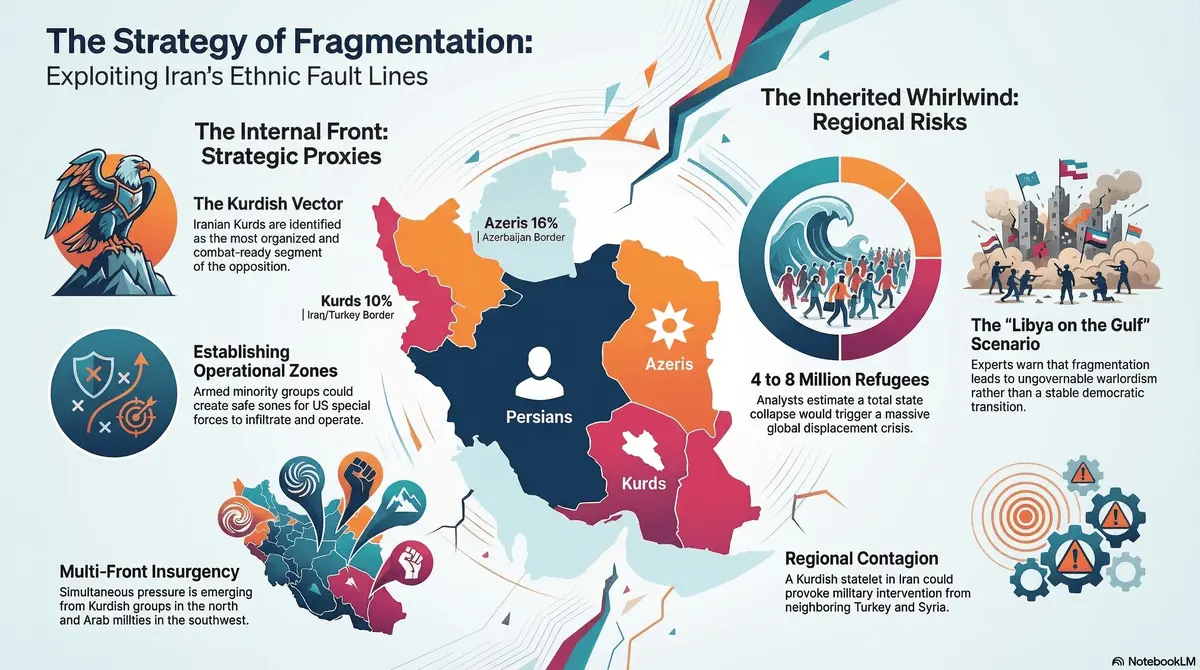
The Ethnic Demographics of Iran Iran is a deeply diverse nation of roughly 90 million people, where ethnic Persians constitute approximately 50 to 60 percent of the population. The remaining demographic landscape includes significant minority groups such as Azeris (16 percent), Kurds (9 to 10 percent), as well as Lurs, Baloch, Arabs, and Turkmens. These groups experience drastically different levels of integration within the state, fundamentally altering how they interact with the central government and the Islamic Revolutionary Guard Corps (IRGC).
Historical Significance of State Centralization Modern state consolidation in Iran began under the rule of Reza Shah Pahlavi in 1925, but it was the 1979 Islamic Revolution that cemented a highly centralized theocratic and security state. The government rapidly constructed a massive security apparatus centered around the IRGC, which was tasked with defending the ideological legacy of the revolution. Over the decades, this security infrastructure has primarily suppressed, rather than resolved, the deeply rooted ethnic separatist tensions across the country.
The Key Players in Kurdish Opposition Kurdish fighters, concentrated near the border of northern Iraq, are widely considered the most organized segment of the broader Iranian opposition movement. Organizations like the Kurdistan Democratic Party of Iran (KDPI) maintain thousands of combatants and have recently issued statements hinting at imminent action against the state. Analysts note these groups are attractive to foreign intelligence services because they offer a structured, armed resistance capable of forcing the state to redirect military resources internally.
Why This Strategy Carries Severe Risks Historians and foreign policy analysts draw uncomfortable parallels between this strategy and the 1990s disintegration of Yugoslavia, warning that the collapse of a heavily centralized state can trigger prolonged fragmentation and massive human tragedy. Fanning the flames of ethnic insurgencies threatens to displace up to eight million people rapidly and could easily spill across borders, dragging neighboring nations into a widespread conflagration.
Q&A: Unpacking Internal Destabilization Strategies
Q: WHY might military planners in the United States and Israel view ethnic insurgencies as a viable alternative to conventional warfare?
A: Planners may view internal insurgencies as a mechanism to degrade the regime’s authority and infrastructure without the need to deploy their own ground troops.
- Proxy Utilization: Employing organized minority factions provides “boots on the ground” to directly challenge the IRGC, forcing the government into a multi-front domestic war.
- Cascading Unrest: Strategists calculate that a successful armed offensive by minority groups could overwhelm security forces, creating a cascading effect that encourages broader civilian populations to return to street protests.
- Safe Zone Creation: Similar to the strategy used in Afghanistan in 2001, Kurdish fighters could potentially carve out autonomous zones where foreign special forces could operate safely.
Q: HOW do the unique political and social dynamics of different minority groups complicate any unified strategy of destabilization?
A: The varying degrees of societal integration and differing political objectives among minorities make a cohesive national uprising highly improbable.
- Kurdish Political Aspirations: Kurdish organizations primarily seek regional self-determination or a federalist structure, maintaining a relatively organized political and military apparatus.
- Baloch Radicalization: The Baloch insurgency in southeastern Iran is dominated by radical Sunni organizations deeply embedded in transnational smuggling economies spanning into Pakistan, presenting a vastly different dynamic than the Kurdish struggle.
- Azeri Integration: Despite being the largest minority, Azeris are highly integrated into the state apparatus—demonstrated by the heritage of leaders like Ayatollah Ali Khamenei and President Masoud Pezeshkian—making them difficult to mobilize against the government.
Q: WHY would the weaponization of Iranian ethnic fault lines pose severe security threats to neighboring nations?
A: Because ethnic groups in the region are transnational, igniting conflicts within Iran would inevitably draw neighboring states into the violence.
- Turkish Security Threats: Arming Kurdish rebels inherently threatens Turkey and Syria, both of which view armed Kurdish autonomy movements as existential threats to their own territorial sovereignty.
- Af-Pak Frontier Volatility: Elevating the Baloch insurgency would severely destabilize the volatile border regions of Pakistan and Afghanistan, potentially triggering wider regional chaos.
- Caucasus Instability: Encouraging hostility or unrest among the Azeri population risks spilling over into the Caucasus, destabilizing Azerbaijan.
Q: HOW do prominent figures within the broader Iranian opposition view the potential armament of ethnic separatist groups?
A: Leading opposition figures strongly oppose ethnic separatism, viewing it as a direct threat to the nation’s historical territorial integrity.
- Nationalist Pushback: Opposition figures like Reza Pahlavi have explicitly condemned coalitions of Kurdish groups seeking self-determination, declaring that the territorial integrity of Iran is the “ultimate red line”.
- Federalist Justifications: Some minority representatives, such as Arash Saleh, argue that their goal is a federalized state to ensure inclusion, but this does little to assuage fears of national balkanization.
- Internal Fracturing: Relying heavily on minority militias risks putting foreign governments on a collision course with Persian nationalist opposition groups, thereby fracturing the broader anti-regime movement.
Q: WHY is the concept of a “New Middle East” frequently referenced by critics of this fragmentation strategy?
A: The concept represents a highly controversial geopolitical doctrine that theorizes regional security can be achieved by erasing existing borders and breaking rivals into smaller ethnic statelets.
- Strategic Lineage: This vision of pulverizing rivals into fragments has historically been a core component of hardline Israeli strategies, particularly associated with figures like Benjamin Netanyahu.
- Warlordism Realities: Critics assert that this doctrine ignores historical precedents, arguing that state collapse inevitably leads to decentralized warlordism and the proliferation of loose weapons, rather than compliant micro-states.
- Mass Displacement: Implementing this theory could trigger an unprecedented refugee crisis, potentially displacing millions of civilians and devastating the economic stability of surrounding Gulf states.
Q: HOW are foreign intelligence agencies reportedly interacting with these ethnic insurgent groups?
A: Media reports claim intelligence agencies are actively arming and coordinating with rebel factions, though these claims face strong official pushback.
- Alleged Armament Programs: Several reports suggest that the CIA is actively working to arm Iranian Kurdish forces in an attempt to foment a coordinated uprising against the state.
- Official Denials: The White House has publicly characterized stories of arming the rebels as “completely false,” although they have confirmed that diplomatic discussions with Kurdish leaders have taken place.
- Verification Status: At this time, the direct armament of separatist groups by foreign intelligence agencies remains unverified by official sources.
Editorial Note & Transparency
Verification Log:
- Media Report: Detailed demographic breakdowns and historical context sourced from regional analyses and international press reporting.
- Geopolitical Analysis: Strategic assessments regarding the risks of state fragmentation sourced from defense and foreign policy researchers.
- Official Statement: Responses from government spokespeople regarding alleged intelligence operations with minority groups.
Compliance:
- Privacy: This article respects user data under our Privacy Policy.
- Transparency: No sponsored content influenced this reporting.
Contact Us: For corrections or feedback, please email: news.desk@qnanews.com