Tel Aviv — Israel faces a complex and deadly challenge as Iran utilizes cluster munitions during coordinated missile strikes across central and northern regions. The strikes represent a significant escalation on March 10, 2026, marking the eleventh day of the ongoing conflict involving the United States, Israel, and Iran. Unexploded submunitions have proven lethal to civilians, prompting urgent warnings from military authorities regarding the lingering threat.
Below is a detailed examination of the escalating missile threats and coordinated military strategies.
Context & Background
What triggered this recent escalation? The conflict, which includes the United States and Israel launching a joint military campaign, prompted retaliatory strikes from Iran. Iran and its proxy forces have subsequently synchronized their attacks, heavily targeting the northern and central regions of Israel, including Tel Aviv and Jerusalem. These coordinated strike strategies mark a severe intensification of regional hostilities and have stretched defensive capabilities.
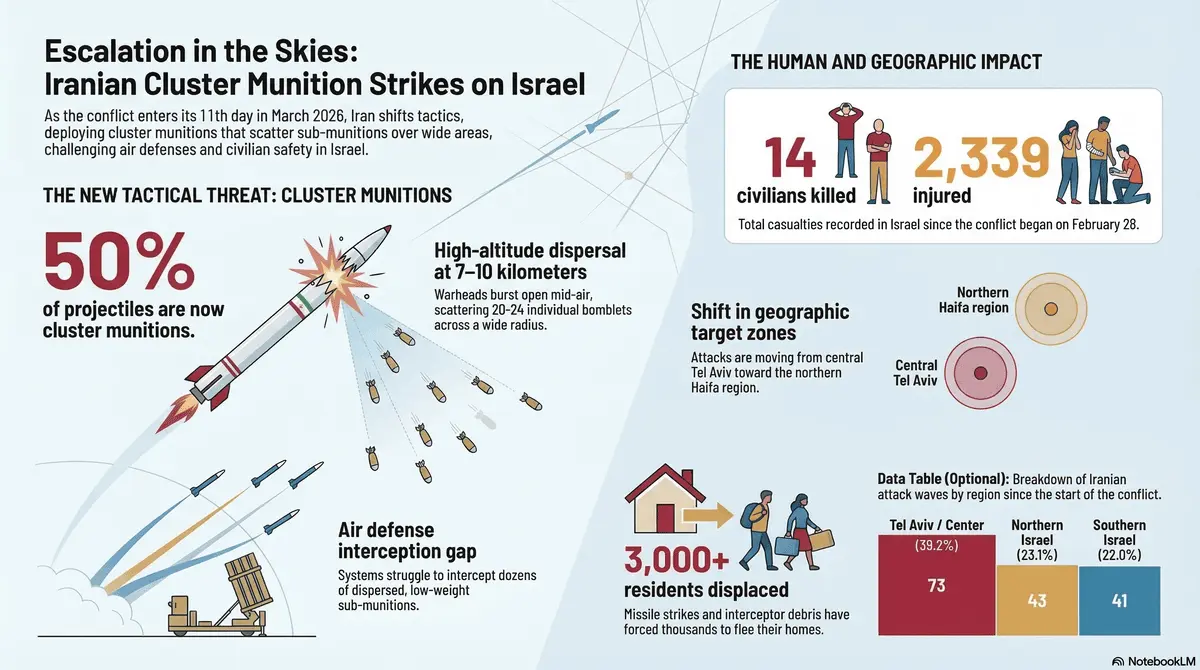
The role of cluster munitions Military officials report that roughly half of the projectiles launched by Iran toward Israel are cluster munitions. These weapons disperse dozens of smaller explosive bomblets over wide areas, maximizing the threat to unprotected civilian targets. This creates a deadly challenge for Israel‘s air defense systems, as intercepting the parent missile is nearly impossible once the submunitions have scattered.
Impact on civilian populations The continuous missile barrages have resulted in significant casualties, with 14 civilians killed and over 2,339 injured in Israel since the start of the conflict. The use of submunitions leaves unexploded ordnance scattered across populated areas, acting essentially as land mines. These unexploded devices continue to threaten civilians returning from shelters long after the initial air raids have ended.
Q&A: Unpacking The Iranian Missile Strategy
Q: WHY are cluster munitions particularly difficult for Israeli air defenses to intercept?
A: Once the parent munition disperses its payload, traditional defense systems cannot effectively target the numerous small bomblets.
- High-Altitude Release: The missiles release submunitions at an altitude of 4 to 6 miles, spreading them across large distances.
- System Limitations: The Arrow system is effective against intact ballistic missiles, but neither it nor the Iron Dome is designed to intercept dozens of small, scattered explosives.
- Wide Dispersion: According to N.R. Jenzen-Jones, the design of these weapons scatters the bomblets so widely that they act indiscriminately over a massive area.
Q: HOW are regional proxy forces coordinating their military operations with Iran?
A: Allied militia groups have integrated their tactical strikes with Iran, synchronizing drone and rocket launches to overwhelm Israel‘s defenses.
- Simultaneous Launches: Researcher Kobi Michael notes that rockets originating from Lebanon are frequently fired at the exact same time as ballistic missiles from Iran.
- Guerrilla Tactics: Militant fighters in Lebanon are returning to small-unit guerrilla warfare and rationing anti-tank rockets to prepare for potential ground invasions.
- Strategic Positioning: Elite fighters have moved back toward Khiyam near the border of Lebanon and Israel to anticipate ground maneuvers.
Q: WHY are the unexploded bomblets from these strikes considered a lingering hazard?
A: A high failure rate in detonation leaves active explosives scattered on the ground that can trigger easily when disturbed.
- Dud Rate Danger: Submunitions fail to explode on initial impact more frequently than standard warheads, turning them into volatile hazards similar to land mines.
- Civilian Vulnerability: Because these munitions target densely populated areas like Tel Aviv, civilians returning from shelters are at high risk of stepping on or handling them.
- Official Warnings: The military and local police in Israel have had to issue urgent flyers and public service announcements warning residents not to touch unexploded ordnance.
Q: HOW has the international community historically viewed the use of cluster munitions?
A: These weapons are broadly condemned and restricted due to their indiscriminate nature and long-term danger to non-combatants.
- International Convention: Over 120 nations have signed the Convention on Cluster Munitions, which bans their use, though Israel, the United States, and Iran are not signatories.
- Humanitarian Law: Organizations such as Amnesty International have cited the deliberate use of such indiscriminate weapons as a blatant violation of international humanitarian law.
- Historical Precedent: These weapons have been utilized in numerous global conflicts, including by Israel in Lebanon in 2006, leaving hazardous remnants that required extensive demining.
Q: HOW are political leaders responding to the trajectory of the ongoing war?
A: Leadership rhetoric indicates a prolonged military engagement despite some allied predictions of an imminent conclusion.
- Domestic Determination: Prime Minister Benjamin Netanyahu warned that the military offensive against Iran is not yet finished.
- Allied Stance: President Donald Trump has insisted that the conflict will be over soon, highlighting a potential discrepancy in allied timelines.
- Command Decisions: At this time, whether the new leader of Iran, Mojtaba Khamenei, directly commanded the deployment of cluster munitions remains unverified by official sources.
Editorial Note & Transparency
Verification Log:
- Military Analysis Reports: Data from the Alma Research and Education Center tracking attack waves, casualties, and regional targets.
- International News Wires: Associated Press reporting on the technical specifications and civilian impact of cluster munitions.
- Security Expert Interviews: Fox News interviews with national security experts detailing the coordinated strike strategies between Iran and its allies.
Compliance:
- Privacy: This article respects user data under our Privacy Policy.
- Transparency: No sponsored content influenced this reporting.
Contact Us: For corrections or feedback, please email: news.desk@qnanews.com