Washington/Tehran — Donald Trump has urged international allies to deploy warships to secure the Strait of Hormuz amid severe disruptions to global oil shipping. Tensions peaked on March 13, 2026, when United States forces struck military targets on Iran’s Kharg Island, a critical oil export hub. In retaliation, Iran has threatened to block all energy exports from the region and ordered evacuations near major ports in the United Arab Emirates.
Below is a detailed examination of the economic, military, and geopolitical impacts of the blocked shipping lanes and escalating regional strikes.
Context & Background
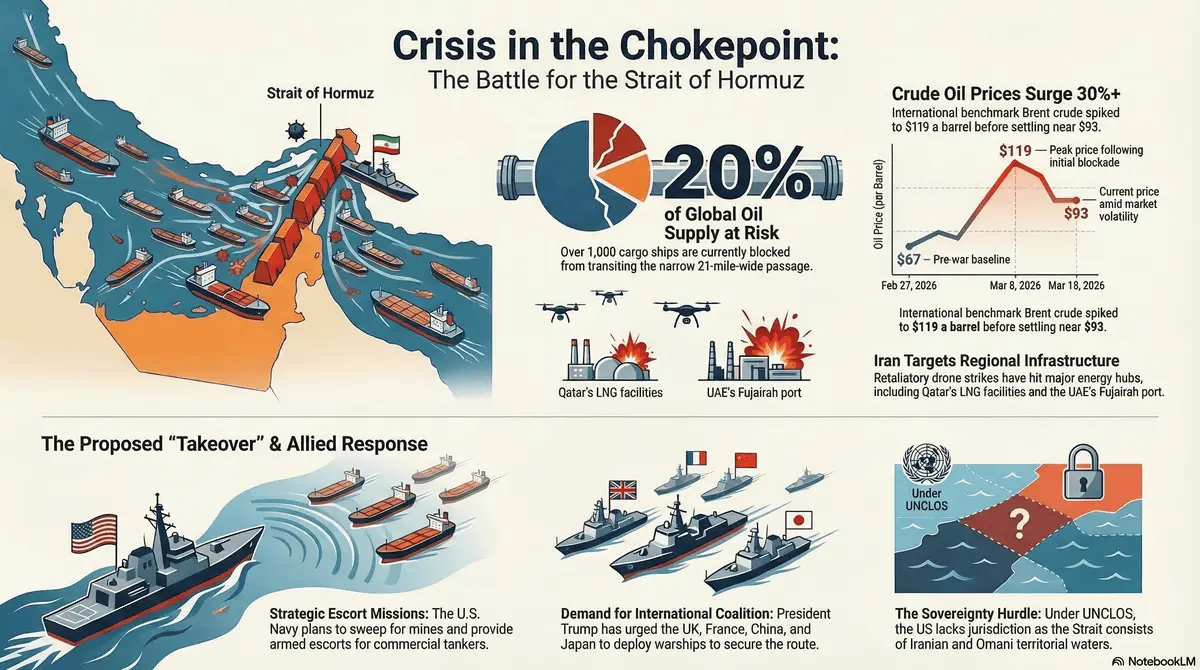
How did this start? The crisis originated when Iran effectively closed the Strait of Hormuz—a critical chokepoint handling one-fifth of global oil supplies—in retaliation to a broader United States and Israel military campaign that began on February 28, 2026. Ebrahim Jabari, a senior adviser in the Islamic Revolutionary Guard Corps, declared the strait closed and threatened to set non-compliant ships ablaze, drastically impacting global energy markets.
The historical significance of Kharg Island Kharg Island, located in the Persian Gulf, processes approximately 90% of Iran’s crude oil exports, making it the crown jewel of the nation’s energy infrastructure. On March 13, 2026, the United States Central Command conducted massive precision strikes on over 90 military targets on the island, representing a major escalation in international military operations.
Regional retaliation and wider targets As the conflict intensifies, Iran has expanded its targeting to include infrastructure and perceived United States assets in neighboring Gulf Cooperation Council states, such as the United Arab Emirates, Kuwait, and Bahrain. The Islamic Revolutionary Guard Corps warned residents to evacuate near three major ports in the United Arab Emirates, including Jebel Ali in Dubai, claiming these locations house American military hideouts and threatening further regional instability.
Why this matters for the global economy The blockade and subsequent strikes have sent shockwaves through the global economy, causing oil prices to surge, with international benchmark Brent crude temporarily topping $119 a barrel. Amin Nasser, the CEO of Saudi Aramco, warned of catastrophic consequences for global markets if the disruption continues, as thousands of cargo ships and oil tankers face severe supply chain disruptions while blocked from transiting the vital waterway.
Q&A: Unpacking the Strait of Hormuz Crisis
Q: Why is the United States struggling to independently secure the Strait of Hormuz?
A: The logistical complexity and sheer volume of threats from asymmetric Iranian naval capabilities make unilateral escort missions exceedingly difficult for the United States.
- Asymmetric Tactics: Iran utilizes small, fast boats that can swarm larger targets and has laid advanced sea mines in the narrow shipping lanes.
- Geographic Constraints: The strait’s transit lanes are in some places only three to four miles from the coastline of Iran, leaving ships with under two minutes to react to drone or missile strikes.
- Capacity Limitations: Energy Secretary Chris Wright acknowledged that the United States Navy is not yet ready for immediate escort operations, as military assets are currently focused on striking Iranian targets.
Q: How has the international community responded to calls for a naval coalition?
A: Global powers are cautiously considering options, but a robust international naval coalition has not yet fully materialized in the Middle East.
- Diplomatic Appeals: Donald Trump directly urged China, France, Japan, South Korea, and the United Kingdom to send warships to protect their economic interests.
- European Preparations: Emmanuel Macron, the President of France, indicated that European allies are preparing a purely defensive escort mission for when the conflict’s most intense phase concludes.
- British Considerations: The United Kingdom is reportedly exploring the deployment of minehunting drones from the Middle East to help unblock the shipping route.
Q: How is the conflict impacting domestic infrastructure within the Gulf states?
A: The retaliatory strategy deployed by Iran has directly damaged energy and transportation hubs across neighboring Arab nations.
- Facility Fires: A major fire forced the partial suspension of operations at a critical oil storage hub in Fujairah, United Arab Emirates, following an intercepted drone strike.
- Aviation Disruptions: A drone strike successfully targeted the radar system at Kuwait International Airport in Kuwait, which had already suspended all commercial flights.
- Production Halts: QatarEnergy in Qatar paused its liquefied natural gas production after strikes on operational facilities, while Saudi Arabia shut down its Ras Tanura refinery after a drone interception.
Q: Why are oil markets reacting with such extreme volatility?
A: Markets are pricing in the immediate loss of a major global transit route alongside the threat of broader infrastructure destruction.
- Supply Chokepoint: The Strait of Hormuz processes roughly 20% of the world’s oil supply and a quarter of global liquefied natural gas.
- Insurance Spikes: Cargo operators face soaring insurance premiums due to the physical dangers posed to crews and vessels from missiles and sea mines.
- Failed Interventions: Historic releases of government oil reserves by the International Energy Agency have thus far failed to stabilize the surging crude prices.
Q: How does the internal leadership dynamic in Iran influence the conflict’s trajectory?
A: The transition of power has injected profound uncertainty into the strategic calculations of Iran.
- New Leadership: Ayatollah Mojtaba Khamenei has recently assumed the role of supreme leader and vowed to continue blocking the strait to avenge national martyrs.
- Unverified Status: At this time, the exact physical condition and whereabouts of Mojtaba Khamenei remains unverified by official sources, following conflicting claims regarding his health from Donald Trump and international diplomats.
- Diplomatic Rejection: Senior Iranian officials, including Kamal Kharazi, have completely ruled out diplomacy, citing past grievances and broken promises by Donald Trump.
Editorial Note & Transparency
Verification Log:
- News Agency Report: The Associated Press detailing naval operations and minelayer destruction in the Persian Gulf.
- Live Blog Coverage: The Guardian and ABC News providing real-time updates on Kharg Island strikes and diplomatic responses.
- Broadcast Transcript: Fox 10 and CNBC covering official statements from the US Defense Department regarding the Strait of Hormuz.
Compliance:
- Privacy: This article respects user data under our Privacy Policy.
- Transparency: No sponsored content influenced this reporting.
Contact Us: For corrections or feedback, please email: news.desk@qnanews.com