Washington/Tehran — The United States military continues its intensive bombardment campaign against Iranian targets as diplomatic and economic tensions escalate globally. Operations saw a massive surge in intensity on Friday, March 13, 2026, with strikes obliterating military installations. While Iranian officials signal a willingness to negotiate an end to the conflict, President Donald Trump has refused to accept current ceasefire terms, demanding total capitulation and the cessation of disruptions in the Strait of Hormuz.
Below is a detailed breakdown of the ongoing military operations, leadership changes, and global economic impacts.
Context & Background
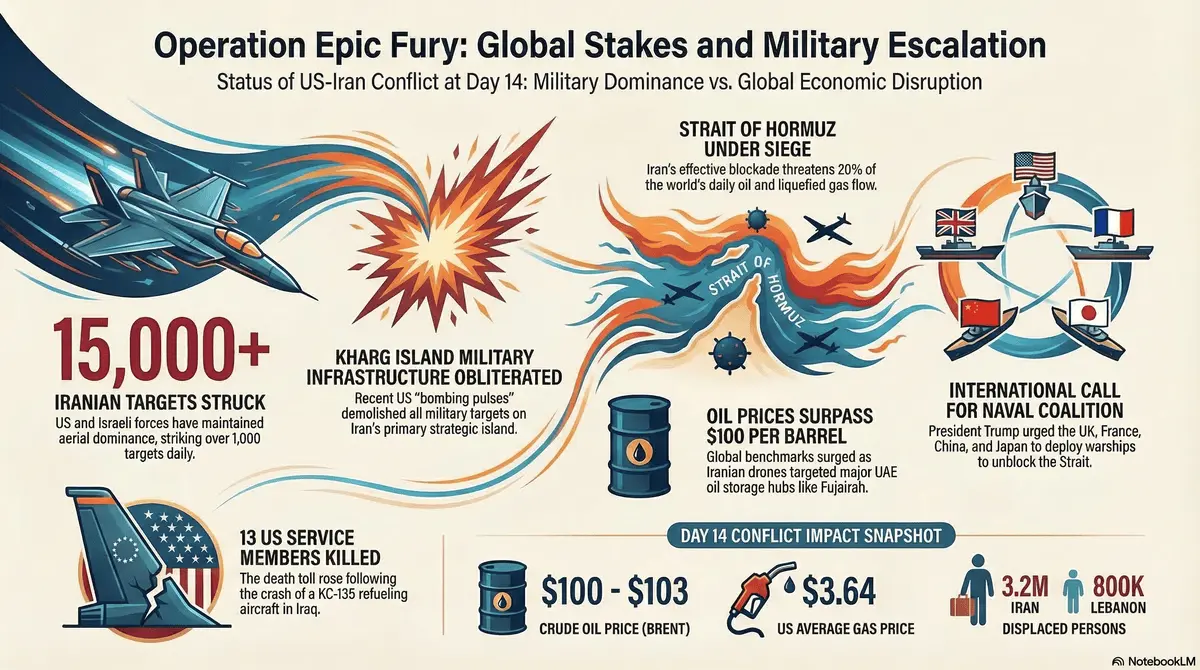
How did the current escalation unfold? The United States military campaign, dubbed Operation Epic Fury, has resulted in over 15,000 strikes on Iranian military assets over the past two weeks. President Donald Trump stated the United States has decimated the Iranian military, taking out the vast majority of its drones and missiles while temporarily sparing energy infrastructure. Despite claims of victory, US forces recently hit the strategically vital Kharg Island, with Donald Trump threatening to target its oil facilities next if Iran interferes with international shipping.
Who is leading Iran following initial strikes? Following the death of his father Ali Khamenei in the opening salvos of the war, Mojtaba Khamenei has been named the new supreme leader of Iran. However, Mojtaba Khamenei has not been seen publicly, leading US Secretary of War Pete Hegseth to claim the leader is wounded, likely disfigured, and relying entirely on written statements. Donald Trump has publicly questioned if the new leader is still alive, calling his exact status a rumor.
What is happening in the Strait of Hormuz? The Strait of Hormuz is a critical global shipping choke point that Iran has functionally blocked through drone and missile attacks on commercial vessels. Donald Trump is currently pressing for a team effort from international allies, including the United Kingdom, China, France, and Japan, to deploy warships to secure the waterway. The blockade has severely constrained international energy flows, sending global benchmark oil prices above $100 a barrel.
Why is the United States easing Russian sanctions? To combat the soaring energy costs linked to the Middle East conflict, the United States Treasury Department announced measures to temporarily ease sanctions on Russian oil. Donald Trump defended the move as a necessity to ensure global oil availability, though it has drawn criticism from international allies, including Ukrainian President Volodymyr Zelenskyy.
Q&A: Unpacking the US-Iran Conflict
Q: Why has the United States refused Iran’s ceasefire offers?
A: President Donald Trump stated that while Iran is ready to make a deal, the current terms are insufficient to guarantee long-term regional security.
- Nuclear Abandonment: Any acceptable deal must include an ironclad commitment from Iran to permanently abandon its nuclear ambitions.
- Strait Reopening: The administration requires absolute assurance that the Strait of Hormuz will remain open and safe for global shipping without Iranian interference.
- Military Degradation: The United States aims to continue striking until the Iranian military and proxy networks are rendered entirely combat-ineffective.
Q: How is the United States responding to disruptions in the Strait of Hormuz?
A: The United States is attempting to build a multinational naval coalition while threatening direct military retaliation against Iranian oil assets.
- Coalition Building: Donald Trump has publicly urged the United Kingdom, Japan, South Korea, and others to deploy warships to jointly protect international tankers.
- Targeting Deterrence: While US strikes on Kharg Island focused on military targets, Donald Trump warned that oil infrastructure will be wiped out if Iranian blockades continue.
- Naval Attrition: US Central Command reports destroying over 30 Iranian minelaying vessels to degrade their capacity to physically block the strait.
Q: How has the conflict impacted the global oil market and economy?
A: The effective closure of critical shipping lanes has sparked a severe energy supply crunch, driving up global fuel costs and triggering inflationary fears.
- Price Spikes: Brent crude oil prices breached $100 per barrel, leading to increased gasoline prices for consumers in the United States and worldwide.
- Sanctions Adjustments: The United States Treasury Department took unprecedented steps to temporarily authorize the delivery of some sanctioned Russian crude oil to offset the market deficit.
- Economic Jitters: Stock markets initially sank over fears of a prolonged conflict, with analysts warning that sustained energy disruptions increase the likelihood of an economic recession.
Q: How has the US military sustained its operational tempo?
A: The Pentagon has leveraged aerial dominance and over 50,000 deployed personnel to conduct the highest volume of strikes in recent history.
- Aerial Dominance: US and Israeli air forces are operating with virtual impunity, striking over 1,000 targets daily due to the degradation of Iranian air defenses.
- Logistical Casualties: The massive operational scope has incurred costs, including the deaths of six US crew members in a KC-135 refueling aircraft crash in western Iraq on March 12, 2026.
- Troop Deployments: To bolster regional presence, the United States is deploying an additional 2,500 Marines and the USS Tripoli to the Middle East.
Q: Why is there uncertainty surrounding Iran’s leadership?
A: The lack of public appearances by Mojtaba Khamenei has fueled speculation regarding the stability and continuity of the Iranian regime following the initial US strikes.
- Missing from Public View: Since being named supreme leader, Mojtaba Khamenei has only released a written statement, prompting widespread rumors regarding his physical condition. At this time, his exact health status remains unverified by official sources.
- US Intelligence Claims: US Secretary of War Pete Hegseth asserted that the new leader is cowering underground, wounded, and disfigured.
- Domestic Control: Despite leadership uncertainty, the Iranian Revolutionary Guard remains deeply entrenched and has threatened to expand the war to other fronts across the region.
Editorial Note & Transparency
Verification Log:
- News Media: Multiple articles from The Guardian, NBC News, Fox News, and USA Today confirming US strikes, casualties, and global economic conditions.
- Official Statements: Quotations from Donald Trump, Pete Hegseth, and US Central Command regarding military operations and ceasefire terms.
- Economic Data: Price tracking metrics confirming the rise in global oil and domestic gasoline prices.
Compliance:
- Privacy: This article respects user data under our Privacy Policy.
- Transparency: No sponsored content influenced this reporting.
Contact Us: For corrections or feedback, please email: news.desk@qnanews.com