Washington/New York — The United States is experiencing an elevated threat of domestic terrorism following a series of unconnected attacks across multiple states, which is compounding concerns over depleted staffing within federal counterterrorism agencies. These violent incidents, which include a deadly shooting at a university and an assault on a synagogue, have escalated notably since March 1, 2026, against the backdrop of the intensifying war with Iran. Former officials warn that the combination of international conflict and the loss of experienced personnel presents a severe national security challenge.
Below is a detailed breakdown of the ongoing domestic terror threats and federal agency limitations.
Context & Background
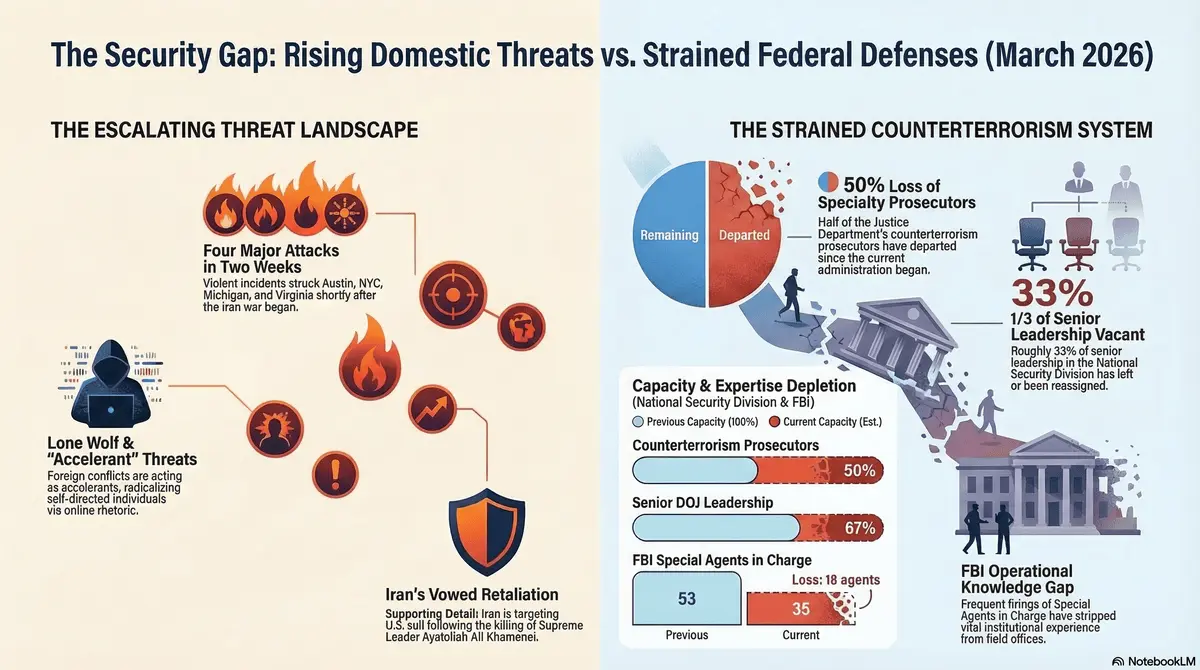
How did the recent wave of attacks start? The recent surge in violence involves a series of unconnected lone-actor incidents that authorities are investigating as potential acts of terrorism. The sequence gained national attention following a mass shooting at an Austin, Texas bar on March 1, 2026, executed by an attacker displaying anti-Western and pro-Iranian sentiments. Since then, subsequent attacks in Michigan, Virginia, and New York City have heightened public alarm.
The impact of the Iran war The ongoing military conflict between the United States and Iran is acting as a major accelerant for radicalization. According to former homeland security advisor Claire Moravec, international conflicts can increase the intensity of grievances for disaffected individuals, prompting self-directed lone wolves to act. Iran has a well-documented history of plotting targeted killings and inspiring violence on American soil, further elevating the threat matrix.
Staffing crises at the FBI and DOJ As the terror threat grows, the Federal Bureau of Investigation and the Department of Justice are struggling with a significant loss of experienced counterterrorism prosecutors and agents. Under FBI Director Kash Patel, dozens of agents have been fired, while the DOJ’s National Security Division has lost approximately half of its counterterrorism prosecuting staff since the start of the Donald Trump administration.
Why the public advisory system is dark Despite the spike in violence, the Department of Homeland Security has not updated the National Terrorism Advisory System to issue new public warnings. The agency cited a lapse in federal funding for its inability to maintain the alert website, though counterterrorism experts like Javed Ali question if political considerations regarding the unpopular war are also suppressing public advisories.
Q&A: Unpacking the Domestic Terrorism Surge
Q: How are the recent attacks connected to international conflicts?
A: While generally self-directed, the perpetrators appear heavily influenced by overseas military actions and geopolitical grievances.
- Motivator Accelerants: Wars, such as the ongoing conflict in Iran, act as catalysts that intensify existing ideological grievances for radicalized individuals.
- Personal Triggers: In the West Bloomfield, Michigan synagogue attack, the suspect, Ayman Mohamad Ghazali, was reportedly motivated by the deaths of four family members in an Israeli airstrike in Lebanon.
- Ideological Alignment: The Texas bar shooter, Ndiaga Diagne, explicitly wore clothing endorsing Iran and reading “Property of Allah,” indicating a clear alignment with foreign ideologies.
Q: Why are lone wolf attackers so difficult for federal agencies to stop?
A: Lone actors operate without direct communication with established sleeper cells or foreign governments, making their actions highly unpredictable.
- Zero Communication: Former DHS advisor Charles Marino notes that true lone wolves keep external communications to an absolute minimum, avoiding surveillance tripwires.
- Online Radicalization: These individuals are often radicalized by viewing inflammatory rhetoric on the internet and television rather than attending organized training camps.
- Self-Directed Execution: Because they do not rely on a network for logistics, federal authorities cannot easily predict when or where a lone actor will decide to strike.
Q: How have recent personnel changes at federal agencies impacted national security?
A: Mass firings and resignations have stripped the FBI and DOJ of the institutional knowledge required to effectively track and prevent terrorist threats.
- Experience Drain: Retired senior FBI official Frank Montoya stated that the most experienced personnel best positioned to prevent attacks are no longer with the government.
- Leadership Losses: The DOJ has seen the departure of approximately one-third of its senior leadership within the counterterrorism division.
- Plummeting Morale: Agents reportedly face internal scrutiny, such as polygraph tests to find media leakers, which has prompted experienced leaders to resign in frustration.
Q: Why has the Old Dominion University shooting sparked specific counterterrorism concerns?
A: The shooter in Norfolk, Virginia was a known entity who had previously been incarcerated for attempting to provide material support to the Islamic State.
- Prior Convictions: The gunman, Mohamed Bailor Jalloh, pleaded guilty to terrorism charges in 2016 and had only been released from prison in 2024.
- Missed Warning Signs: The fact that a known terrorism convict could acquire a weapon and access a university campus highlights potential intelligence and surveillance gaps.
- Student Intervention: The threat was only neutralized because students in the classroom physically subdued and killed the shooter.
Q: How is the Department of Homeland Security addressing the public regarding these threats?
A: The agency has largely failed to issue formal public warnings, citing funding lapses while simultaneously undergoing disruptive leadership transitions.
- System Failure: The National Terrorism Advisory System website has not been updated, with a posted note blaming a lack of federal funding.
- Leadership Turmoil: DHS is currently facing massive upheaval following the dismissal of Secretary Kristi Noem and the pending confirmation of Markwayne Mullin.
- Unverified Plots: At this time, reports that Iran is plotting specific drone strikes in California remain unverified by official sources.
Editorial Note & Transparency
Verification Log:
- News Reports: Sourced from established networks detailing the timeline of attacks in Michigan, Virginia, Texas, and New York City.
- Expert Analysis: Perspectives from former homeland security and FBI officials analyzing lone wolf behaviors and staffing impacts.
- Official Statements: Reviews of public communications from the FBI, DOJ, and local law enforcement regarding the suspects and threat levels.
Compliance:
- Privacy: This article respects user data under our Privacy Policy.
- Transparency: No sponsored content influenced this reporting.
Contact Us: For corrections or feedback, please email: news.desk@qnanews.com