Los Angeles/New York — Netflix has unexpectedly withdrawn from the bidding war to acquire Warner Bros. Discovery, clearing the path for a massive $111 billion takeover by Paramount Skydance. Following regulatory meetings at the White House, Netflix co-CEOs Ted Sarandos and Greg Peters announced their decision to exit the deal on February 26, 2026, stating the revised transaction was no longer financially attractive. This sudden reversal has triggered immense corporate restructuring anxieties and shifted the future of the global entertainment landscape.
Below is a detailed examination of the merger’s regulatory hurdles, political implications, and industry fallout.
Context & Background
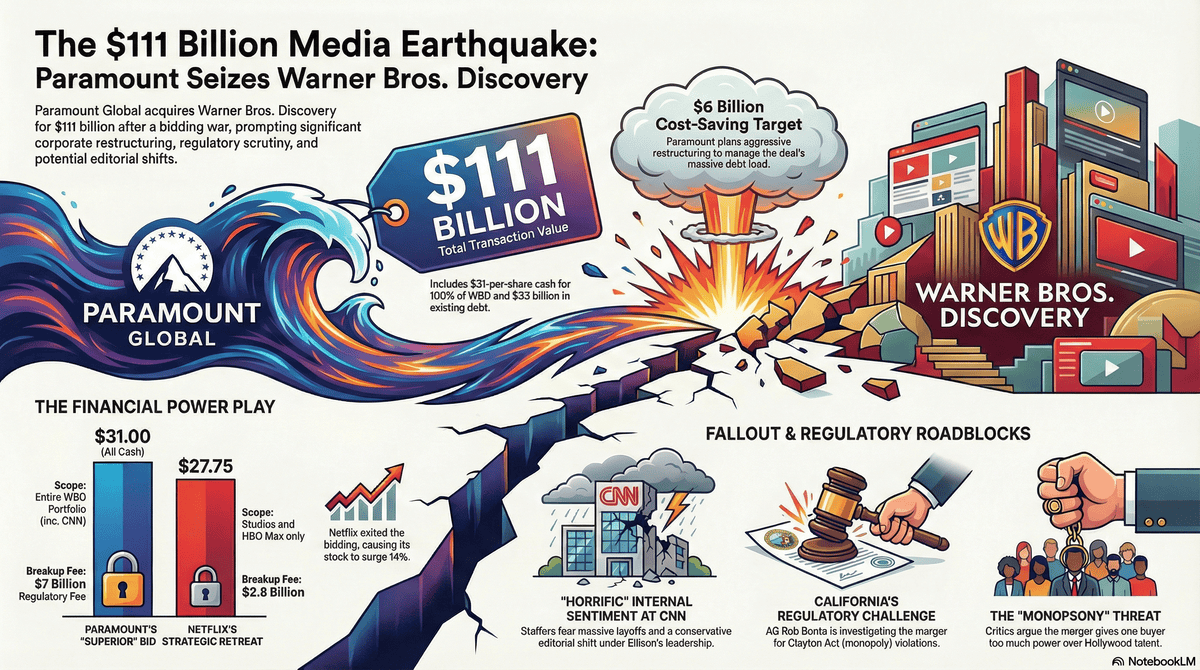
How did this bidding war unfold? Following an initial $83 billion merger agreement between Netflix and Warner Bros. Discovery on December 5, Paramount Skydance escalated the competition with a sweetened $31-per-share all-cash offer. Warner Bros. Discovery CEO David Zaslav and the board indicated the new bid could constitute a superior proposal, prompting Netflix to walk away rather than overpay for the assets.
Who are the key players in the prospective Paramount merger? The acquisition effort is being spearheaded by Paramount Skydance chief David Ellison, backed by his billionaire father Larry Ellison and a consortium of financing. They are navigating regulatory channels with the strategic help of Makan Delrahim, while facing fierce potential legal opposition from California Attorney General Rob Bonta.
Why does this media consolidation matter? A combination of Paramount Skydance and Warner Bros. Discovery would drastically consolidate the entertainment industry, shrinking the field of major studios from five to four. Furthermore, it would place massive news operations like CNN and CBS News under the exact same corporate umbrella, raising significant concerns among journalists regarding narrative control, ideological shifts, and labor monopsonies.
What are the political dimensions of the deal? Critics note that David Ellison maintains a close relationship with President Donald Trump, who has historically disparaged CNN. Media watchdogs and Democratic leaders like Senator Elizabeth Warren have warned that the consolidation could result in a Donald Trump-aligned ownership structure exerting partisan political influence over independent journalism.
Q&A: Unpacking the Warner Bros. Discovery Acquisition
Q: How did financial discipline factor into the decision by Netflix to withdraw?
A: Netflix leadership determined that exceeding the $31-per-share price point would damage the company’s financial standing and negatively impact their accretion math.
- Shareholder Response: Netflix stock had fallen over 18% since the initial deal announcement but surged by more than 10% after the withdrawal was made public.
- Strategic Valuation: Co-CEOs Ted Sarandos and Greg Peters stated the acquisition was always a “nice to have” rather than a “must have” at any price.
- Debt Avoidance: By bowing out, Netflix completely avoids the burden of assuming the roughly $33 billion in debt currently held on the books of Warner Bros. Discovery.
Q: Why are regulators heavily scrutinizing the Paramount Skydance and Warner Bros. Discovery merger?
A: The massive $111 billion transaction presents severe antitrust and labor concerns regarding market monopolization across multiple entertainment sectors.
- Horizontal Consolidation: The merger would unite direct competitors in cable television, sports, and news, which potentially violates aspects of the Clayton Act aimed at preventing monopolies.
- Labor Monopsony: Hollywood writers and talent have raised alarms that fewer studios will drive down wages, eliminate creative leverage, and decrease project competition.
- State Intervention: California Attorney General Rob Bonta has explicitly stated the merger is not a done deal and initiated a vigorous state-level review to potentially seek a court order blocking the closure.
Q: How will the acquisition potentially impact the operations and editorial direction of CNN?
A: The network is bracing for severe ideological shifts and staff reductions under the new leadership of David Ellison.
- Staff Panic: Inside CNN headquarters in New York, employees are reportedly experiencing “off the charts” panic regarding job security and structural changes.
- Editorial Precedent: Staff point to CBS News, where Paramount Skydance installed Bari Weiss, resulting in a perceived rightward shift and attempts to appeal to conservative viewers.
- Presidential Pressure: President Donald Trump has frequently targeted CNN, leading to profound fears that the new ownership might reshape the network to align with his political interests and establish a partisan media environment.
Q: How is Paramount Skydance financing and structuring this massive acquisition?
A: The $111 billion deal relies on a combination of expanded equity commitments, aggressive ticking fees, and assumption of existing corporate debt.
- Per-Share Valuation: Paramount Skydance raised its all-cash offer to $31 per share to explicitly outbid the $27.75 per share agreement previously held by Netflix.
- Penalty Fees: Paramount Skydance committed to paying the $2.8 billion breakup fee owed to Netflix, alongside a $7 billion regulatory termination fee if the deal fails.
- Funding Sources: The consortium expanded financing commitments, leveraging $45.7 billion in equity that reportedly includes backing from foreign sovereign wealth funds. At this time, the exact identities of these foreign sovereign wealth funds remain unverified by official sources.
Q: Why might international regulatory bodies take a different approach than United States enforcers?
A: European regulators historically prioritize local market competition rather than broad global consolidation concerns when reviewing entertainment mergers.
- Precedent Cases: Transactions like Amazon’s purchase of MGM and Disney’s acquisition of 21st Century Fox were approved in Europe with only minor regional conditions.
- Geographic Scope: European authorities typically focus on requiring companies to sell off specific cable television assets where regional monopolies might form, allowing the overarching corporate merger to proceed.
- Deal Timing: Paramount Skydance aims to close the deal swiftly upon receiving these relatively smoother foreign approvals, which puts immense pressure on domestic challengers to act quickly.
Editorial Notes & Transparency
Verification Log:
- Financial Reporting: Analysis of stock performance, per-share valuations, and termination fee structures sourced from established financial media tracking the Netflix and Paramount Skydance bids.
- Legal Documentation: Examination of state and federal antitrust strategies, including public statements from the California Department of Justice and Clayton Act frameworks.
- Industry Publications: Internal memos, town hall accounts, and employee sentiment reports detailing the internal reactions at Warner Bros. Discovery and CNN.
Compliance:
- Privacy: This article respects user data under our Privacy Policy.
- Transparency: No sponsored content influenced this reporting.
Contact Us: For corrections or feedback, please email: news.desk@qnanews.com