Category: Geopolitics

  • Why US Intelligence Fears China’s ‘Secret’ Nuclear Tests, Explained

    Why US Intelligence Fears China’s ‘Secret’ Nuclear Tests, Explained

    Washington/Beijing — The United States has formally accused China of conducting a covert “yield-producing” nuclear test in 2020, violating the voluntary global moratorium on nuclear testing. The alleged incident took place on June 22, 2020, at China’s Lop Nur nuclear test site in the northwestern Xinjiang region.

    Below is a detailed examination of the evidence, competing claims, and the geopolitical implications of this explosive accusation.

    Context & Background

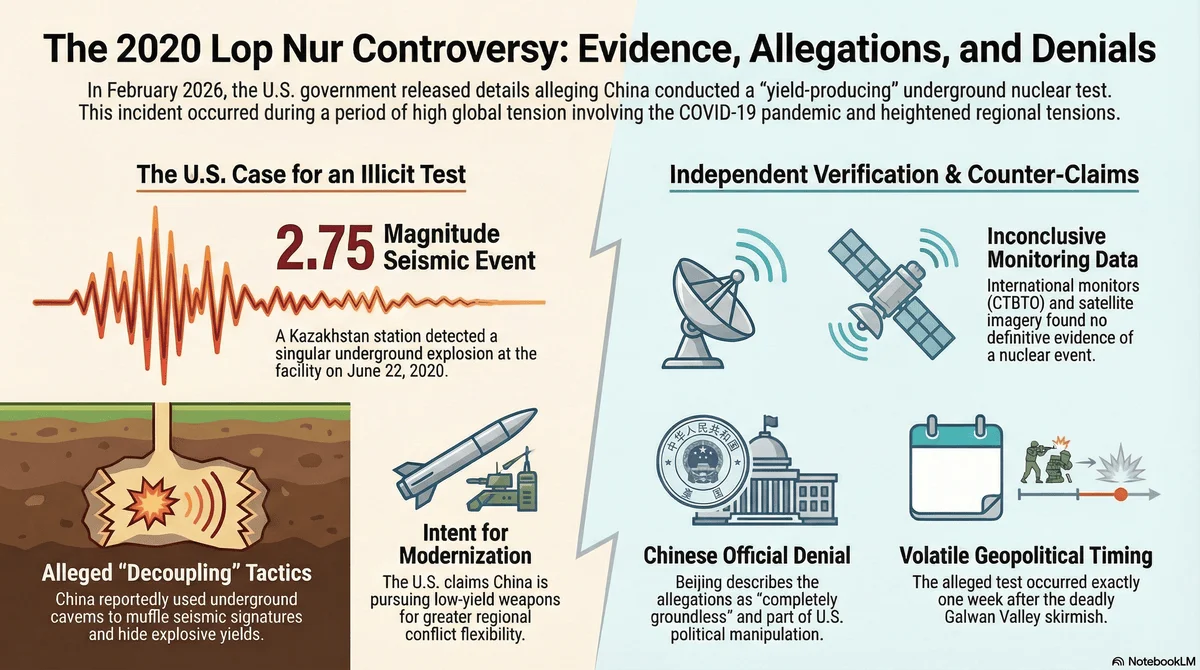
    The Accusation – US Assistant Secretary Christopher Yeaw claims seismic data indicates a “singular explosion” consistent with a nuclear test. The core evidence is a seismic signal detected by a remote station in Kazakhstan, recording a magnitude 2.75 event originating from Lop Nur. Yeaw states this is “consistent with what you would expect from a nuclear explosive test” and unlikely to be an earthquake.

    The Denial – Chinese Foreign Ministry spokesperson Lin Jian has categorically rejected the allegations as “completely groundless” and “political manipulation,” maintaining that China has adhered to its testing moratorium.

    Regional Concerns – Indian Member of Parliament Manish Tewari raised concerns linking the test’s timing to the Galwan Valley clash (just one week prior) and the COVID-19 pandemic, questioning whether a nation dealing with a pandemic would prioritize “alleged nuclear activities” over containment.

    The Stakes – This accusation threatens to trigger a new global arms race. U.S. officials have signaled they may resume American nuclear testing “on an equal basis” in response, potentially ending decades of nuclear restraint.

    Q&A: Unpacking the Evidence and Implications

    Q: The U.S. claims to have evidence of a test. What specifically does the data show, and is it conclusive?

    A: The evidence is contested and remains unverified by independent international bodies.

    • U.S. Evidence: A seismic signal detected by a Kazakhstan station showing a magnitude 2.75 event from Lop Nur, described as “consistent with what you would expect from a nuclear explosive test.”
    • CTBTO Position: The Comprehensive Nuclear-Test-Ban Treaty Organization confirmed their sensors detected “two very small seismic events, 12 seconds apart” but stated the data was insufficient to confidently attribute it to a nuclear explosion.
    • Independent Analysis: Seismologist Ben Dando of NORSAR noted that while wave ratios were consistent with an explosion, the signal was weak and recorded at only one station, making definitive confirmation impossible.
    • Data Discrepancy: The U.S. describes a “singular explosion” while the CTBTO reports “two very small seismic events” 12 seconds apart. The USGS recorded a magnitude 4.1 earthquake that day, but its epicenter was 200 kilometers away from the test site.

    Q: If China did test a weapon, how did they attempt to hide it from the world?

    A: U.S. officials allege China utilized a technique known as “decoupling.”

    • The Technique: Detonating a nuclear device suspended inside a massive underground cavern—often a salt dome—rather than embedding it tightly in rock.
    • How It Works: The cavern acts as a muffler, allowing the explosive force to reverberate within the hollow space, significantly reducing the seismic shockwaves that travel through the earth.
    • Strategic Purpose: This would theoretically allow a country to test low-yield weapons without triggering the global monitoring stations designed to detect larger blasts.

    Q: Beyond the technical “how,” why would China risk breaking the moratorium now?

    A: Analysts point to China’s rapid nuclear modernization program and strategic needs.

    • Arsenal Expansion: The Pentagon estimates China’s arsenal has grown to over 500 warheads, with a goal of 1,000 by 2030.
    • Miniaturization: China may be seeking to miniaturize warheads to fit multiple weapons on a single missile (MIRV technology).
    • Low-Yield Development: There is speculation that China seeks “tactical” or low-yield nuclear weapons for flexible options in regional conflicts.
    • Data Scarcity: Unlike the U.S., which conducted over 1,000 tests before the 1992 moratorium, China conducted only 45. They have significantly less historical data to rely on for computer simulations.

    Q: How does this alleged event resonate in the specific context of India and regional security?

    A: The timing has raised significant alarms in India.

    • Timing Correlation: Member of Parliament Manish Tewari highlighted that June 22, 2020, fell just one week after the deadly Galwan Valley clash between Indian and Chinese troops.
    • Strategic Posture: Tewari questioned whether a nation where COVID-19 originated would prioritize “alleged nuclear activities” over pandemic containment, suggesting a disturbing strategic posture during a global crisis.
    • Signal of Dominance: This link suggests that if the test occurred, it might have been intended as a subtle signal of dominance during a period of heightened border tension.

    Q: What are the geopolitical consequences if the U.S. acts on these allegations?

    A: The primary consequence is the potential collapse of the global testing moratorium.

    • U.S. Response: President Donald Trump has stated the U.S. would consider testing “on an equal basis” with China and Russia.
    • Official Position: U.S. officials have indicated they are prepared to resume low-yield testing if necessary to correct an “intolerable disadvantage.”
    • Global Impact: This could end decades of nuclear restraint and encourage other nuclear-armed nations to resume live explosive testing, triggering a new global arms race.

    Editorial Note & Transparency

    Verification Log:

    • Official Government Statements: U.S. State Department (Christopher Yeaw, Thomas DiNanno); Chinese Foreign Ministry (Lin Jian).
    • International Monitoring Data: Comprehensive Nuclear-Test-Ban Treaty Organization (CTBTO).
    • Satellite & Expert Analysis: Center for Strategic and International Studies (CSIS); NORSAR (Ben Dando); Carnegie Endowment for International Peace (Tong Zhao).
    • Legislative Commentary: Statements from Indian Parliament Member Manish Tewari.

    Compliance:

    • Privacy: This article respects user data under our Privacy Policy.
    • Transparency: No sponsored content influenced this reporting.

    Contact Us: For corrections or feedback, please email: newsdesk@qnanews.com

  • Crisis to “Ceasefire”: US and India Strike $500 Billion Trade Deal, Ending 50% Tariff Standoff

    Crisis to “Ceasefire”: US and India Strike $500 Billion Trade Deal, Ending 50% Tariff Standoff

    Washington/New Delhi — A six-month diplomatic and trade crisis between the United States and India has concluded with a sweeping new framework agreement. Following months of tension that saw US tariffs on Indian goods spike to 50%, the two nations have agreed to a “ceasefire” deal. The agreement slashes tariffs to 18% and involves a commitment from New Delhi to purchase $500 billion in US goods, alongside a contested pledge regarding Russian oil imports.

    Below is a detailed breakdown of the deal, the controversies surrounding it, and what it means for the global economy.

    Context & Background

    How did the crisis start? The crisis began in August 2025, when the Trump administration imposed a “reciprocal” tariff of 25% on Indian goods, followed immediately by an additional 25% penalty cited as a response to India’s continued purchase of Russian oil. This brought total duties to 50%, effectively pricing many Indian goods out of the US market.

    The Diplomatic Fallout Tensions escalated beyond trade. Reports emerged in late 2025 that India had paused major defense procurements from the US, including orders for Predator drones, though officials denied a formal freeze. The standoff was exacerbated by personal friction; President Trump had claimed credit for mediating a ceasefire between India and Pakistan—a claim New Delhi vehemently rejected.

    Historical Significance This agreement marks a shift from “strategic altruism” to transactional diplomacy. While the US previously tolerated India’s independent foreign policy (including ties with Russia) to bolster it as a counterweight to China, the new administration has prioritized trade balance and compliance with US sanctions.

    Q&A: Unpacking the Deal

    Q: What are the key terms of the new US-India trade framework?

    A: The “Interim Agreement,” announced on February 6, 2026, fundamentally resets trade terms between the two nations.

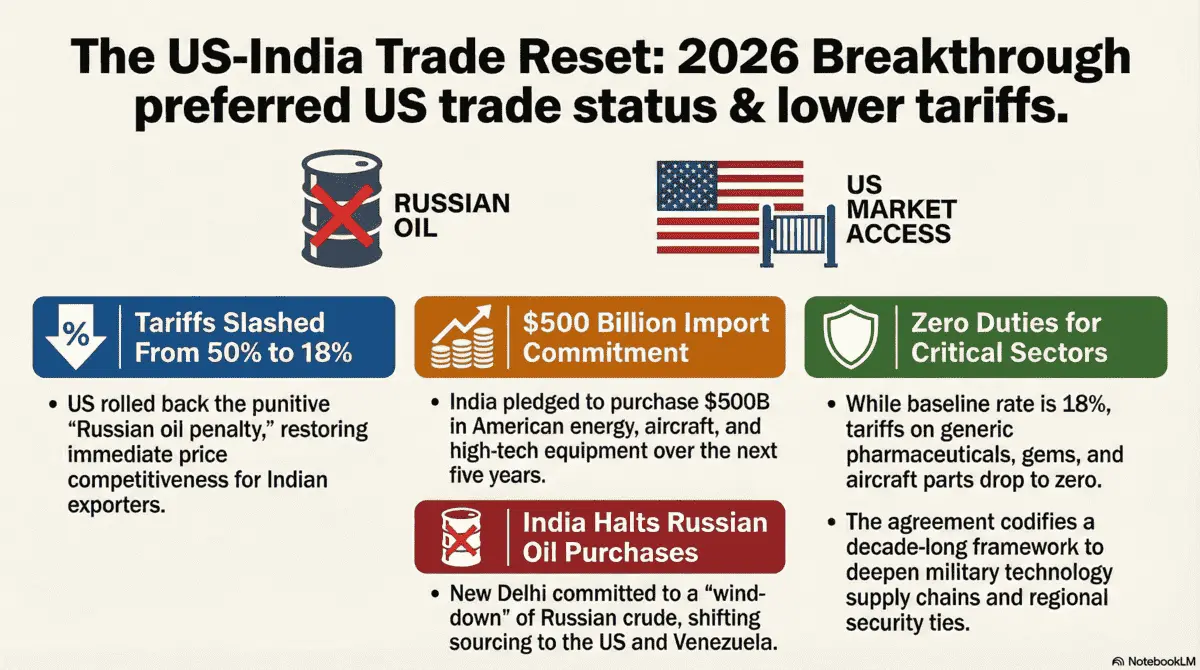
    • Tariff Reduction: The US has agreed to roll back the punitive tariffs imposed in August 2025. Duties on Indian exports—which had reached 50% due to a combination of reciprocal tariffs and penalties—will be reduced to a flat reciprocal rate of 18%.
    • Purchase Commitments: India has expressed an intention to purchase $500 billion worth of US products over the next five years. This basket includes energy products (oil and LNG), aircraft, defense equipment, and technology such as Graphics Processing Units (GPUs) for data centers.
    • Sectoral Relief: The US will remove tariffs on specific Indian goods, including generic pharmaceuticals, gems, and aircraft parts, subject to final negotiations.

    Q: Is India actually stopping Russian oil imports?

    A: This remains the most contentious and ambiguous part of the deal.

    • The US Position: President Donald Trump’s Executive Order explicitly states that India has “committed to stop directly or indirectly importing Russian Federation oil”. The order includes a strict monitoring mechanism, warning that if India resumes buying Russian crude, the punitive 25% tariff could be reimposed.
    • India’s Position: The official Joint Statement issued by both nations does not mention Russian oil. While the Ministry of External Affairs (MEA) has not directly contradicted Trump’s claim, they have reiterated that India’s energy policy is guided solely by “energy security” and “objective market conditions”.
    • The Reality: Industry sources suggest a “wind-down period” is necessary. Indian refiners have already booked Russian cargoes through March and April 2026. A complete halt faces logistical hurdles, particularly for refiners like Nayara Energy, which is 49% owned by Russia’s Rosneft and relies heavily on Russian crude.

    Q: Why is the $500 billion purchase target significant?

    A: The figure is ambitious, aiming to more than double current trade volumes.

    • Government Confidence: Indian Commerce Minister Piyush Goyal called the $500 billion target “very conservative,” projecting that India’s demand for goods will reach $2 trillion in the coming years. He highlighted that the aviation sector alone could account for over $100 billion in orders.
    • Skepticism: Critics argue the target is unrealistic given that India’s total imports from the US were only around $42 billion in 2024-25. Some analysts view this as a coerced target that forces India to substitute cheaper imports with more expensive US goods to balance the trade deficit.

    Q: Which sectors are the biggest winners?

    A: The reduction of tariffs from 50% to 18% is a major relief for several Indian industries:

    • Chemicals & Polymers: These sectors were hit hard by the trade war. Analysts expect immediate margin expansion and a shift in US sourcing from China to India.
    • Steel & Aluminum: Indian steel exports, previously hampered by Section 232 tariffs, are expected to regain competitiveness.
    • Energy: US energy producers stand to gain massively as India pivots supply chains away from Russia toward US crude and potentially Venezuelan oil.

    Editorial Note & Transparency

    Correction/Update: This article focuses on the “US-India Trade and Diplomatic Crisis” resolution.

    Privacy & Ethics: All quotes and figures are derived from public statements, official executive orders, and credible news reports (Times of India, Reuters, The Wire, White House Press Office). No private data was accessed.

    Contact Us: For corrections or feedback, please email: [news.desk@qnanews.com]

    Keywords: US-India Trade Deal 2026, Trump Tariffs India, Russian Oil Ban, Piyush Goyal, 50% Tariff Rollback, India US Relations, Executive Order 14257.