Category: World

  • US and Israel Launch Operation Epic Fury Against Iran Amid Escalating Regional Conflict

    US and Israel Launch Operation Epic Fury Against Iran Amid Escalating Regional Conflict

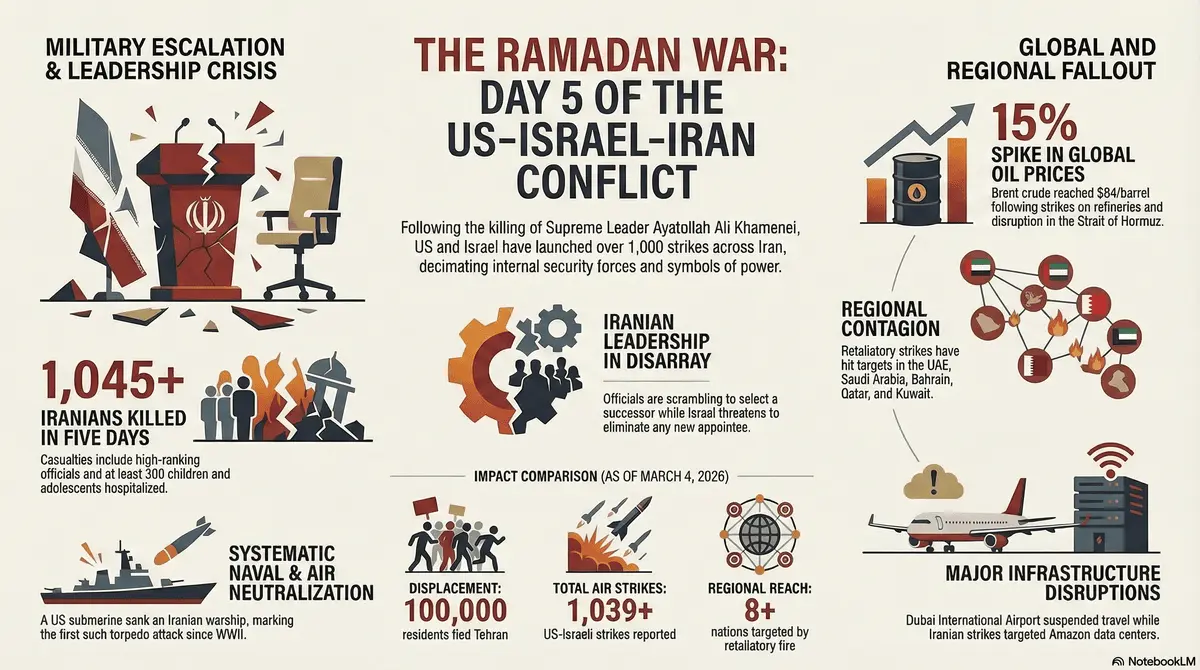
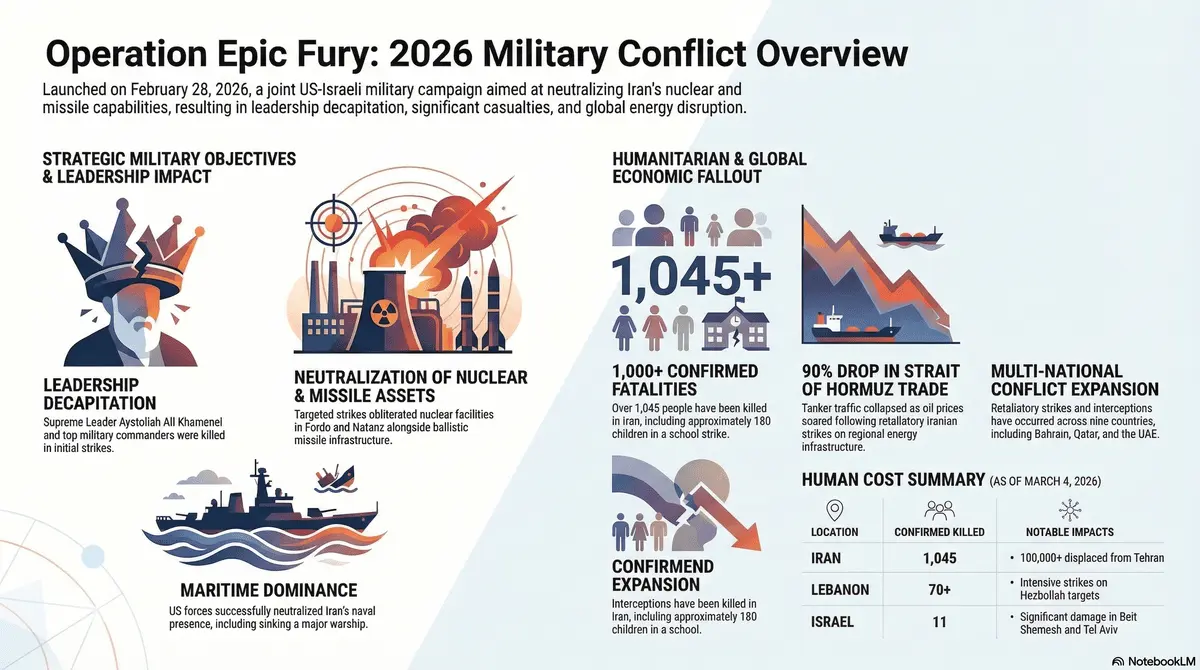
    Washington/Tehran — The United States and Israel have initiated major combat operations against Iran, resulting in widespread casualties and regional instability. This military campaign, dubbed Operation Epic Fury, formally began on March 1, 2026. Retaliatory strikes by Iran have targeted multiple countries hosting US military bases, significantly impacting global shipping and energy markets.

    Below is a detailed breakdown of the ongoing military operations, casualty reports, and geopolitical implications.

    Context & Background

    The Catalyst for Operation Epic Fury According to President Donald Trump, the United States launched this military campaign to neutralize the Iranian regime’s nuclear program and ballistic missile capabilities. The strikes follow the earlier Operation Midnight Hammer and aim to dismantle what the administration describes as Iran’s extensive proxy terror networks across the Middle East.

    Key Figures Killed in Action The initial wave of attacks resulted in the death of Supreme Leader Ayatollah Ali Khamenei, ending his nearly 37-year rule. Other senior officials killed include army chief of staff General Abdol Rahim Mousavi and defence minister General Aziz Nasirzadeh, creating a significant leadership vacuum within the Islamic Republic.

    Interim Leadership and Succession A temporary leadership council comprising reformist president Masoud Pezeshkian, judiciary head Gholamhossein Mohseni Ejei, and jurist Alireza Arafi has been formed to govern the country. The 88-member Assembly of Experts is tasked with selecting a new supreme leader, with Khamenei’s son, Mojtaba Khamenei, considered a potential successor.

    Regional Retaliation In response to the USIsraeli strikes, Iran has launched waves of ballistic missiles and drones at Israel and at least 27 bases hosting US troops across the region. Countries targeted include Bahrain, Iraq, Kuwait, Qatar, and the United Arab Emirates, broadening the scope of the conflict significantly.

    Q&A: Unpacking Operation Epic Fury

    Q: How has the military conflict impacted the maritime and economic sectors?

    A: The escalating war has severely disrupted global shipping and energy supplies, particularly around key maritime chokepoints.

    • Strait of Hormuz Disruption: Tanker traffic has plummeted by approximately 90% following missile attacks on commercial vessels, such as a Maltese-flagged container ship.
    • Naval Engagements: A US submarine successfully torpedoed and sank an Iranian warship in the Indian Ocean off the coast of Sri Lanka, resulting in at least 87 fatalities.
    • Energy Market Volatility: Oil prices have spiked due to the ongoing hostilities, raising concerns about potential long-term impacts on the global economy.

    Q: Why is the humanitarian toll escalating so rapidly across the region?

    A: The widespread and intense nature of the strikes by all involved parties has led to significant civilian and military casualties across multiple nations.

    • Iranian Casualties: Over 1,045 individuals have been killed in Iran, with significant civilian impacts reported, including a deadly strike on a girls’ school in Minab.
    • Regional Fatalities: Retaliatory strikes have caused deaths in Lebanon, Israel, Kuwait, the United Arab Emirates, and Bahrain, alongside six US service members killed in action.
    • Displaced Populations: The intensity of the bombings has forced an estimated 100,000 residents to flee Tehran, exacerbating the regional humanitarian crisis.

    Q: How is the international community responding to the legality and execution of the strikes?

    A: Global leaders are divided, with some fully endorsing the military operations and others raising significant legal and diplomatic concerns.

    • Western Support: Several nations, including Australia and Canada’s conservative opposition, have expressed support for the US-led effort to prevent Iran from maintaining its current regime and obtaining a nuclear weapon.
    • Legal Scrutiny: Canadian Prime Minister Mark Carney characterized the strikes as prima facie inconsistent with international law, noting the lack of UN consultation.
    • Diplomatic Fallout: The attacks have strained allied relations, with Spain emphasizing a “no to war” position after facing trade threats from President Donald Trump over military cooperation disagreements.

    Q: How is the Iranian military responding strategically to the US-Israeli bombardment?

    A: Iran has utilized a decentralized command structure and widespread proxy networks to maintain continuous retaliatory pressure.

    • Decentralized Operations: Iranian Foreign Minister Abbas Araghchi noted that military units are operating largely independently under general orders, potentially blunting the impact of strikes on central command hubs.
    • Proxy Mobilization: Groups such as Hezbollah in Lebanon and militias like Kataib Hezbollah in Iraq have intensified rocket and drone attacks on Israel and US bases.
    • Infrastructure Threats: The Islamic Revolutionary Guard Corps has threatened the complete destruction of regional military and economic infrastructure in retaliation for the ongoing assault.

    Q: How are domestic politics in the United States influencing the ongoing military campaign?

    A: The conflict has ignited intense political debate within the United States regarding executive war powers and strategic objectives.

    • Executive Authority: President Donald Trump has asserted broad constitutional authority to execute Operation Epic Fury without prior congressional approval to eliminate imminent threats.
    • Legislative Action: The US Senate recently voted against a resolution intended to curb the president’s ability to wage war on Iran, allowing the campaign to proceed.
    • Bipartisan Reactions: While many lawmakers strongly support the administration’s decisive actions as necessary for national security, there remains scrutiny regarding the open-ended strategic timeline and risks to deployed personnel.

    Editorial Note & Transparency

    Verification Log:

    • Government Press Release: White House official statements detailing Operation Epic Fury, strategic goals, and quoting political leaders.
    • International News Agency: Reports from Al Jazeera, BBC, and AP News tracking casualties, geopolitical developments, and retaliatory strikes across the region.
    • Broadcast Media: Transcripts and video summaries from PBS News, Sky News, and Fox News outlining the timeline of events, military analysis, and official addresses.

    Compliance:

    • Privacy: This article respects user data under our Privacy Policy.
    • Transparency: No sponsored content influenced this reporting.

    Contact Us: For corrections or feedback, please email: news.desk@qnanews.com

  • US and Israel Intensify Strikes on Iran as Regional Conflict Expands

    US and Israel Intensify Strikes on Iran as Regional Conflict Expands

    Tehran/Washington — The United States and Israel have escalated a massive, coordinated military assault against Iran, resulting in widespread destruction and prompting intense regional retaliation. This unprecedented escalation follows the targeted killing of Iranian Supreme Leader Ayatollah Ali Khamenei during the initial wave of strikes on Saturday, February 28, 2026.

    Below is a detailed examination of the military operations, regional impacts, and political ramifications of this unfolding conflict.

    Context & Background

    The Catalyst and Initial Operations The United States and Israel initiated a massive aerial bombardment campaign aimed at dismantling Iran’s military capabilities and leadership structure. This operation, beginning on Saturday, February 28, 2026, successfully eliminated Supreme Leader Ayatollah Ali Khamenei and significantly damaged facilities belonging to the Islamic Revolutionary Guard Corps.

    Target Selection and Collateral Damage Military planners focused on state power symbols, including the presidential office, military bases, and police stations across Iran. However, the strikes have resulted in significant civilian casualties, with the Iranian death toll surpassing 1,045 individuals, including hundreds of children. At this time, reports of an attack on a girls’ school in Minab remains unverified by official sources from the attacking nations, though international organizations have expressed profound concern.

    Iranian Retaliation and Regional Escalation Following the initial bombardment, Iran commenced retaliatory strikes against Israel and allied nations hosting American military assets, including Saudi Arabia, the United Arab Emirates, and Qatar. The Islamic Revolutionary Guard Corps has explicitly threatened the complete destruction of both military and economic infrastructure throughout the Middle East, prompting widespread airspace closures.

    The Succession Crisis in Tehran The sudden death of Ayatollah Ali Khamenei has triggered only the second succession process in the history of the Islamic Republic. Senior clerics in the Assembly of Experts are rapidly convening to select a replacement, with hardliner Mojtaba Khamenei emerging as a prominent contender.

    Q&A: Unpacking The Middle East Conflict

    Q: How are the United States and Israel degrading Iranian naval and aerial defenses?

    A: Coalition forces are utilizing advanced weaponry and strategic strikes to systemically dismantle Iran’s defensive frameworks and naval presence.

    • Submarine Warfare: A United States submarine successfully sank an Iranian warship in international waters, marking a rare historical use of submarine torpedoes in modern combat.
    • Air Defense Suppression: Aerial bombardments have systematically targeted and damaged Iranian air defenses, ballistic missile sites, and drone launch facilities.
    • Airspace Control: United States Defense Secretary Pete Hegseth stated that the coalition expects to achieve complete dominance over Iranian skies shortly.

    Q: Why are Iranian counter-attacks targeting neighboring Gulf states?

    A: Iran is striking regional neighbors to retaliate against nations hosting United States military installations and to disrupt the broader global economy.

    • Military Base Proximity: Countries like Bahrain, Qatar, and the United Arab Emirates host significant American military bases, making them strategic targets for Iranian missiles and drones.
    • Economic Disruption: By targeting critical commercial hubs and shipping lanes, Iran aims to impose severe economic costs on the international community.
    • Deterrence Strategy: The Islamic Revolutionary Guard Corps seeks to deter further allied cooperation by demonstrating its capacity to inflict widespread regional damage.

    Q: How is this conflict impacting global energy markets and international travel?

    A: The escalation has triggered immediate spikes in oil prices and forced sweeping cancellations of commercial flights across the Middle East.

    • Crude Oil Surge: Brent crude prices escalated to $84 a barrel, representing a 15% increase, due to disruptions near the Strait of Hormuz.
    • Aviation Paralysis: Major aviation hubs, including Dubai, have suspended all flights as civilian infrastructure faces direct drone and missile threats.
    • Refinery Threats: Drone strikes have targeted major energy facilities, such as the Aramco refinery in Saudi Arabia, exacerbating market anxieties.

    Q: Why is the leadership succession in Iran considered a critical juncture for the conflict?

    A: The appointment of a new Supreme Leader will dictate Iran’s strategic posture and determine whether the nation seeks diplomatic de-escalation or prolonged warfare.

    • Ideological Direction: The choice between a reformist or a hardliner, such as Mojtaba Khamenei, will shape the regime’s willingness to negotiate or escalate.
    • Coalition Threats: Israel’s Defense Minister Israel Katz has declared that any successor committed to the destruction of Israel will become an immediate military target.
    • Internal Stability: The selection process is occurring amid wartime chaos, which may further destabilize the government as it attempts to manage both the military response and internal dissent.

    Q: How are international stakeholders and allies responding to the unilateral military actions?

    A: Global reactions are mixed, with some nations expressing support for neutralizing threats while others condemn the circumvention of international law.

    • Legal Concerns: Canadian Prime Minister Mark Carney characterized the strikes as potentially inconsistent with international law due to the lack of United Nations consultation.
    • Mediation Offers: South African President Cyril Ramaphosa has offered to mediate a ceasefire to prevent further regional destabilization.
    • Domestic Opposition: In the United States, the Senate failed to pass a resolution to rein in President Donald Trump’s war powers, signaling continued domestic political friction over the conflict.

    Editorial Note & Transparency

    Verification Log:

    • News Agency: [Al Jazeera, AP News, The Guardian, and The Independent reporting on military actions and political fallout.]
    • Open Source Intelligence: [Bellingcat analysis utilizing Planet Labs satellite imagery to verify police station damage.]
    • Government Briefings: [Statements from the United States Pentagon, Israeli military, and Iranian state television.]

    Compliance:

    • Privacy: This article respects user data under our Privacy Policy.
    • Transparency: No sponsored content influenced this reporting.

    Contact Us: For corrections or feedback, please email: news.desk@qnanews.com

  • US and Israel Launch Joint Military Operation Against Iran

    US and Israel Launch Joint Military Operation Against Iran

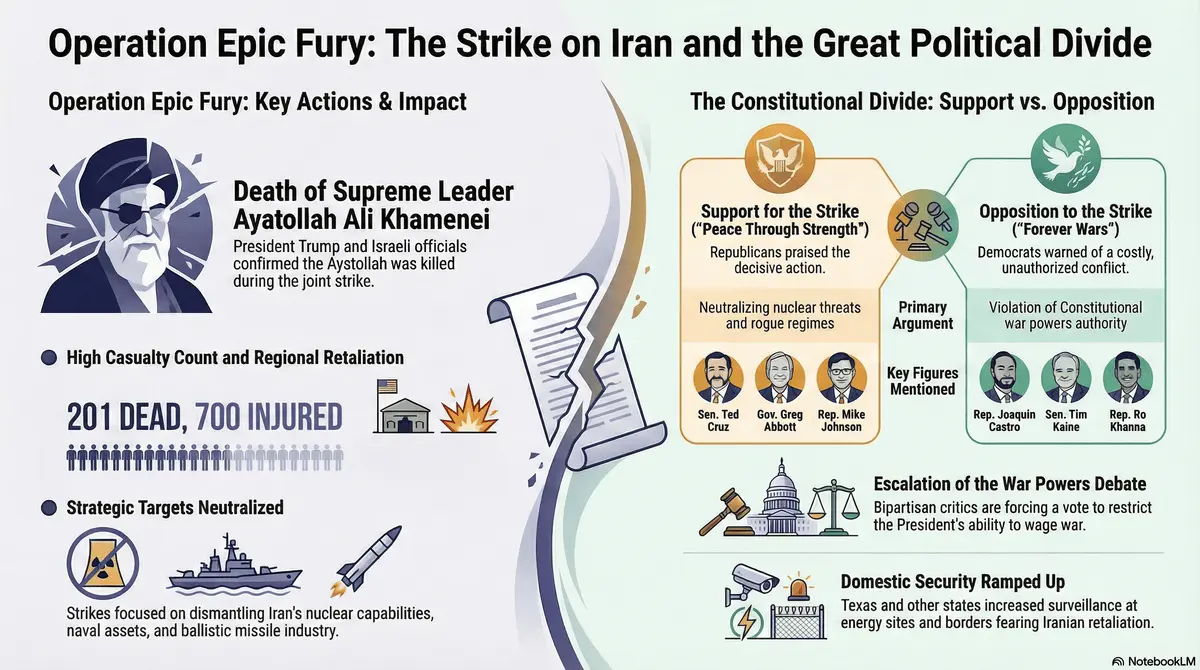
    WASHINGTON/TEHRAN — The United States and Israel initiated major combat operations against Iran, resulting in the reported death of Supreme Leader Ali Khamenei. The joint strikes began overnight into February 28, 2026. This unprovoked attack bypasses congressional authorization, prompting immediate calls from lawmakers for a War Powers Resolution vote to restrict further escalation.

    Below is a detailed breakdown of the political and strategic consequences of the strikes.

    Context & Background

    How did this start? President Donald Trump ordered the strikes, citing the need to neutralize threats from the Iranian regime, pointing to its nuclear ambitions, support for regional terrorism, and history of targeting Americans. The administration labeled the campaign Operation Epic Fury, framing it as a necessary measure to eliminate the regime’s ballistic missile capabilities and naval forces.

    The key players The operation was jointly executed by the military forces of the United States and Israel under the direction of President Donald Trump and Prime Minister Benjamin Netanyahu. Within the U.S. Congress, Republican leaders like House Speaker Mike Johnson have supported the strikes, while a bipartisan coalition including Democrats like Representative Joaquin Castro and Republicans like Representative Thomas Massie are demanding legislative oversight.

    Historical significance The attack marks a major escalation in the nearly 50-year geopolitical struggle between the United States and the Islamic Republic of Iran. It severely tests the constitutional separation of powers, as the executive branch launched a massive military campaign aimed at regime change without a formal declaration of war from the legislative branch.

    Q&A: Unpacking the Military Strikes on Iran

    Q: How are lawmakers attempting to limit the president’s military authority?

    A: Lawmakers are pushing for a swift vote on a War Powers Resolution to restrict further unauthorized military action in Iran.

    • Bipartisan Effort: Representatives Ro Khanna and Thomas Massie authored a resolution to force a public vote and reassert congressional war powers.
    • Senate Threshold: Because of specific legislative rules, the resolution would only need a simple majority of 51 votes to pass the U.S. Senate.
    • Veto Threat: Even if passed, President Donald Trump would likely veto the resolution, requiring a challenging two-thirds majority to overturn.

    Q: Why are proponents of the strikes arguing that the action was necessary?

    A: Supporters argue the preemptive strikes were essential to dismantle Iranian capabilities and protect international security.

    • Nuclear Prevention: Proponents state the operation guarantees that Iran will never obtain nuclear weapons after refusing diplomatic off-ramps.
    • Regime Change Opportunity: Leaders argue that severely degrading the Islamic Revolutionary Guard Corps provides the Iranian public an opportunity to overthrow their authoritarian government.
    • Retaliation History: Allies emphasize that the Iranian regime has spent decades funding proxy groups and chanting against the United States.

    Q: How is the lack of congressional approval impacting domestic political stability?

    A: The unilateral nature of the strikes has ignited fierce debate over the constitutional separation of powers.

    • Constitutional Violation Claims: Critics, including Senator Tammy Baldwin, accuse the administration of illegally bombing a sovereign nation by totally disregarding the constitutionally required congressional sign-off.
    • Briefing Deficits: Many lawmakers assert that the administration failed to present actionable intelligence or a coherent strategy to Congress before launching the attacks.
    • Civilian Casualties: State media reports massive death tolls, but at this time, the exact number of civilian casualties remains unverified by official sources.

    Q: Why are critics warning about the long-term consequences of this operation?

    A: Opponents fear the strikes could plunge the United States into a prolonged and costly regional conflict.

    • Escalation Risks: Experts caution that the strikes could trigger widespread retaliation against American troops and bases stationed throughout the Middle East.
    • Absence of Strategy: Lawmakers highlight the lack of a defined end-state or post-strike stabilization plan, warning of the disastrous consequences seen in previous regime-change wars.
    • Domestic Costs: Critics argue that funding another foreign conflict diverts essential resources away from domestic priorities like healthcare and affordable housing.

    Q: How did the Iranian government and military respond to the initial attack?

    A: Iran immediately launched retaliatory strikes against American and Israeli targets in the region.

    • Drone and Missile Deployment: Following the initial bombardment, Iranian forces fired missiles and drones toward Israel and at a U.S. Navy base in Bahrain.
    • Regime Resilience: Analysts note that aerial bombing alone historically struggles to completely dismantle entrenched regimes.
    • Proxy Mobilization: The regime may utilize its network of proxy militias to broaden its retaliatory campaign in the Middle East.

    Editorial Notes & Transparency

    Verification Log:

    • News Reports: Articles from local and national outlets detailing the military operations and political responses.
    • Official Statements: Public releases and social media posts from U.S. Senators, Representatives, and the President.
    • International Analysis: Documentation of historical context and geopolitical strategy from foreign policy experts.

    Compliance:

    • Privacy: This article respects user data under our Privacy Policy.
    • Transparency: No sponsored content influenced this reporting.

    Contact Us: For corrections or feedback, please email: news.desk@qnanews.com

  • Andrew Held 11 Hours Over Epstein Data Leak

    Andrew Held 11 Hours Over Epstein Data Leak

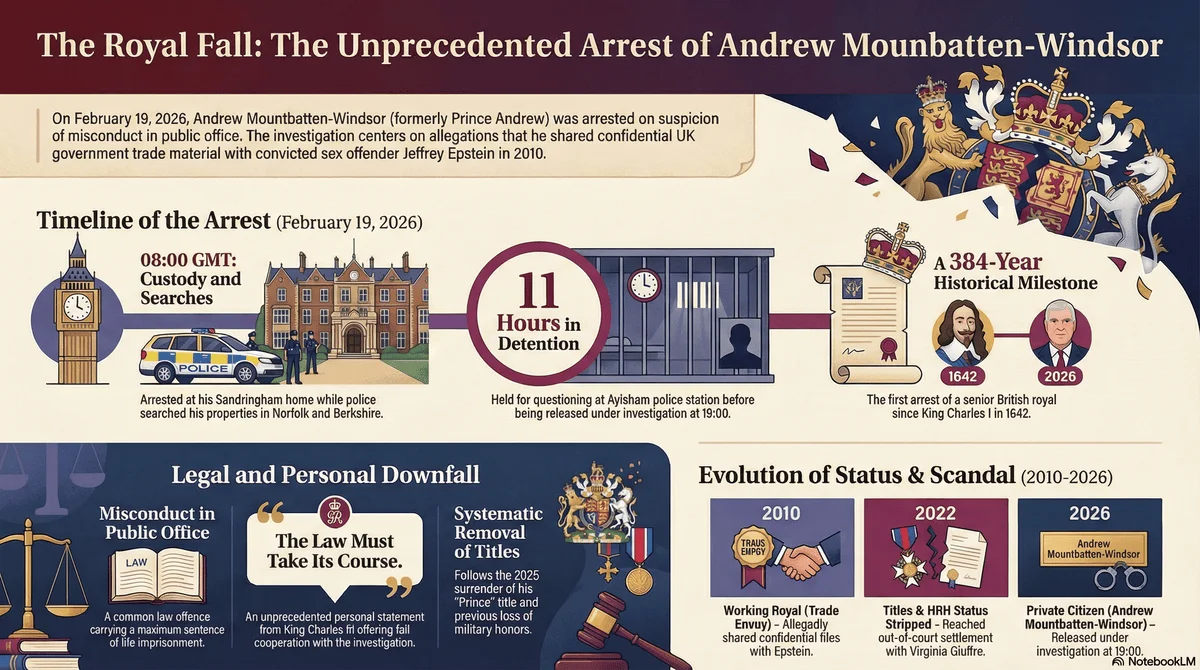
    London/Norfolk — Andrew Mountbatten-Windsor, formerly Prince Andrew, was arrested and subsequently released under investigation by British police on suspicion of misconduct in public office linked to his ties with convicted sex offender Jeffrey Epstein. The arrest took place on February 19, 2026—Mountbatten-Windsor’s 66th birthday—with Thames Valley Police detaining him and executing property searches at the Sandringham estate in Norfolk and the Royal Lodge in Berkshire.

    This marks the first time a senior British royal has been arrested in nearly 400 years, signaling a historic erosion of deference to the monarchy and a new era of legal accountability for powerful public figures. Below is a detailed examination of the charges, the evidence, and the institutional implications.

    Context & Background

    The Charges — Mountbatten-Windsor faces suspicion of misconduct in public office, not sexual offenses. The arrest stems directly from millions of pages of documents released by the U.S. Justice Department late last month. These files allegedly reveal that in 2010, while serving as Britain’s special envoy for international trade, Mountbatten-Windsor forwarded confidential government investment briefs—including details on the reconstruction of Helmand province in Afghanistan—to Epstein.

    The Arrest Strategy — Police leadership determined that merely inviting Mountbatten-Windsor for an interview under caution would not be sufficient to progress the investigation. Arresting him granted investigators the immediate legal authority needed to conduct searches of his properties in Berkshire and Norfolk without having to separately apply to a magistrate for search warrants.

    Royal Response King Charles III released an unprecedented personal statement asserting that “the law must take its course.” He signed the statement as “Charles R,” a highly unusual move designed to demonstrate personal support for the police investigation and explicitly distance the Crown from his brother’s actions.

    Historical Significance — This is the first arrest of a senior British royal in nearly 400 years. The arrest is forcing the royal family to aggressively insulate itself from the fallout to preserve its public standing and signals a historic erosion of deference to the monarchy.

    Q&A: Understanding the Charges and Implications

    Q: How did the recently unsealed Epstein files trigger this specific arrest?

    A: The arrest stems from newly released documents revealing alleged misuse of government information.

    • Document Release: Millions of pages of documents released by the U.S. Justice Department late last month.
    • The Allegation: Files allegedly reveal that in 2010, while serving as Britain’s special envoy for international trade, Mountbatten-Windsor forwarded confidential government investment briefs to Epstein.
    • Sensitive Content: The leaked information included details on the reconstruction of Helmand province in Afghanistan.
    • Legal Basis: This alleged sharing of confidential government information with a private individual forms the basis for the misconduct in public office charge.

    Q: Why did Thames Valley Police choose to arrest him rather than conduct a voluntary interview?

    A: The arrest was a strategic decision to maximize investigative authority.

    • Insufficient Voluntary Approach: Police leadership determined that merely inviting Mountbatten-Windsor for an interview under caution would not be sufficient to progress the investigation.
    • Legal Authority: Arresting him granted investigators the immediate legal authority needed to conduct searches of his properties.
    • Warrant Bypass: The arrest allowed searches at the Sandringham estate in Norfolk and the Royal Lodge in Berkshire without having to separately apply to a magistrate for search warrants.
    • Procedural Advantage: This approach enabled faster collection of potential evidence while maintaining the element of surprise.

    Q: Are these charges related to the sexual assault allegations made by the late Virginia Giuffre?

    A: No, but the investigation carries symbolic significance for assault survivors.

    • Separate Investigation: The current investigation by Thames Valley Police is strictly focused on misconduct in public office, not sexual offenses.
    • Family Response: Giuffre’s family celebrated the arrest as a “win” and a step toward accountability.
    • Future Uncertainty: At this time, whether this arrest will lead to a broader criminal probe into sexual assault allegations remains unverified by official sources.
    • Current Status: Mountbatten-Windsor has consistently denied any wrongdoing related to sexual assault allegations.

    Q: How is this event impacting the British monarchy as an institution?

    A: The arrest is forcing unprecedented institutional distance and damage control.

    • Aggressive Insulation: The royal family is actively working to insulate itself from the fallout to preserve its public standing.
    • King’s Unprecedented Statement: King Charles III signed his public statement as “Charles R,” a highly unusual personal signature rather than the typical official royal communication.
    • Strategic Messaging: The statement asserting “the law must take its course” demonstrates personal support for the police investigation.
    • Historical Shift: This represents a historic erosion of deference to the monarchy and signals that even senior royals are not above the law.

    Q: What is the potential legal penalty if Mountbatten-Windsor is convicted?

    A: The charges carry extremely severe potential consequences.

    • Offense Severity: Misconduct in public office is a highly serious offense in the U.K.
    • Maximum Penalty: According to the Crown Prosecution Service, the charge carries a maximum sentence of life imprisonment.
    • Current Status: Mountbatten-Windsor has only been released under investigation, meaning he has neither been formally charged nor exonerated.
    • Next Steps: Police will continue their investigation to determine whether sufficient evidence exists to bring formal charges.

    Q: How is the United States responding to the arrest?

    A: The arrest is amplifying pressure for U.S. accountability measures.

    • Congressional Response: Democratic Congressman Suhas Subramanyam noted the disparity between U.K. criminal probes and the U.S., where consequences for those in the Epstein files have mostly played out in the “court of public opinion.”
    • Legal Limitations: Mountbatten-Windsor cannot be legally compelled to testify in the U.S.
    • Political Pressure: American lawmakers hope his arrest will pressure him into cooperating with ongoing congressional inquiries.
    • Precedent Impact: The U.K. arrest may create momentum for similar accountability measures against other prominent figures named in the Epstein documents.

    Editorial Note & Transparency

    Verification Log:

    • Official Police Statements: Thames Valley Police and the National Police Chiefs’ Council regarding the arrest, release under investigation, and the 30-minute advance notice provided to the Home Office.
    • Official Royal Statements: A direct public statement from King Charles III.
    • Legal Disclosures: U.S. Justice Department document releases outlining the 2010 email correspondence between Mountbatten-Windsor and Epstein.
    • Eyewitness Reports: Journalists and photographers documenting Mountbatten-Windsor’s departure from Aylsham police station and unmarked police presence at Sandringham.

    Compliance:

    • Privacy: This article respects user data under our Privacy Policy.
    • Transparency: No sponsored content influenced this reporting.

    Contact Us: For corrections or feedback, please email: newsdesk@qnanews.com

  • Trump Insists on Iran Deal After 3-Hour Netanyahu Summit

    Trump Insists on Iran Deal After 3-Hour Netanyahu Summit

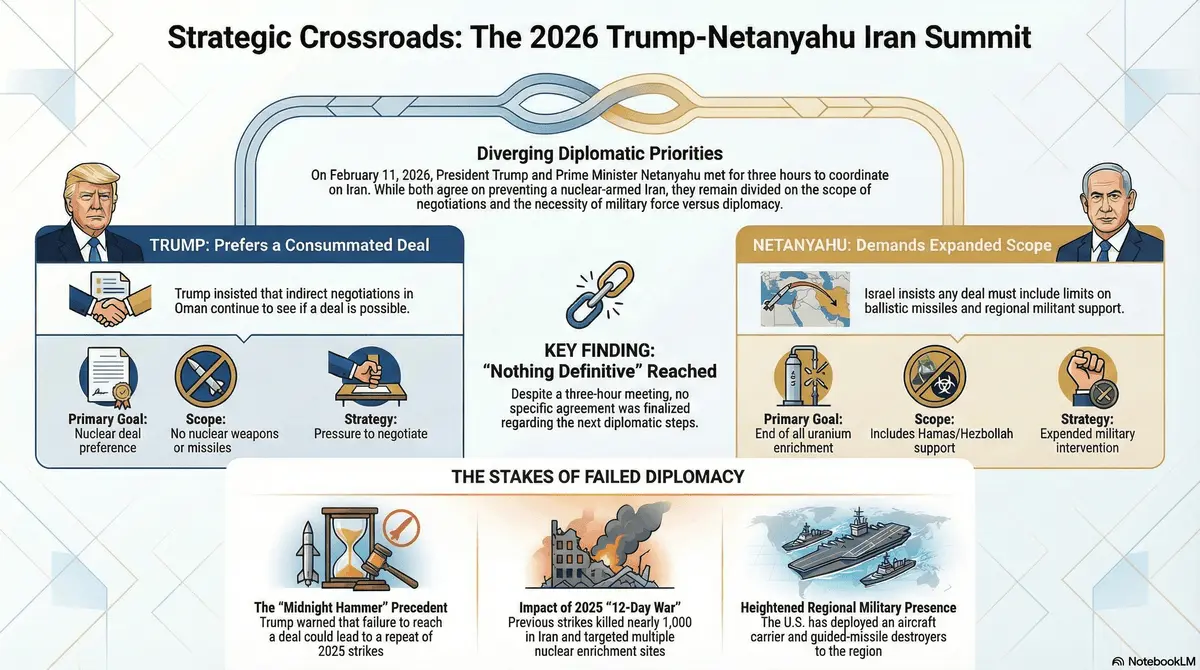
    Washington, D.C. — President Donald Trump met with Israeli Prime Minister Benjamin Netanyahu for a private, three-hour summit at the White House on Wednesday, February 11, 2026, formally insisting that negotiations with Iran must continue as the U.S. pursues a new nuclear deal. The meeting underscored a sharp divide between Washington’s diplomatic ambitions and Israel’s security demands, with the two leaders leaving key questions about Iran’s nuclear capabilities and regional proxy networks unresolved.

    Below is a detailed breakdown of the summit, the tensions surrounding it, and what it means for the future of the Middle East.

    Context & Background

    The Summit

    The private, three-hour meeting took place behind closed doors at the White House in Washington, D.C., on Wednesday, February 11, 2026. President Trump formally insisted that negotiations with Iran continue to determine whether a deal can be reached.

    Key Figures

    President Trump stated, “I insisted that negotiations with Iran continue to see whether or not a Deal can be consummated.” Prime Minister Netanyahu presented Israel’s “essential principles” for security, and separately met with Secretary of State Marco Rubio.

    Why It Matters

    The outcome of these talks could determine whether the Middle East moves toward diplomatic stabilization or a significant military escalation, directly impacting global security and energy markets.

    Historical Significance

    This summit marks a pivotal moment in U.S.-Israel relations under the Trump administration, as both nations navigate divergent priorities — Washington’s preference for a nuclear-focused diplomatic deal versus Israel’s demand for a comprehensive rollback of Iran’s regional power.

    Q&A: Unpacking the Summit

    Q: Why is the Trump administration pursuing a diplomatic deal while simultaneously increasing military pressure in the Middle East?

    A: The administration is utilizing a “maximum pressure” strategy coupled with an open door for diplomacy. Key elements include:

    • Trump has authorized a significant military buildup — including an aircraft carrier and guided-missile destroyers — in the region.
    • Trump has stated his “preference” is a deal that ensures “no nuclear weapons, no missiles.”
    • This approach aims to force Tehran into a “reasonable and responsible” position by highlighting the “steep” consequences of failure, citing U.S. strikes in June 2025 that targeted Iranian enrichment facilities.

    Q: How do Israel’s specific demands for the Iran talks differ from the current U.S. negotiating framework?

    A: There is a notable gap in scope between the two allies’ positions:

    • The U.S. Position: Current indirect talks in Oman, led by U.S. envoys Steve Witkoff and Jared Kushner, have primarily focused on Iran’s nuclear program.
    • Israel’s Position: Netanyahu’s office has explicitly stated that any agreement must also include strict limits on Iran’s ballistic missile program and a total cessation of support for regional proxies like Hamas and Hezbollah.
    • The Gap: Whether the U.S. will expand its negotiating criteria to meet all of Israel’s “essential principles” remains unverified by official sources.

    Q: What is the “Board of Peace,” and how does it affect regional stability beyond Iran?

    A: The Board of Peace is a new Trump administration initiative with broad regional implications:

    • Purpose: Designed to oversee the Gaza ceasefire plan and resolve broader global crises.
    • Netanyahu’s Role: During this visit, Netanyahu signed on to participate in the board, signaling a deepening of U.S.-Israel coordination on regional “progress.”
    • Broader Significance: This indicates the administration views the Iran nuclear issue as part of a larger, interconnected regional stabilization effort that includes the ongoing situation in Gaza.

    Q: Fact-Check — What is the current status of Iran’s nuclear capabilities following the June 2025 conflict?

    A: Reports are conflicting and the true status remains unclear:

    • Trump’s Claim: U.S. strikes “obliterated” Iran’s nuclear capabilities.
    • Iran’s Statement: Iranian Foreign Minister Abbas Araghchi stated in November 2024 that Iran had ceased uranium enrichment due to war damage.
    • The Reality: Satellite imagery has recently captured new activity at these sites, raising concerns that Iran is salvaging facilities.
    • Verification Gap: The International Atomic Energy Agency (IAEA) has been denied access to bombed sites for months and cannot verify Iran’s current nuclear status or stockpile.

    Q: How does this diplomatic friction affect the global defense and intelligence industries?

    A: The uncertainty creates a high-stakes environment for security and aerospace sectors:

    • The U.S. military presence in the region is at a peak, driving elevated demand in defense procurement.
    • Regional actors like Turkey and Qatar are urging restraint to prevent a total destabilization of the region.
    • The key industry question is whether Iran will accept “any kind of verification” as suggested by President Masoud Pezeshkian, or if the “wall of mistrust” will lead to further military intervention.

    Editorial Note & Transparency

    Correction/Update: This article focuses on the Trump-Netanyahu White House summit of February 11, 2026, and ongoing U.S.-Iran nuclear negotiations.

    Privacy & Ethics: All quotes and figures are derived from public statements, official social media (President Trump’s Truth Social account), government briefings from the Office of the Prime Minister of Israel, diplomatic reports on indirect talks in Oman, IAEA inspection updates, and credible news coverage from AP, Al Jazeera, PBS News, and The Guardian. No private data was accessed.

    Contact Us: For corrections or feedback, please email: newsdesk@qnanews.com

    Editorial Disclosure: No sponsored content influenced this reporting.

    Keywords: Trump Netanyahu Summit 2026, Iran Nuclear Deal, US Israel Relations, Maximum Pressure Strategy, IAEA Iran, Board of Peace, Steve Witkoff, Jared Kushner, Iran Ballistic Missiles, Middle East Diplomacy.