Seattle / Washington — Researchers at the University of Washington have discovered evidence of a violent collision between two exoplanets orbiting a distant star. This rare observation, formally published in The Astrophysical Journal Letters on March 11, 2026, offers unparalleled insights into the chaotic formation of planetary systems and potential exomoons. The celestial event occurred around Gaia20ehk, a star located approximately 11,000 light-years from Earth near the constellation Puppis.
Below is a detailed examination of this astronomical event and its implications for astrobiology.
Context & Background
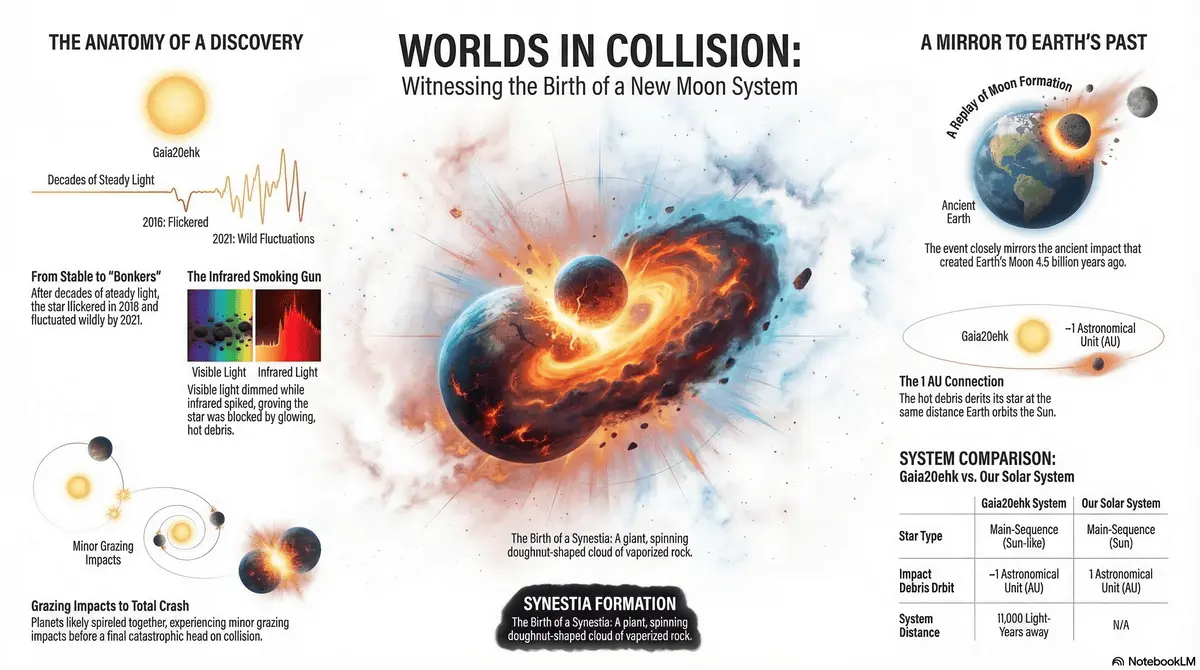
The Initial Discovery The investigation began when astronomer Andy Tzanidakis observed anomalous dimming from Gaia20ehk, a typically stable main-sequence star. While the star’s light output was consistent for years, it began exhibiting unusual dips in brightness in 2016 and fluctuated chaotically by 2021.
The Cause of the Anomalies Researchers deduced that the erratic flickering was not intrinsic to the star itself, but was instead caused by a massive cloud of hot dust and rock debris passing in front of it. This debris cloud is the resulting wreckage of a catastrophic collision between two planetary bodies within the system.
Similarity to Earth’s Moon Formation This cosmic crash bears striking resemblances to the hypothesized impact of Theia that created the Moon roughly 4.5 billion years ago. The wreckage orbits the star at approximately one astronomical unit, which mirrors the distance between Earth and the Sun, suggesting the material could eventually coalesce into a similar Earth-Moon system analogue.
Significance for Astrobiology Understanding the frequency of such planetary collisions is considered fundamental to astrobiology, as highlighted by James Davenport. The presence of a moon provides stable climates, ocean tides, and protection from asteroids, which are often viewed as critical components for making a planet habitable for life.
Q&A: Unpacking The Planetary Collision
Q: How did astronomers confirm that a collision had occurred rather than a standard stellar fluctuation?
A: Astronomers identified the collision by analyzing the stark contrast between the star’s visible and infrared light emissions.
- Visible Light Dimming: As rock and dust from the shattered planets passed in front of Gaia20ehk, the visible light reaching Earth was obstructed and flickered.
- Infrared Light Surging: The collision generated extreme heat, causing the resulting debris field to glow intensely in the infrared spectrum.
- Thermal Confirmation: This opposing light curve pattern proved that a hot, obscuring mass of planetary wreckage was responsible for the anomalies, rather than the star failing.
Q: How did the collision process unfold over time?
A: The event was not instantaneous but culminated after a series of preliminary impacts as the two planets spiraled toward each other.
- Initial Grazing Impacts: Starting around 2016, the planets experienced minor, grazing collisions that caused slight dips in stellar brightness without producing massive infrared heat.
- Catastrophic Impact: Around 2021, a catastrophic frontal collision completely pulverized the bodies, drastically increasing the debris volume and infrared heat signature.
- Debris Dispersal: The pulverized rock vaporized into a massive, expanding cloud—sometimes referred to as a synestia—that now irregularly eclipses the host star.
Q: Why is the location of the debris cloud significant for the future of this planetary system?
A: The debris cloud is positioned in a specific orbital zone that might allow it to cool and form a stable planetary system.
- Orbital Distance: The scattered material orbits Gaia20ehk at roughly 93 million miles, mimicking the distance from Earth to the Sun.
- Solidification Potential: If the environment remains stable, this material is expected to cool and condense into solid bodies. At this time, the exact timeframe for this cool-down process remains unverified by official sources, though estimates suggest it could take millions of years.
- System Evolution: This ongoing process could eventually yield a rocky exoplanet accompanied by a large exomoon.
Q: How do these observations impact our understanding of the conditions required for life?
A: Witnessing this event allows scientists to gauge the rarity of moon-forming impacts, which are thought to be essential for planetary habitability.
- Tidal Generation: A large moon drives ocean tides, which facilitate the global mixing of chemical and biological materials on a planet’s surface.
- Planetary Shielding: Natural satellites can intercept inbound asteroids, protecting the primary planet from potentially devastating impacts.
- Tectonic Activity: Lunar gravity may help drive the tectonic plate activity necessary to regulate a planet’s climate and atmosphere over geological timescales.
Q: How will researchers detect similar planetary collisions in the future?
A: Astronomers will rely on next-generation surveying telescopes to scan the galaxy for similar long-term stellar anomalies.
- Upcoming Technology: Instruments like the Simonyi Survey Telescope at the Vera C. Rubin Observatory will be crucial for capturing these rare events as they begin operations.
- Decadal Monitoring: Researchers anticipate finding up to 100 new impacts over the next ten years by leveraging continuous, decade-long data collection.
- Astrobiological Targeting: Identifying more systems with moon-forming collisions will help narrow the search for potentially habitable worlds outside our solar system.
Editorial Note & Transparency
Verification Log:
- Academic Journal: Information sourced from peer-reviewed findings published in The Astrophysical Journal Letters.
- Institutional Press Release: Statements and analyses provided by the University of Washington astronomy research team.
- Science Media Coverage: Aggregated reporting from science news outlets analyzing telescope data from the Puppis constellation event.
Compliance:
- Privacy: This article respects user data under our Privacy Policy.
- Transparency: No sponsored content influenced this reporting.
Contact Us: For corrections or feedback, please email: news.desk@qnanews.com