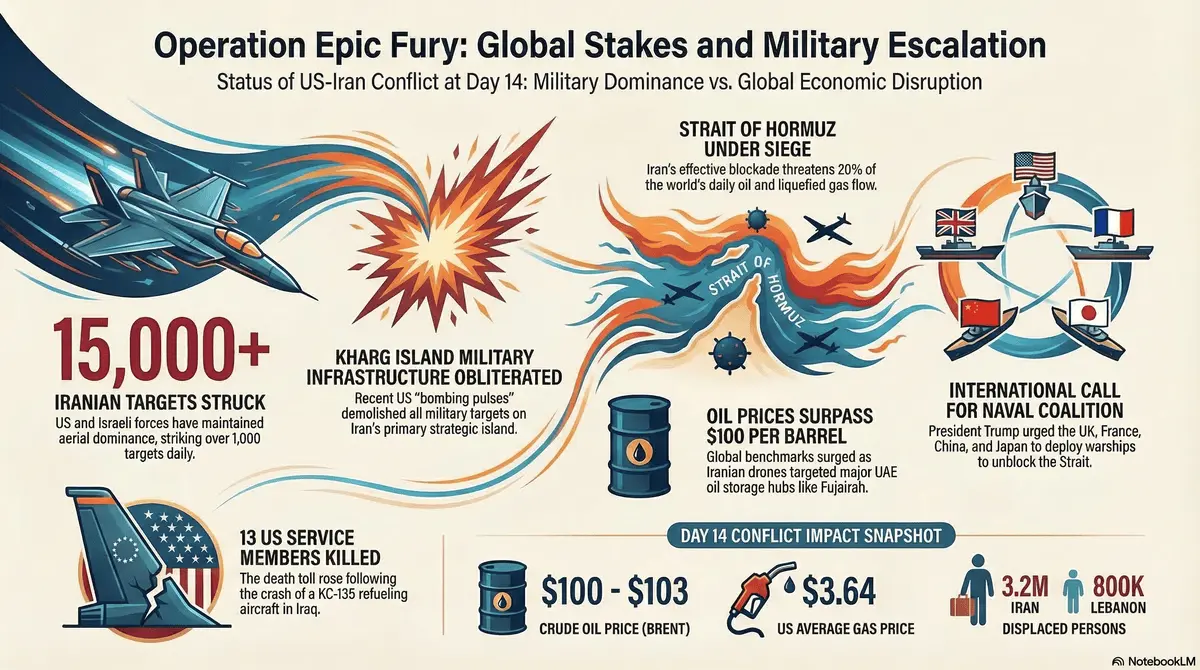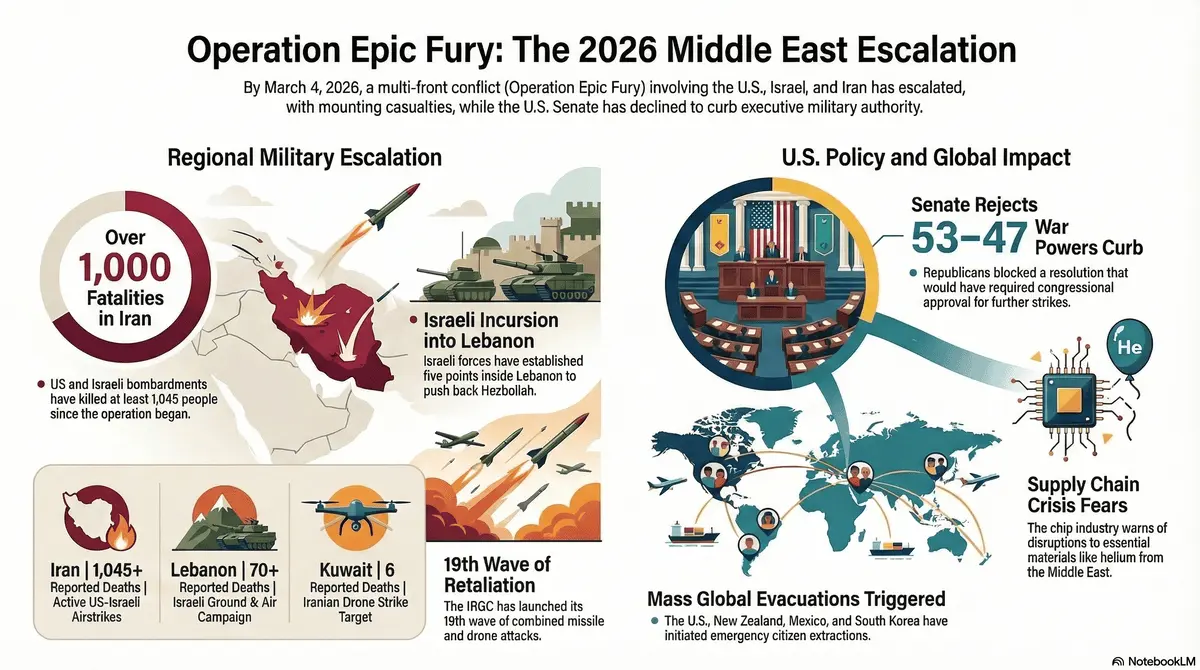
Washington, D.C. — The United States Senate has rejected a bipartisan war powers resolution intended to restrict President Donald Trump‘s authority to unilaterally direct military operations against Iran. The measure failed in a 47-53 vote mostly along party lines on Wednesday, March 4, 2026. The vote comes amid escalating hostilities in the Middle East, including retaliatory strikes from Iran and the deaths of six American soldiers in Kuwait.
Below is a detailed examination of the legislative effort and the ongoing conflict.
Context & Background
What prompted the war powers resolution? Senator Tim Kaine introduced the measure following joint U.S. and Israeli military strikes against the Iranian regime, which killed Iranian Supreme Leader Ayatollah Ali Khamenei. Democrats and some critics expressed concern over the administration’s shifting rationale for the attacks and the lack of congressional authorization under the 1973 War Powers Act.
How did the Senate vote unfold? The resolution failed on a 47-53 vote, reflecting deep partisan divides over foreign policy and executive power. Senator Rand Paul was the sole Republican to support the measure, while Senator John Fetterman was the only Democrat to vote against it, arguing that the strikes successfully thwarted Iran‘s nuclear ambitions.
What is the administration’s stance? The White House and Republican leadership maintain that President Donald Trump is acting within his constitutional authority as commander in chief to defend American interests. Defense Secretary Pete Hegseth indicated that the U.S. is “just getting started,” while Secretary of State Marco Rubio asserted that the administration complied with the requirement to notify Congress within 48 hours of initiating hostilities.
What are the next steps for Congress? The House of Representatives is scheduled to vote on a companion war powers resolution introduced by Representatives Ro Khanna and Thomas Massie on Thursday. However, the measure faces steep opposition from Republican leadership, including House Speaker Mike Johnson, who argued that limiting the president’s authority would endanger American forces.
Q&A: Unpacking Operation Epic Fury
Q: How does the War Powers Act apply to the current conflict?
A: The resolution attempts to leverage the 1973 legislation to reassert congressional authority over declarations of war.
- Constitutional Mandate: The Act requires the president to notify Congress within 48 hours of deploying troops and mandates an end to hostilities within 60 days without an Authorization for Use of Military Force.
- Administration Argument: Officials argue inherent executive authority allows defensive military actions without prior congressional approval.
- Legislative Challenges: Passing such a resolution requires a simple majority, but overriding a likely presidential veto would necessitate a two-thirds majority in both chambers.
Q: Why are lawmakers divided on the long-term strategy of the campaign?
A: Divisions stem from differing assessments of the threat level and the potential for a prolonged, endless war.
- Democrat Concerns: Lawmakers like Senator Chris Murphy warn that destroying Iran‘s missile capacity requires endless aerial campaigns, risking trillions of dollars and further American casualties.
- Republican Support: Senators such as Roger Wicker view the campaign as a measured necessity to eliminate threats from religious extremists and secure the region.
- Troop Deployment Scope: At this time, the deployment of U.S. ground troops in Iran remains unverified by official sources, though officials have refused to rule it out.
Q: How has the conflict escalated geographically since the initial strikes?
A: The hostilities have rapidly expanded beyond Iran, drawing in neighboring countries and international waters.
- Lebanon Strikes: Israel has expanded its operations into Lebanon, targeting Hezbollah militants and issuing evacuation orders south of the Litani River.
- Maritime Clashes: A U.S. submarine sank an Iranian warship off the coast of Sri Lanka, and unverified attacks have been reported off the coast of Kuwait.
- Regional Projectiles: NATO defenses intercepted an Iranian ballistic missile over Turkey, and Iran has targeted U.S. bases in Iraq.
Q: Why is the House resolution expected to face significant hurdles?
A: The House companion bill faces strong opposition from both Republican leadership and a faction of pro-Israel Democrats.
- Leadership Opposition: Speaker Mike Johnson has explicitly condemned the resolution, asserting it would “kneecap” U.S. forces.
- Competing Legislation: Representative Josh Gottheimer has introduced an alternative bill granting the administration 30 days to conclude military action, potentially siphoning Democratic support.
- Veto Threat: Even if successful in the House, the measure lacks the bipartisan supermajority required to overcome a presidential veto.
Q: How might Congress exert influence if war powers resolutions fail?
A: Lawmakers are considering using the appropriations process as an alternative mechanism to constrain or guide military action.
- Funding Requests: The Defense Department is expected to request a supplemental funding package for the ongoing operations.
- Oversight Hearings: Senators like Chris Coons are demanding open hearings on the administration’s goals and exit strategy before approving additional defense investments.
- AUMF Debate: Some Republicans, such as Senator Thom Tillis, have suggested debating a new Authorization for Use of Military Force if the conflict becomes a prolonged engagement.
Editorial Note & Transparency
Verification Log:
- Mainstream News Media: Reporting from NPR, AP News, CBS, and BBC regarding the Senate vote tallies, legislative maneuvering, and the ongoing military conflict.
- Government Statements: Quotes and press releases from U.S. Senators (Tim Kaine, John Fetterman, Rand Paul), Representatives (Mike Johnson), and administration officials (Pete Hegseth, Marco Rubio).
- International Reports: Updates from Al Jazeera and The Guardian regarding the expansion of hostilities into Lebanon, Turkey, and Iraq.
Compliance:
- Privacy: This article respects user data under our Privacy Policy.
- Transparency: No sponsored content influenced this reporting.
Contact Us: For corrections or feedback, please email: news.desk@qnanews.com