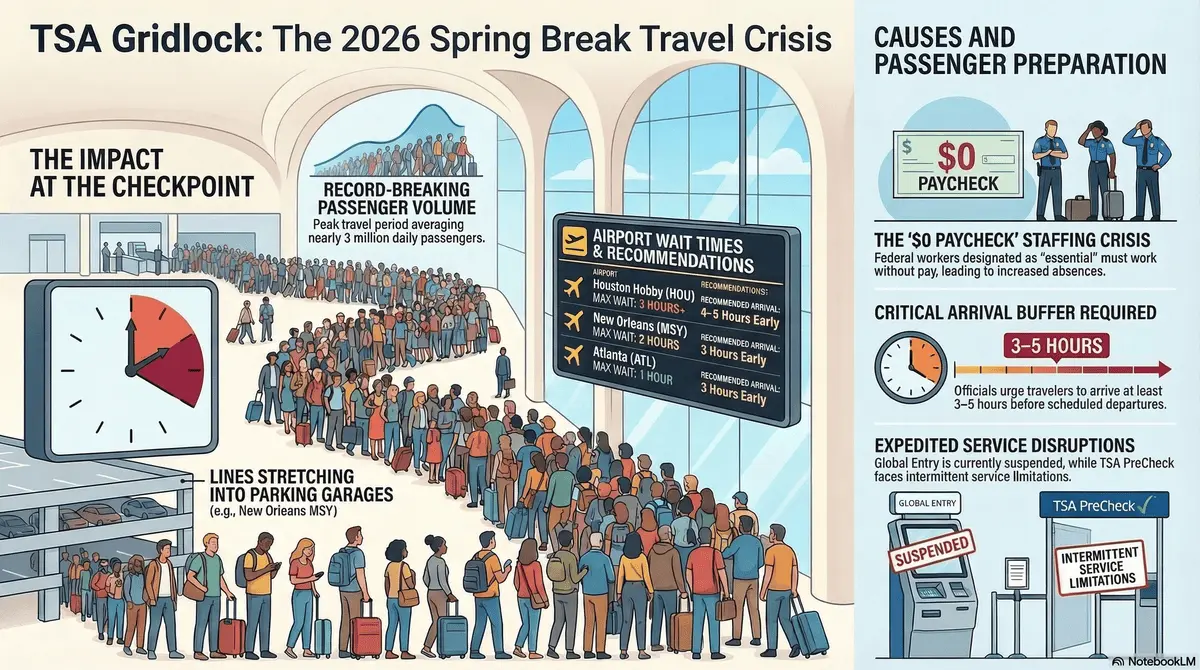
Houston/New Orleans — Travelers are facing unprecedented delays at security checkpoints due to severe Transportation Security Administration (TSA) staffing shortages linked to a partial government shutdown. On March 8, 2026, lines extended up to three hours at major hubs as the spring break travel rush began. The disruption comes as unpaid federal workers face increasing financial hardship, prompting absences that are straining aviation infrastructure.
Below is a detailed examination of the shutdown’s impact on air travel and the political standoff fueling it.
Context & Background
How did this start? The impasse began when funding for the Department of Homeland Security expired in mid-February, following a stalemate in Congress. Democratic lawmakers refused to pass a funding bill without instituting reforms for U.S. Immigration and Customs Enforcement and U.S. Customs and Border Protection after federal agents killed two Americans, Renee Good and Alex Pretti, in Minneapolis in January.
The key players The crisis features Congressional Democrats, led by figures like Sen. Chuck Schumer and Sen. Patty Murray, who demand accountability, and Republicans, alongside President Donald Trump, who argue sufficient changes were already made. Aviation industry leaders, including Chris Sununu of Airlines for America and Geoff Freeman of the U.S. Travel Association, are actively lobbying Congress to resolve the crisis and ensure essential workers are paid. Furthermore, President Donald Trump announced the dismissal of DHS Secretary Kristi Noem, planning to nominate Sen. Markwayne Mullin as her replacement amid the ongoing turmoil.
Why this matters The shutdown forces essential TSA officers to work without pay, leading to a rise in unscheduled absences as workers face their first completely missed paycheck. With spring break passenger volumes expected to hit record highs, the staffing crisis has caused crippling bottlenecks, forcing facilities like William P. Hobby Airport in Houston to recommend arriving up to five hours early.
Q&A: Unpacking the DHS Shutdown and Travel Disruptions
Q: How are TSA staffing shortages directly affecting airport operations?
A: Reduced personnel numbers have crippled security checkpoint capacities, leading to massive queues and suspended expedited screening services.
- Wait Time Escalation: Average wait times hit two to three hours at airports in New Orleans, Houston, and Atlanta, with lines frequently spilling into parking garages and baggage claim areas.
- Service Suspensions: Expedited programs like Global Entry have been fully suspended, and PreCheck lanes at specific hubs like William P. Hobby Airport have faced closures due to limited capacity.
- Traveler Impact: The bottlenecks have caused numerous travelers to miss flights, leading to cascading scheduling disruptions across the aviation system.
Q: Why are aviation industry leaders so concerned about the prolonged shutdown?
A: Trade associations fear that continued missed paychecks will exacerbate sickouts and trigger mass resignations during one of the busiest travel periods of the year.
- Financial Strain: TSA screeners, who earn an average salary of around $35,000, are facing severe financial hardship, forcing many to rotate taking unpaid days off to save on commuting costs.
- Spring Break Volume: The industry expects to screen an average of 2.8 million passengers per day in March and April, an all-time high that current staffing levels cannot accommodate.
- Economic Toll: Industry advocates note that a previous shutdown caused 9,000 flights to be delayed or canceled, resulting in billions of dollars in economic losses.
Q: How are the political dynamics in Washington stalling a resolution?
A: Deeply entrenched partisan positions regarding immigration enforcement reforms have prevented the passage of any DHS funding legislation.
- Democratic Demands: Lawmakers are insisting on new checks for DHS law enforcement personnel, including barring face masks and tightening warrant rules, before approving a budget.
- Republican Stance: GOP leaders and the administration maintain that the demands are political stunts and that necessary operational changes have already been implemented following the Minneapolis incident.
- Legislative Gridlock: While the House recently advanced a spending bill for DHS, it was approved largely along party lines and failed to gain the necessary 60 votes in the Senate.
Q: How are airports and airlines responding to the immediate crisis?
A: Local aviation authorities and airlines are implementing emergency crowd control and communication measures while lobbying for a swift political resolution.
- Passenger Advisories: Hubs such as William P. Hobby Airport are broadcasting warnings urging travelers to arrive four to five hours early to accommodate the prolonged screening times.
- Crowd Management: Airport staff and local law enforcement are being deployed to organize winding queues that have breached standard security zones and entered parking garages.
- Worker Support: Aviation partners are attempting to alleviate the financial burden on TSA agents by distributing food and gas gift cards, though industry leaders note these gestures cannot replace standard payroll.
Q: Why is the suspension of expedited screening programs exacerbating the delays?
A: The halt of trusted traveler programs has funneled highly vetted passengers into standard security lanes, severely restricting overall checkpoint throughput.
- Global Entry Pause: The suspension of the Global Entry program has forced international arrivals into standard customs lines, eliminating a critical shortcut for frequent travelers.
- PreCheck Disruptions: While officially operational, TSA PreCheck lanes have faced intermittent closures at facilities like William P. Hobby Airport due to the sheer lack of available agents to staff them.
- Systemic Bottlenecks: Industry advocates argue that pausing these programs forces pre-approved, low-risk travelers into general queues, unnecessarily compounding the congestion during peak travel windows.
Editorial Note & Transparency
Verification Log:
- News Reports: Aggregated coverage detailing airport wait times, traveler testimonies, and the political standoff in Washington.
- Official Statements: Quotes and press releases from trade groups like Airlines for America and the U.S. Travel Association, as well as comments from DHS officials like Lauren Bis.
- Airport Advisories: Official alerts and social media updates from Louis Armstrong New Orleans International Airport, William P. Hobby Airport, and Hartsfield-Jackson Atlanta International Airport regarding recommended arrival times.
Compliance:
- Privacy: This article respects user data under our Privacy Policy.
- Transparency: No sponsored content influenced this reporting.
Contact Us: For corrections or feedback, please email: news.desk@qnanews.com