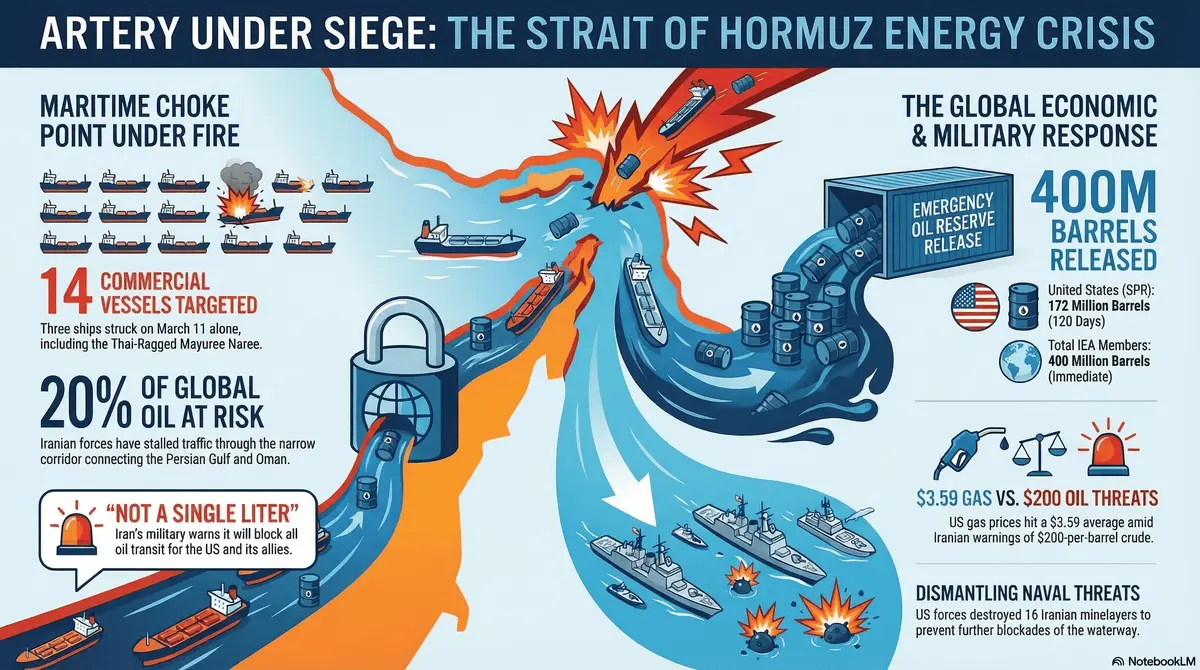
Dubai/Washington — Multiple commercial vessels have been struck by projectiles in the Strait of Hormuz amidst an ongoing war between the United States, Israel, and Iran. On March 11, 2026, authorities confirmed that three cargo ships were attacked off the coast of Iran, effectively halting transit through the vital maritime corridor. In response to the crisis, the International Energy Agency and the United States government have announced massive releases from their strategic petroleum reserves to stabilize soaring energy prices.
Below is a detailed examination of the maritime attacks, energy market impacts, and regional security dynamics.
Context & Background
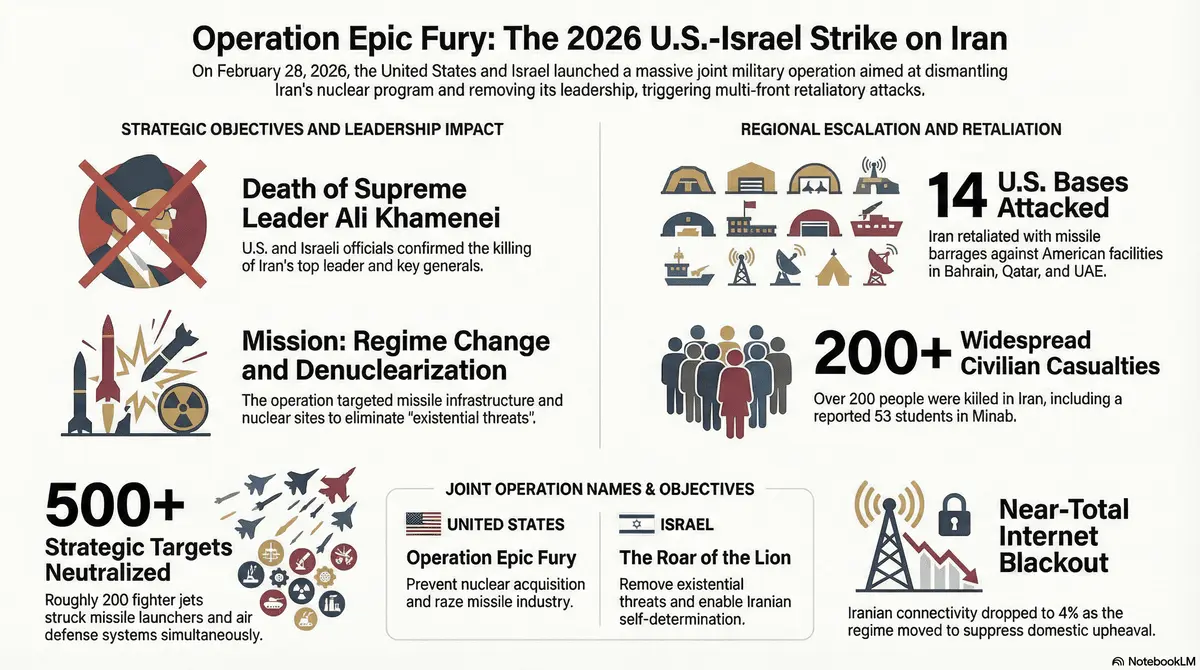
How did the current conflict start? The hostilities began on Feb. 28, 2026, when the United States and Israel launched a coordinated military campaign against Iran. The initial airstrikes resulted in the death of Iran’s Supreme Leader, Ali Khamenei, prompting Tehran to retaliate by targeting regional infrastructure and commercial shipping. The United States initiated the operation, dubbed Operation Epic Fury, to eliminate threats from the Iranian regime and its military apparatus.
The strategic significance of the Strait of Hormuz The Strait of Hormuz is a narrow waterway connecting the Persian Gulf and the Gulf of Oman, serving as a critical global energy artery. Approximately 20% of the world’s traded oil and natural gas typically passes through this maritime corridor. Its effective closure by Iranian military actions has severely disrupted the global supply chain and triggered widespread economic anxiety.
The key players and international response Iran’s Islamic Revolutionary Guard Corps has actively targeted international shipping, while the United States military has countered by destroying Iranian minelaying vessels. To mitigate the economic fallout, the International Energy Agency, led by Fatih Birol, authorized the release of 400 million barrels of emergency oil. Concurrently, U.S. Energy Secretary Chris Wright announced that the United States will release 172 million barrels from the Strategic Petroleum Reserve.
Q&A: Unpacking the Strait of Hormuz Crisis
Q: How is the disruption in the Strait of Hormuz impacting global energy markets?
A: The effective closure of the waterway has sparked a sharp increase in global oil prices and prompted unprecedented emergency interventions.
- Price Surge: Crude oil prices briefly jumped to nearly $120 a barrel, driving the United States national average for gasoline up to $3.59 per gallon.
- Supply Shock Mitigation: The International Energy Agency unanimously agreed to release 400 million barrels of oil, representing the largest emergency release in its history.
- Reserve Drawdown: President Donald Trump authorized the release of 172 million barrels from the Strategic Petroleum Reserve to ease domestic fuel costs.
- Export Interruption: Oil shipments from Saudi Arabia and Iraq have been severely choked off, though Iran continues to export its own crude through the corridor.
Q: Why is Iran targeting commercial shipping in the Persian Gulf?
A: The attacks are a retaliatory strategy aimed at inflicting economic pain on the United States and its allies to force an end to the military campaign.
- Economic Leverage: Iran seeks to trigger global economic chaos and manipulate regional security to demonstrate its leverage over international energy supplies.
- Military Objectives: The Islamic Revolutionary Guard Corps explicitly stated it will not allow oil to pass through the strait for the benefit of the United States or Israel.
- Target Range: Missiles and drones have hit vessels flagged to various nations, including a Thai-flagged bulk freighter, the Mayuree Naree, which caught fire after an explosion.
Q: How are the United States and Israel conducting their military operations?
A: The allied forces are utilizing advanced technology and widespread airstrikes to systematically dismantle Iranian military infrastructure.
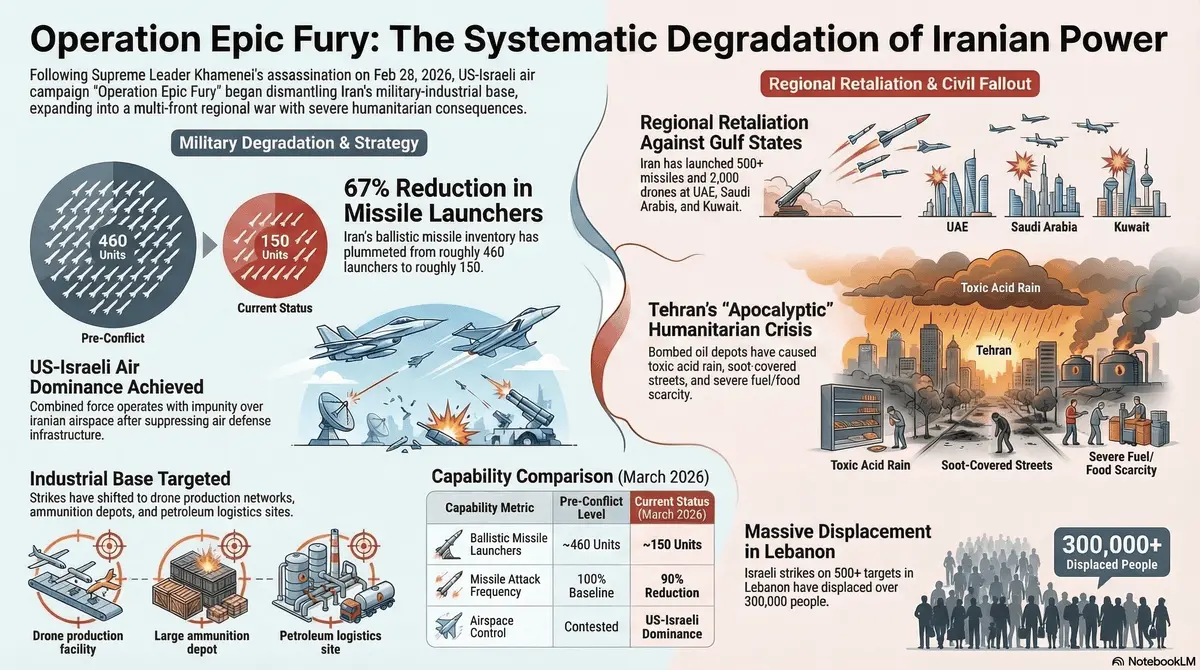
- Targeted Destruction: United States Central Command, under Admiral Brad Cooper, reported striking over 5,500 targets, including taking out an entire class of Iranian warships and 16 minelaying vessels.
- AI Integration: The United States military is employing advanced artificial intelligence tools to rapidly process data and identify strike targets in seconds.
- Multi-Front Engagement: While the United States focuses on Iran, Israel is conducting simultaneous, large-scale strikes against Hezbollah infrastructure in Lebanon and Beirut.
Q: Why are Gulf nations and international organizations expressing alarm over the conflict?
A: The war’s expansion threatens the sovereign security of neighboring states and risks triggering a severe humanitarian and economic catastrophe.
- Regional Spillover: Countries such as the United Arab Emirates, Kuwait, and Qatar have been forced to intercept incoming Iranian missiles and drones targeting their airspace and oil fields.
- Diplomatic Condemnation: The United Nations Security Council voted 13-0 to demand a halt to Iran’s “egregious attacks” on its Gulf neighbors, though Russia and China abstained.
- Infrastructure Threats: Drones have struck near major civilian hubs, including the Dubai International Airport, resulting in minor injuries and highlighting the vulnerability of the region.
Q: How is the Iranian leadership responding to the ongoing bombardment?
A: Iranian officials have adopted a defiant stance while managing internal leadership transitions following the deaths of key figures.
- Defiant Posturing: President Masoud Pezeshkian demanded security guarantees and reparations from the United States and Israel as a condition for peace.
- Leadership Succession: Following the death of Ali Khamenei, his son Mojtaba Khamenei was selected as the new supreme leader, despite reports that he was injured in the initial airstrikes.
- Unverified Status: At this time, the exact severity of Mojtaba Khamenei’s injuries remains unverified by official sources.
Editorial Note & Transparency
Verification Log:
- Military Command Bulletins: Cross-referenced statements from U.S. Central Command and the Israel Defense Forces regarding military targets and strike data.
- Economic Data Centers: Verified crude oil pricing fluctuations and strategic petroleum reserve release metrics from the International Energy Agency.
- Official Diplomatic Broadcasts: Monitored press conferences and official releases from the United Nations Security Council and regional government ministries.
Compliance:
- Privacy: This article respects user data under our Privacy Policy.
- Transparency: No sponsored content influenced this reporting.
Contact Us: For corrections or feedback, please email: news.desk@qnanews.com