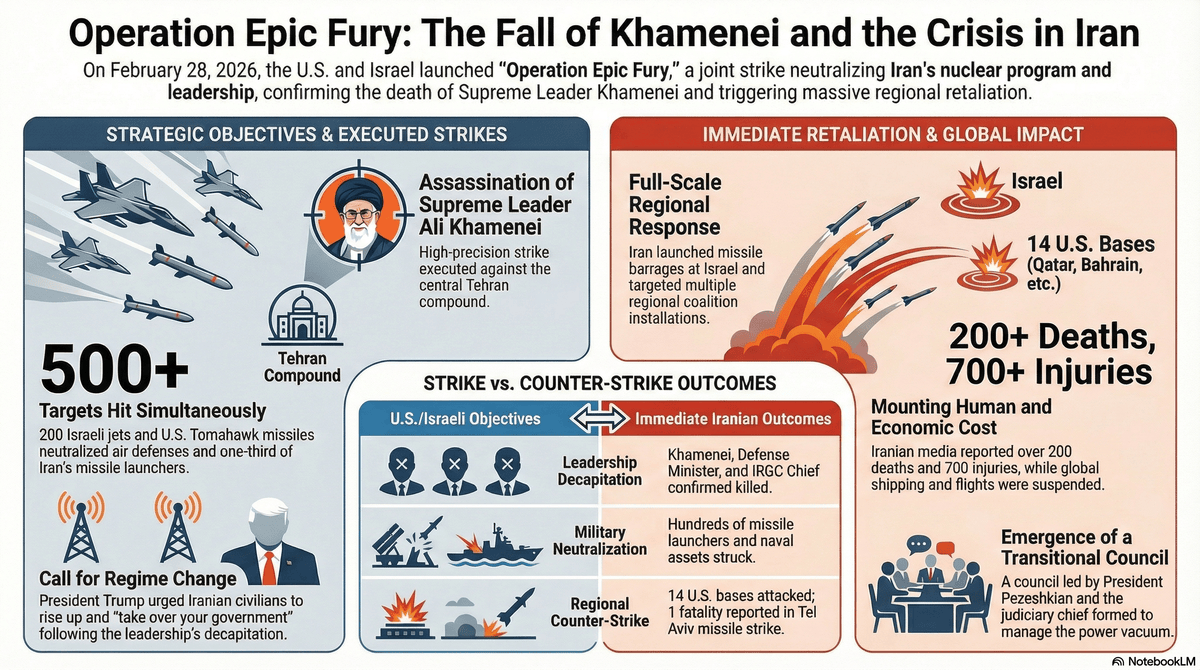
Dubai/Washington — Tensions in the Middle East have intensified following the first public statement from Iran‘s newly appointed Supreme Leader, Mojtaba Khamenei, who vowed to maintain a blockade on a critical global oil route and continue military retaliation against the United States and Israel. The escalation follows a series of lethal airstrikes that began on February 28, 2026, which killed his father, former Supreme Leader Ayatollah Ali Khamenei, and ignited the current widespread conflict. This ongoing warfare has profoundly impacted global energy markets, sending oil prices soaring and drawing neighboring Gulf states into the crossfire.
Below is a detailed examination of the ongoing war, its leadership shifts, and its global economic ramifications.
Context & Background
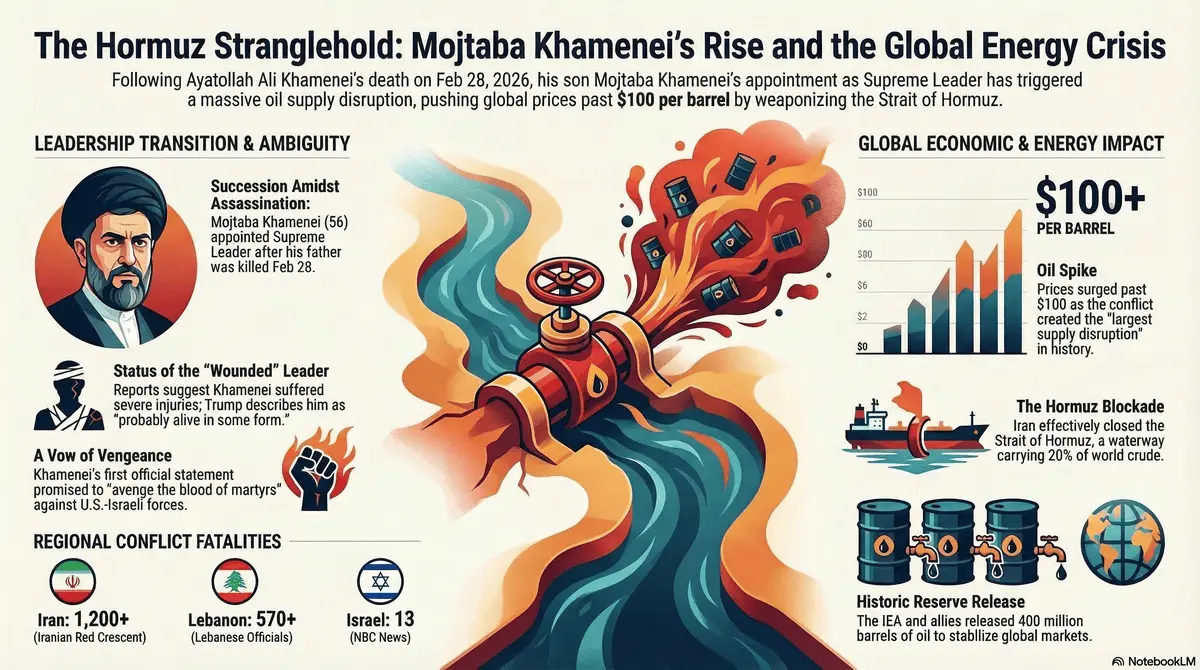
How did the leadership transition occur? Following the death of Ayatollah Ali Khamenei during the initial wave of United States and Israeli airstrikes on February 28, 2026, the Assembly of Experts in Iran swiftly appointed his son, Mojtaba Khamenei, as the new supreme leader. The 56-year-old hardline cleric, closely tied to the Islamic Revolutionary Guard Corps, delivered his first public message via a state television news anchor rather than an on-camera appearance, fueling rumors about his health after being reportedly wounded in the strikes.
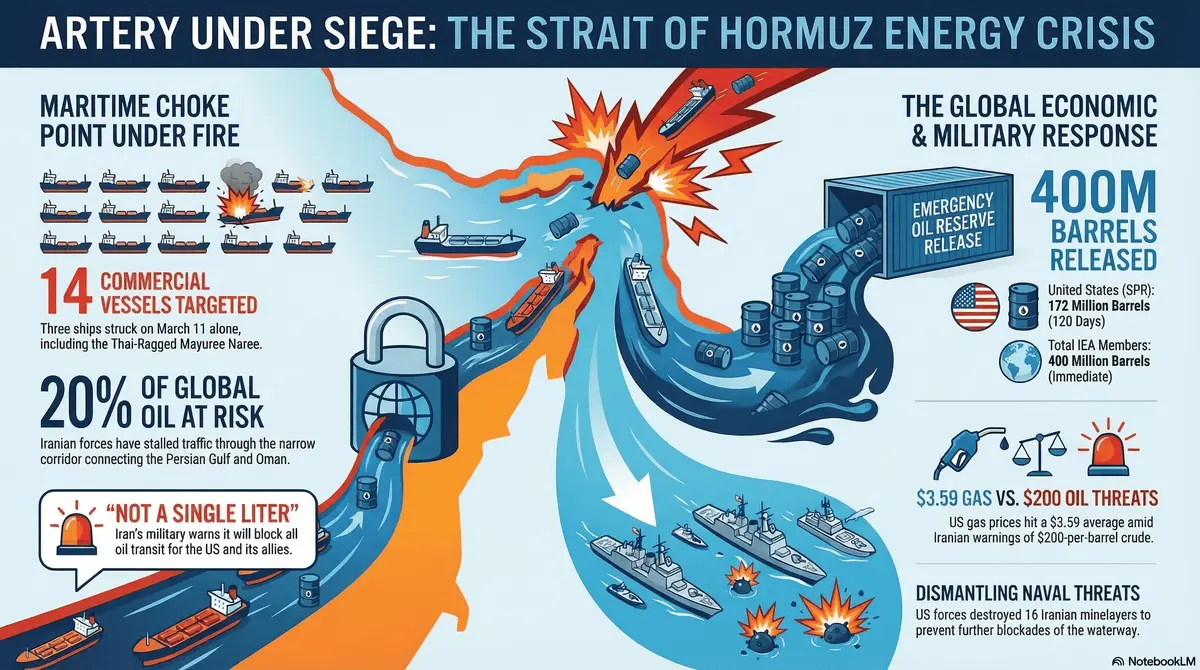
What is the strategic significance of the Strait of Hormuz? The Strait of Hormuz is a vital maritime chokepoint through which approximately one-fifth of the world’s traded oil passes. Mojtaba Khamenei has explicitly stated that Iran will continue to use the closure of this strait as leverage to pressure its adversaries, rendering the waterway effectively impassable. Consequently, the disruption has triggered massive shocks to the global economy, prompting the International Energy Agency to coordinate a record release of 400 million barrels of oil to stabilize surging crude prices.
Why are neighboring Gulf states being targeted? In addition to confronting the United States and Israel, the Iranian military has launched missile and drone attacks against neighboring Arab nations, including Saudi Arabia, the United Arab Emirates, and Bahrain. Mojtaba Khamenei justified these attacks by demanding that these countries shut down American military bases hosted on their soil, warning that promised American protection is a lie. The targeted nations have responded by activating their air defense systems and intercepting incoming Iranian loitering munitions and ballistic missiles.
How is the United States responding militarily and economically? The United States Central Command has conducted over 5,000 strikes against Iranian targets, crippling the Iranian Navy and degrading its drone and ballistic missile capabilities. Economically, the administration under President Donald Trump has authorized the release of 172 million barrels from the Strategic Petroleum Reserve and temporarily eased sanctions to allow the purchase of stranded Russian oil in a bid to lower domestic and global gas prices.
Q&A: Unpacking the US-Israel War with Iran
Q: How is the Iranian military adapting its tactics against superior air power?
A: Iran is utilizing asymmetric warfare tactics, including the deployment of cluster munitions and coordination with regional proxies, to challenge allied air defense systems.
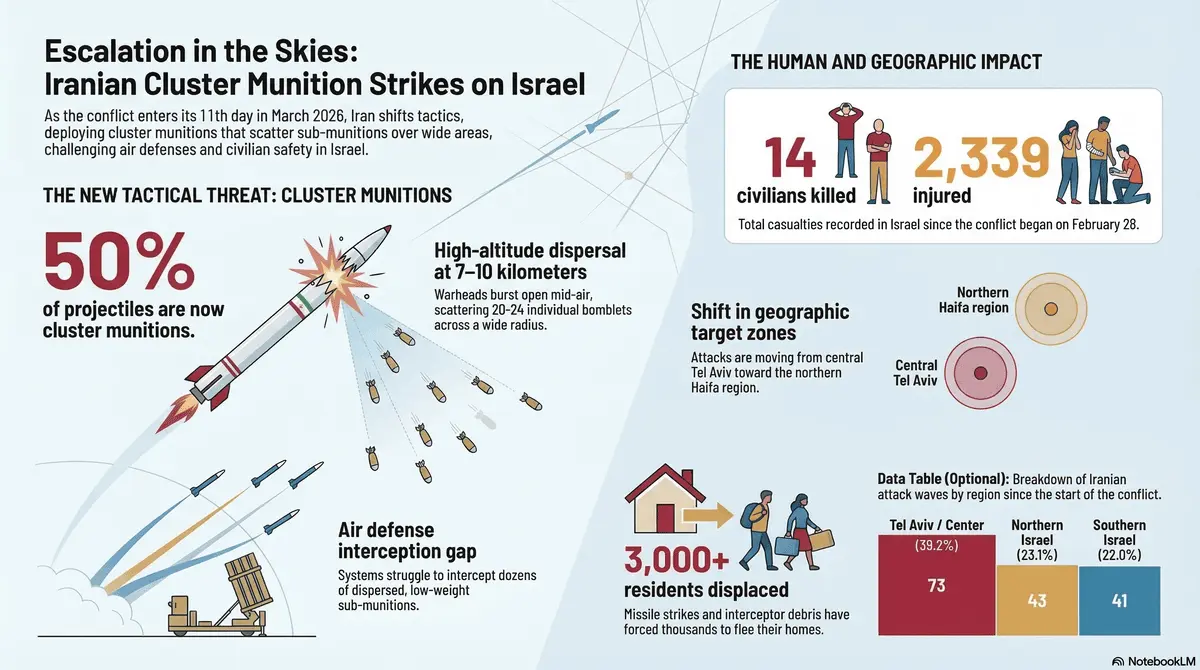
- Cluster Munitions Deployment: Iran has launched cluster munitions that scatter dozens of smaller bomblets across a wide area, making them highly difficult for Israel‘s air defense systems to intercept and posing a lethal threat to civilians.
- Proxy Group Coordination: Iranian forces are increasingly coordinating their missile barrages with regional proxy groups like Hezbollah in Lebanon, launching synchronized attacks to overwhelm enemy radar.
- Concealment Strategies: The United States military has accused Iranian forces of moving rocket launchers into civilian neighborhoods, near schools and hospitals, to deter allied airstrikes.
Q: Why have civilian and heritage sites sustained damage during the airstrikes?
A: Airstrikes have inadvertently struck civilian infrastructure and historical landmarks due to proximity to military targets and allegedly outdated intelligence.
- Outdated Intelligence: An American munition struck an elementary school in Minab, Iran, killing over 170 people; preliminary investigations suggest the compound was targeted because it served as a military base over a decade ago.
- Heritage Site Proximity: The United Nations cultural agency verified damage to historical landmarks such as the Golestan Palace in Tehran and the Masjed-e Jāme in Isfahan, prompting Iran to request enhanced protection statuses.
- Collateral Impact: Intense urban bombing campaigns by the Israel Defense Forces in Beirut, Lebanon, and Tehran have leveled residential buildings situated near suspected militant infrastructure.
Q: How are global energy markets reacting to the prolonged conflict?
A: Global oil markets have experienced severe volatility, with crude prices spiking above $100 per barrel due to the effective blockade of crucial shipping routes.
- Price Surges: Brent crude oil surged by more than 10 percent, crossing the $100 per barrel threshold as a direct result of maritime disruptions.
- Shipping Reroutes: At least 16 commercial vessels have been attacked by Iranian forces in the Persian Gulf, forcing international shipping companies to abandon the Strait of Hormuz and severely disrupting supply chains.
- Strategic Interventions: In an effort to counter the price spikes, the United States Treasury Department authorized temporary purchases of Russian oil stranded at sea, while global agencies orchestrated massive reserve releases.
Q: Why has the status of the new Iranian Supreme Leader sparked widespread speculation?
A: The physical absence of the new leader from public view has led to unverified rumors regarding his health and survival.
- Absence from Broadcasts: Mojtaba Khamenei‘s inaugural address to the nation was read by a television news anchor rather than broadcast as a live or recorded video message.
- Injury Reports: Multiple reports suggest the leader was injured during the strikes that killed his father, with an Iranian ambassador confirming he sustained minor injuries.
- Unverified Claims: At this time, claims that Mojtaba Khamenei is in a coma or suffered severe amputations remain unverified by official sources.
Q: How are international governments managing the safety of their citizens and military personnel?
A: Foreign governments are executing mass evacuations and bolstering defensive postures at regional military installations.
- Citizen Evacuations: The United States State Department has assisted over 27,000 Americans in evacuating the region, with an additional 40,000 returning via commercial travel.
- Base Defenses: Following deadly drone strikes on international bases, including an attack that killed a French soldier in Irbil, Iraq, allied forces are deploying interceptor drones sourced from Ukraine.
- Aviation Incidents: A United States KC-135 refueling plane crashed in western Iraq; officials confirmed the incident occurred in friendly airspace and was not the result of hostile fire.
Q: Why are human rights and international sporting organizations becoming involved in the conflict’s fallout?
A: The domestic crackdown by the Iranian regime has prompted international actors to offer asylum and reconsider Iran‘s participation in global events.
- Asylum Offers: Australia granted asylum to six players and a staff member of the Iranian women’s national soccer team after they faced regime retaliation for refusing to sing the national anthem.
- Tournament Participation: President Donald Trump publicly suggested that the Iranian men’s national soccer team should not participate in the upcoming World Cup, citing safety concerns.
- Domestic Repression: Iranian state television hosts have openly threatened domestic critics and protesters with severe consequences, including property confiscation and violence, as the regime seeks to maintain internal control.
Editorial Note & Transparency
Verification Log:
- Government Statements: Press briefings from the United States Central Command, United States Treasury Department, and various Middle Eastern defense ministries.
- News Reports: Field reporting and geopolitical analysis from established international broadcast and print media.
- International Agencies: Data and alerts from the International Energy Agency and the United Nations.
Compliance:
- Privacy: This article respects user data under our Privacy Policy.
- Transparency: No sponsored content influenced this reporting.
Contact Us: For corrections or feedback, please email: news.desk@qnanews.com