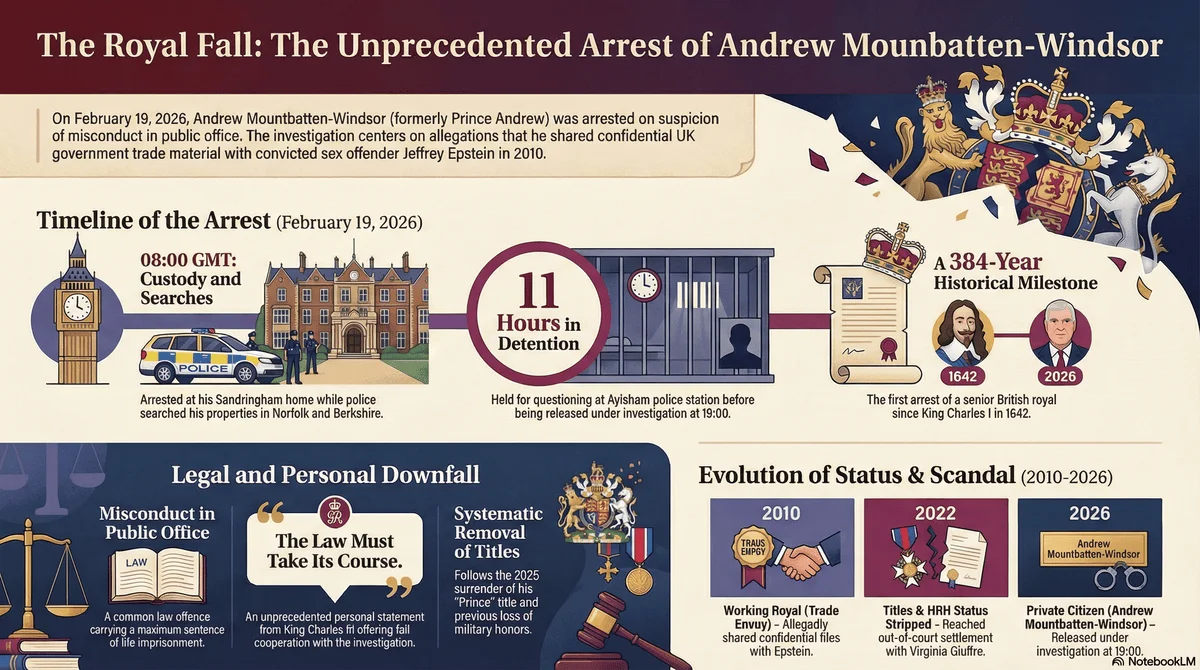
London/Norfolk — Andrew Mountbatten-Windsor, formerly Prince Andrew, was arrested and subsequently released under investigation by British police on suspicion of misconduct in public office linked to his ties with convicted sex offender Jeffrey Epstein. The arrest took place on February 19, 2026—Mountbatten-Windsor’s 66th birthday—with Thames Valley Police detaining him and executing property searches at the Sandringham estate in Norfolk and the Royal Lodge in Berkshire.
This marks the first time a senior British royal has been arrested in nearly 400 years, signaling a historic erosion of deference to the monarchy and a new era of legal accountability for powerful public figures. Below is a detailed examination of the charges, the evidence, and the institutional implications.
Context & Background
The Charges — Mountbatten-Windsor faces suspicion of misconduct in public office, not sexual offenses. The arrest stems directly from millions of pages of documents released by the U.S. Justice Department late last month. These files allegedly reveal that in 2010, while serving as Britain’s special envoy for international trade, Mountbatten-Windsor forwarded confidential government investment briefs—including details on the reconstruction of Helmand province in Afghanistan—to Epstein.
The Arrest Strategy — Police leadership determined that merely inviting Mountbatten-Windsor for an interview under caution would not be sufficient to progress the investigation. Arresting him granted investigators the immediate legal authority needed to conduct searches of his properties in Berkshire and Norfolk without having to separately apply to a magistrate for search warrants.
Royal Response King Charles III released an unprecedented personal statement asserting that “the law must take its course.” He signed the statement as “Charles R,” a highly unusual move designed to demonstrate personal support for the police investigation and explicitly distance the Crown from his brother’s actions.
Historical Significance — This is the first arrest of a senior British royal in nearly 400 years. The arrest is forcing the royal family to aggressively insulate itself from the fallout to preserve its public standing and signals a historic erosion of deference to the monarchy.
Q&A: Understanding the Charges and Implications
Q: How did the recently unsealed Epstein files trigger this specific arrest?
A: The arrest stems from newly released documents revealing alleged misuse of government information.
- Document Release: Millions of pages of documents released by the U.S. Justice Department late last month.
- The Allegation: Files allegedly reveal that in 2010, while serving as Britain’s special envoy for international trade, Mountbatten-Windsor forwarded confidential government investment briefs to Epstein.
- Sensitive Content: The leaked information included details on the reconstruction of Helmand province in Afghanistan.
- Legal Basis: This alleged sharing of confidential government information with a private individual forms the basis for the misconduct in public office charge.
Q: Why did Thames Valley Police choose to arrest him rather than conduct a voluntary interview?
A: The arrest was a strategic decision to maximize investigative authority.
- Insufficient Voluntary Approach: Police leadership determined that merely inviting Mountbatten-Windsor for an interview under caution would not be sufficient to progress the investigation.
- Legal Authority: Arresting him granted investigators the immediate legal authority needed to conduct searches of his properties.
- Warrant Bypass: The arrest allowed searches at the Sandringham estate in Norfolk and the Royal Lodge in Berkshire without having to separately apply to a magistrate for search warrants.
- Procedural Advantage: This approach enabled faster collection of potential evidence while maintaining the element of surprise.
Q: Are these charges related to the sexual assault allegations made by the late Virginia Giuffre?
A: No, but the investigation carries symbolic significance for assault survivors.
- Separate Investigation: The current investigation by Thames Valley Police is strictly focused on misconduct in public office, not sexual offenses.
- Family Response: Giuffre’s family celebrated the arrest as a “win” and a step toward accountability.
- Future Uncertainty: At this time, whether this arrest will lead to a broader criminal probe into sexual assault allegations remains unverified by official sources.
- Current Status: Mountbatten-Windsor has consistently denied any wrongdoing related to sexual assault allegations.
Q: How is this event impacting the British monarchy as an institution?
A: The arrest is forcing unprecedented institutional distance and damage control.
- Aggressive Insulation: The royal family is actively working to insulate itself from the fallout to preserve its public standing.
- King’s Unprecedented Statement: King Charles III signed his public statement as “Charles R,” a highly unusual personal signature rather than the typical official royal communication.
- Strategic Messaging: The statement asserting “the law must take its course” demonstrates personal support for the police investigation.
- Historical Shift: This represents a historic erosion of deference to the monarchy and signals that even senior royals are not above the law.
Q: What is the potential legal penalty if Mountbatten-Windsor is convicted?
A: The charges carry extremely severe potential consequences.
- Offense Severity: Misconduct in public office is a highly serious offense in the U.K.
- Maximum Penalty: According to the Crown Prosecution Service, the charge carries a maximum sentence of life imprisonment.
- Current Status: Mountbatten-Windsor has only been released under investigation, meaning he has neither been formally charged nor exonerated.
- Next Steps: Police will continue their investigation to determine whether sufficient evidence exists to bring formal charges.
Q: How is the United States responding to the arrest?
A: The arrest is amplifying pressure for U.S. accountability measures.
- Congressional Response: Democratic Congressman Suhas Subramanyam noted the disparity between U.K. criminal probes and the U.S., where consequences for those in the Epstein files have mostly played out in the “court of public opinion.”
- Legal Limitations: Mountbatten-Windsor cannot be legally compelled to testify in the U.S.
- Political Pressure: American lawmakers hope his arrest will pressure him into cooperating with ongoing congressional inquiries.
- Precedent Impact: The U.K. arrest may create momentum for similar accountability measures against other prominent figures named in the Epstein documents.
Editorial Note & Transparency
Verification Log:
- Official Police Statements: Thames Valley Police and the National Police Chiefs’ Council regarding the arrest, release under investigation, and the 30-minute advance notice provided to the Home Office.
- Official Royal Statements: A direct public statement from King Charles III.
- Legal Disclosures: U.S. Justice Department document releases outlining the 2010 email correspondence between Mountbatten-Windsor and Epstein.
- Eyewitness Reports: Journalists and photographers documenting Mountbatten-Windsor’s departure from Aylsham police station and unmarked police presence at Sandringham.
Compliance:
- Privacy: This article respects user data under our Privacy Policy.
- Transparency: No sponsored content influenced this reporting.
Contact Us: For corrections or feedback, please email: newsdesk@qnanews.com