Washington, D.C. — The United States government has released the 2025-2030 Dietary Guidelines for Americans, fundamentally altering federal nutritional advice by prioritizing proteins, healthy fats, and whole foods while restricting ultra-processed items. The new framework was formally announced by Health Secretary Robert F. Kennedy Jr. in January 2026. This represents a structural pivot from decades of prior advice that focused heavily on refined carbohydrates, with immediate implications for consumer budgets, public health policy, and global food supply chains.
Below is a detailed examination of the new dietary framework and its broad economic and nutritional impacts.
Context & Background
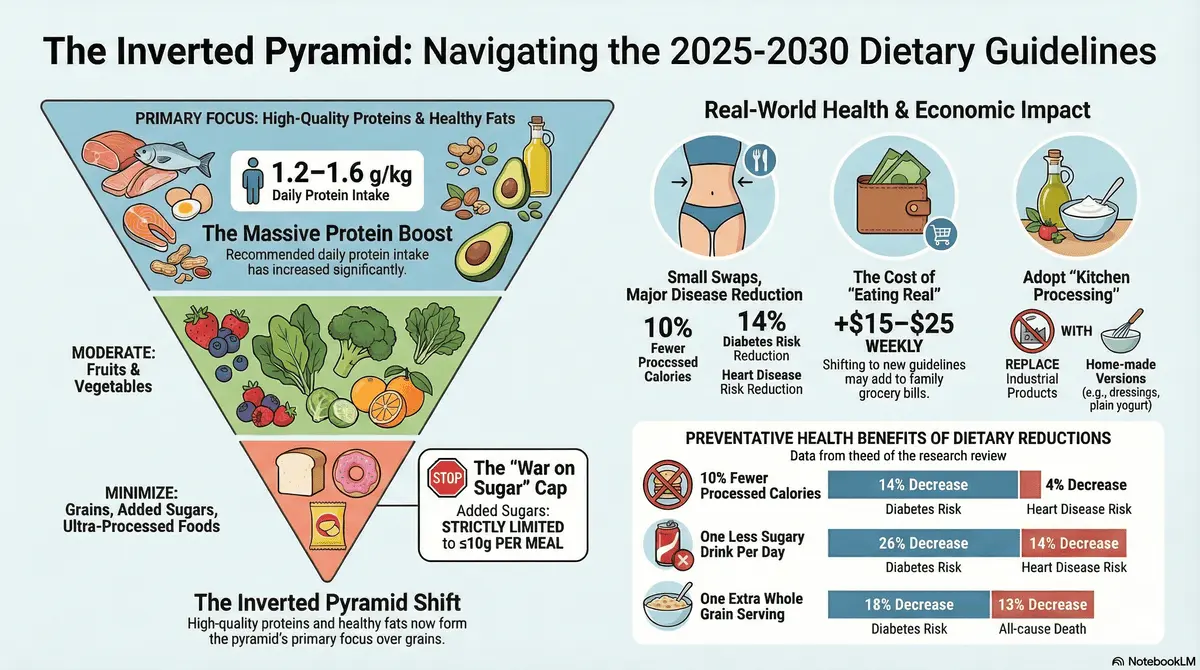
The Inverted Pyramid Paradigm The new guidelines introduce an “inverted pyramid” that abandons the 1992 framework, which recommended six to 11 servings of grains daily. Instead, the modern approach positions high-quality proteins, full-fat dairy, and healthy fats at the pinnacle of a healthy diet, shrinking the recommended intake of refined carbohydrates to the smallest section.
Key Drivers of the Policy Shift Health Secretary Robert F. Kennedy Jr. mandated the guidelines to focus on helping Americans eat real food to combat diet-related chronic diseases. This policy directly targets the overconsumption of calorie-dense, nutrient-poor ultra-processed foods, which currently account for over half of the calories consumed by adults in the United States.
Implications for Federal Nutrition Programs These standards serve as a mandatory blueprint for major federal purchasing and assistance programs, including the National School Lunch Program and the Supplemental Nutrition Assistance Program. Billions of dollars in institutional food spending will be redirected to prioritize whole foods, impacting menus for millions of schoolchildren and low-income families.
Economic Impact on Consumers Aligning with the new recommendations is expected to increase grocery bills, as the Consumer Price Index for food at home rose 2.1% year-over-year. Transitioning a family’s diet to include more whole foods, fresh produce, and premium proteins could add $15 to $25 per week to standard grocery costs, depending on consumer choices and local market conditions.
Q&A: Unpacking the 2025-2030 Dietary Guidelines
Q: How do the new guidelines change daily protein and fat recommendations?
A: The guidelines significantly increase daily protein targets and endorse whole-food sources of fat.
- Protein Thresholds: Recommended intake has risen from 0.8 grams to between 1.2 and 1.6 grams per kilogram of body weight.
- Fat Sources: Full-fat dairy, eggs, red meat, and olive oil are now classified as essential components of a nutrient-dense diet, shifting away from previous low-fat mandates.
- Cardiology Pushback: The American College of Cardiology notes that while proteins are emphasized, prioritizing plant-based proteins and unsaturated fats over red meat and butter remains better supported by long-term cardiovascular evidence.
Q: Why is there such a strict focus on added sugars and ultra-processed foods?
A: The guidelines aim to address chronic diet-related diseases by setting hard limits on ingredients lacking nutritional value.
- Meal-Based Sugar Caps: The previous guidance of limiting sugar to 10% of total daily calories has been replaced by a strict limit of under 10 grams of added sugar per meal.
- Early Childhood Restrictions: The framework advises that children under age four consume zero added sugars to establish healthy baseline dietary habits.
- Chronic Disease Mitigation: Moderate to high-quality evidence links highly processed foods to elevated risks of Type 2 diabetes, cardiovascular disease, dementia, and all-cause mortality.
Q: How will this policy shift impact the agricultural and fresh produce supply chains?
A: The guidelines place immense pressure on supply chains to deliver reliable, high-quality whole foods at scale.
- Logistical Demands: With fruits and vegetables acting as the foundation of the plate, the produce industry must enhance cold chain management and harvesting precision to ensure daily availability.
- Shelf-Stable Integrations: To maintain accessibility and reduce waste, canned, frozen, and dried produce will be heavily leveraged alongside fresh options to mitigate seasonal and geographic constraints.
- Sustainability Pressures: Increased agricultural demand requires resilient farming practices to ensure growth does not severely deplete land and water resources.
Q: How are food manufacturers expected to adapt to the inverted pyramid?
A: Companies will need to heavily invest in reformulation and shifting their product portfolios to remain competitive.
- Product Reformulation: Brands must strip added sugars and artificial ingredients from existing products to meet new federal limits without sacrificing taste or shelf life.
- Ingredient Partnerships: Manufacturers will increasingly rely on specialized ingredient companies that focus on enzymes, cultures, and natural flavorings like herbs and spices.
- Federal Assistance Compliance: To capture spending from the Supplemental Nutrition Assistance Program, manufacturers must ensure their products meet the new “real food” classifications to avoid being phased out of government-subsidized purchasing.
Q: How might these dietary changes influence global markets and investment strategies?
A: Investors are identifying structural winners in sectors that provide natural, nutrient-dense foods and specialized agricultural products.
- Aquaculture Expansion: Producers of omega-3 rich seafood are positioned for significant growth due to the explicit federal protein mandate endorsing seafood.
- Microbiome Focus: The formal federal endorsement of fermented foods like kefir, miso, and sauerkraut provides a financial tailwind for specialized culture and dairy companies.
- Global Standardization: Because the United States accounts for nearly 30% of global food spending, multinational retailers and operators frequently align their global supply strategies with U.S. nutritional standards, exporting these dietary shifts internationally.
Editorial Notes & Transparency
Verification Log:
- Medical Journal: The American College of Cardiology analysis of cardiovascular impacts and protein source comparisons.
- Financial Report: Consumer Price Index metrics detailing grocery inflation and the economic impacts of transitioning to whole foods.
- Industry Insight: Evaluations of supply chain and investment ramifications from the Blue Book and QuotedData.
Compliance:
- Privacy: This article respects user data under our Privacy Policy.
- Transparency: No sponsored content influenced this reporting.
Contact Us: For corrections or feedback, please email: news.desk@qnanews.com