New York/London — Stargazers and astronomers are preparing for a unique celestial alignment featuring six planets visible in the evening sky. Observers can witness this planetary parade shortly after sunset on February 28, 2026. The alignment offers an uncommon opportunity to view a large grouping of planetary bodies tracing a curved arc along the ecliptic plane.
Below is a detailed examination of this rare planetary alignment.
Context & Background
What is a planetary alignment? A planetary alignment, often colloquially referred to as a planetary parade, occurs when several planets gather closely on one side of the sun simultaneously. From the perspective of Earth, these planets appear to line up along the ecliptic, which is the flat plane representing the path the sun takes across the sky. While they appear close together to observers, massive distances still separate these planetary bodies in deep space.
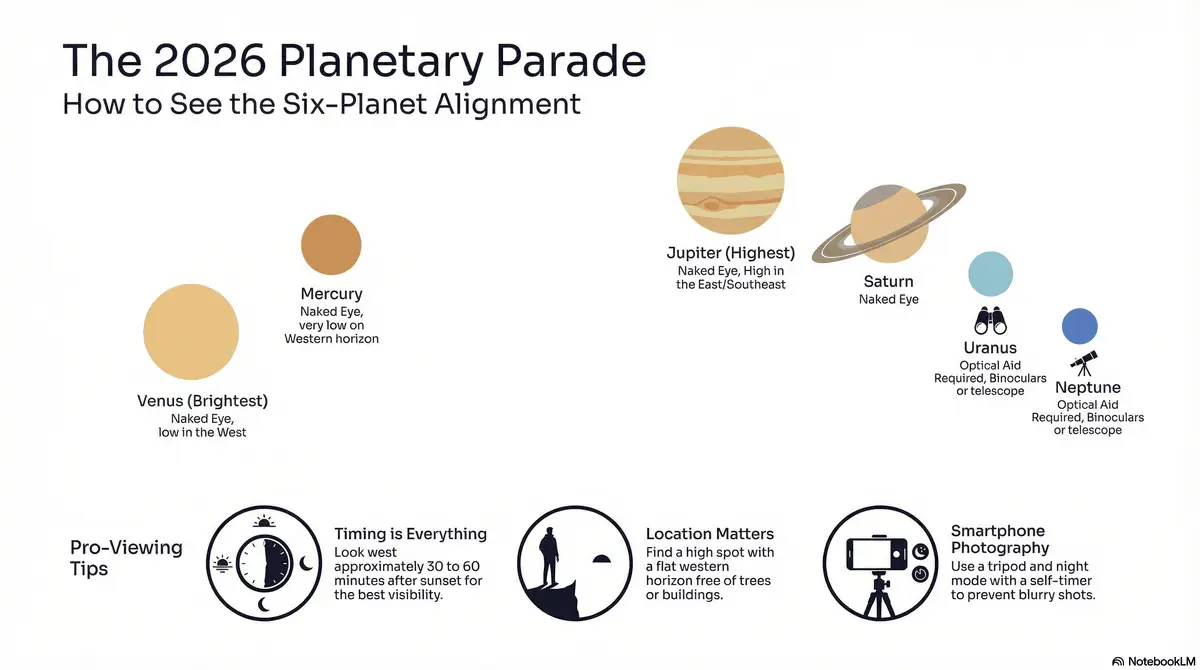
Which celestial bodies are involved? The alignment features six planets: Mercury, Venus, Saturn, Jupiter, Uranus, and Neptune. Venus, Saturn, Jupiter, and Mercury will be visible to the unaided eye, whereas the ice giants Uranus and Neptune require optical assistance to be seen. Mars is the only major planet absent from this evening display, as it is currently positioned in the morning sky below the horizon.
How does orbital mechanics create this view? All planets orbit the sun in a relatively flat disk, which scientists compare to spun pizza dough flattening out. Because each planet travels at a different speed, they constantly shift positions relative to one another. Occasionally, their independent orbital paths bring several of them into the same general quadrant of the sky from the vantage point of Earth.
Why is this specific alignment significant? While seeing two or three planets in the evening is relatively common, a large planetary alignment featuring six planets is a much rarer occurrence. Observers last experienced a full seven-planet alignment in February 2025, and the next one is not predicted until 2040. The concentration of so many bright planets visible simultaneously makes this event a notable target for amateur skywatchers and professional astronomers alike.
Q&A: Unpacking the Planetary Parade
Q: How does the timing of sunset impact the visibility of this alignment?
A: The viewing window is heavily restricted by the setting sun and the rapid descent of the inner planets below the horizon.
- Twilight Interference: Venus and Mercury are positioned very low on the western horizon and will compete with the remaining glare of the sunset.
- Brief Viewing Window: Observers have an optimal viewing time of roughly 30 to 60 minutes after sunset before the lowest planets disappear from view.
- Horizon Obstructions: Because the planets sit so low, any physical obstructions like trees, hills, or tall buildings will completely block the view.
Q: Why are telescopes required to view certain planets in this alignment?
A: While the gas giants and inner planets shine brightly, the extreme distance and composition of the ice giants make them too dim for the naked eye.
- Distance Factor: Uranus and Neptune are located incredibly far from Earth, drastically reducing the amount of reflected sunlight that reaches observers.
- Optical Enhancement: A telescope with an aperture of at least 8 inches is recommended to reveal the tiny bluish disk of Neptune, which sits near Saturn.
- Star Chart Navigation: Identifying these dim planets requires reference points; for example, Uranus can be located roughly 5 degrees below the Pleiades star cluster.
Q: How do environmental factors and location dictate the stargazing experience?
A: Local weather patterns and light pollution play critical roles in determining whether the alignment can be successfully observed.
- Cloud Cover Constraints: Weather forecasts predict mixed conditions, with potential cloud cover obstructing views in locations like Ohio and northern California, while clear skies are expected in southern California.
- Light Pollution Dynamics: For the best chance of spotting fainter bodies, observers must travel away from city lights to dark sky environments.
- Night Vision Adaptation: Astronomers recommend giving eyes up to ten minutes to adjust to the dark and utilizing red-light modes on smartphones to prevent disrupting night vision.
Q: Why has February 28 been specifically targeted as the peak date for this event?
A: The concentration of planets is considered closest on this date, though the exact reason for its viral popularity on social media involves several variables.
- Orbital Grouping: According to astronomy applications like Star Walk, the planets appear most closely grouped together from the perspective of Earth on this specific date.
- Lunar Positioning: The waxing moon will be situated near the bright planet Jupiter, creating a visually appealing endpoint to the planetary line.
- Social Media Amplification: At this time, the exact origin of why February 28 became the definitive viral date remains unverified by official sources, as the planets actually remain in these general positions for several weeks.
Q: How does the visual arrangement of the planets differ across hemispheres?
A: The observer’s geographical latitude fundamentally alters the orientation and trajectory of the planetary parade in the sky.
- Northern Hemisphere View: Observers will see the planets form a curved line starting from the southwest horizon and stretching up toward the southeast, with Jupiter positioned high above.
- Southern Hemisphere View: The alignment will appear visually reversed; for instance, observers in Australia will see Jupiter in the north and Uranus in the northwest.
- Sunset Discrepancies: Variations in local sunset times across different latitudes dictate the exact minute stargazers must begin observing before the lowest planets set.
Editorial Notes & Transparency
Verification Log:
- Scientific Agency Data: Verified via statements from the Royal Astronomical Society and NASA.
- Meteorological Forecasts: Corroborated using weather reports predicting cloud cover in regions like Ohio and California.
- Astronomical Software: Confirmed against planetary tracking applications such as Star Walk.
Compliance:
- Privacy: This article respects user data under our Privacy Policy.
- Transparency: No sponsored content influenced this reporting.
Contact Us: For corrections or feedback, please email: news.desk@qnanews.com