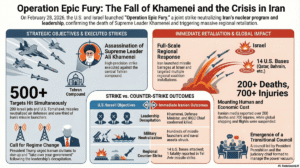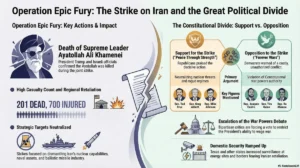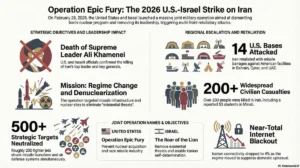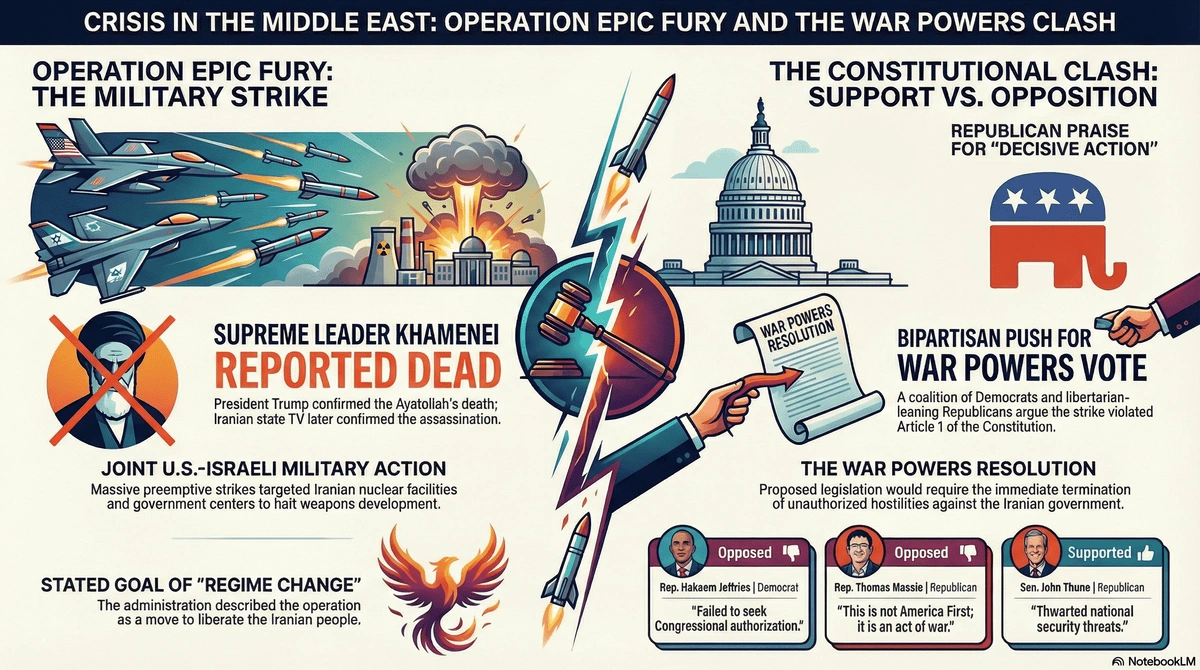
Washington — A joint military operation conducted by the United States and Israel has targeted Iranian military and government sites, leading to the reported death of Iranian Supreme Leader Ayatollah Ali Khamenei. President Donald Trump announced the major combat operations, dubbed Operation Epic Fury, on Saturday, February 28, 2026. The unilateral executive action has triggered intense bipartisan debate within the United States Congress, with lawmakers introducing resolutions to limit presidential war powers.
Below is a detailed breakdown of the geopolitical ramifications and domestic political fallout.
Context & Background
What Triggered Operation Epic Fury? The Trump administration launched the military campaign, citing a need to halt the Iranian nuclear program and respond to Iran‘s support for terrorism across the Middle East. President Donald Trump utilized military force as a last resort following weeks of failed diplomatic negotiations with the Iranian regime. The objective of the strikes includes crippling Iran‘s nuclear capabilities and potentially enabling regime change from within the country.
The Key Players and Leadership President Donald Trump coordinated the strikes alongside Israel, while Secretary of State Marco Rubio briefed top congressional leaders, known as the Gang of 8, prior to the offensive. On the Iranian side, Supreme Leader Ayatollah Ali Khamenei is presumed dead following the bombardment, though conflicting reports have emerged regarding the stability of the Iranian government. In the United States Congress, figures like Senate Majority Leader John Thune and House Speaker Mike Johnson have supported the action, while Democratic leaders like Hakeem Jeffries and Chuck Schumer demand legislative oversight.
The War Powers Resolution Push A bipartisan coalition led by Senators Tim Kaine and Rand Paul, alongside Representatives Ro Khanna and Thomas Massie, is demanding an immediate vote on a War Powers Resolution. This legislative maneuver seeks to restrict the president’s ability to deploy United States armed forces in hostilities against Iran without formal congressional authorization. Proponents argue the Constitution mandates congressional approval for acts of war, expressing fears of entering another prolonged conflict in the region.
Q&A: Unpacking Operation Epic Fury
Q: Why are lawmakers pushing for a War Powers Resolution?
A: Lawmakers are attempting to reassert congressional authority over declarations of war and prevent an open-ended military entanglement.
- Constitutional Duty: Members of Congress emphasize that the Constitution vests the power to declare war exclusively with the legislative branch, not the executive branch.
- Bipartisan Concern: Both Democrats like Representative Adam Smith and Republicans like Senator Rand Paul have opposed the unilateral nature of the strikes, viewing them as an unauthorized war of choice.
- Escalation Fears: Politicians fear the unapproved strikes will pull the United States into a costly, prolonged conflict in the Middle East without a clear strategic endgame.
Q: How has the political establishment reacted to the president’s decision?
A: The reaction is deeply fractured, with most Republicans praising the decisiveness of the strikes and most Democrats demanding immediate congressional oversight.
- Republican Support: Leaders such as Senator Lindsey Graham and Representative Ashley Hinson praised the strikes for targeting a state sponsor of terrorism and defending American interests.
- Democratic Opposition: Figures like Senator Tammy Duckworth and Senator Tim Kaine condemned the strikes as reckless, citing the administration’s failure to consult Congress prior to launching the attacks.
- Republican Dissent: A small but vocal group of Republicans, including Representative Warren Davidson and Representative Thomas Massie, broke ranks to demand strict adherence to constitutional war powers and authorization.
Q: How did the administration communicate the strikes to Congress?
A: The administration provided limited advance notice to a select group of high-ranking congressional leaders rather than seeking broader legislative approval.
- Intelligence Briefing: Secretary of State Marco Rubio reached out to the bipartisan Gang of Eight intelligence leaders prior to the initiation of the military operation.
- Committee Notification: The Defense Department formally notified the House and Senate Armed Services committees early in the morning as the strikes were already underway.
- Demands for Transparency: Senate Minority Leader Chuck Schumer and others have criticized this limited communication, demanding an immediate classified briefing for all senators to understand the scope of the threat.
Q: Why is the possibility of regime change in Iran heavily scrutinized?
A: Historical precedents of intervention in the region suggest that aerial bombardment rarely results in successful or stable regime change.
- Historical Failures: House Minority Leader Hakeem Jeffries noted that past attempts at regime change in countries like Iraq, Libya, and Afghanistan ultimately failed to produce long-term stability.
- Air Power Limitations: Experts like Professor Robert Pape point out that air superiority alone has never successfully toppled a government in modern warfare.
- Civilian Vulnerability: There are profound concerns that encouraging civilian uprisings without ground support could lead to massive casualties, echoing the brutal aftermath of the 1991 uprisings in Iraq.
Q: How are civilian casualties and local impacts being reported?
A: Reports of civilian casualties remain conflicting amid the broader military targeting of Iranian government and defense sites.
- Targeting Strategy: The Trump administration maintains that the joint daytime strikes specifically targeted military and government installations.
- Casualty Claims: At this time, the claim that a girls’ elementary school was hit, resulting in the deaths of 85 students, remains unverified by official sources.
- Domestic Demonstrations: In the United States, cities like Chicago and Appleton have seen public protests demanding an end to the bombing, while some Iranian-Americans have simultaneously rallied to celebrate the potential fall of the regime.
Editorial Notes & Transparency
Verification Log:
- Network Broadcast: ABC7 News and WLS-TV Chicago coverage of military strikes and local protests.
- National Outlet: NBC News and PBS News reports detailing the congressional push for a War Powers Resolution.
- Local Affiliate: KOMO News and FOX 13 Seattle reporting on individual lawmaker reactions and local public safety impacts.
Compliance:
- Privacy: This article respects user data under our Privacy Policy.
- Transparency: No sponsored content influenced this reporting.
Contact Us: For corrections or feedback, please email: news.desk@qnanews.com