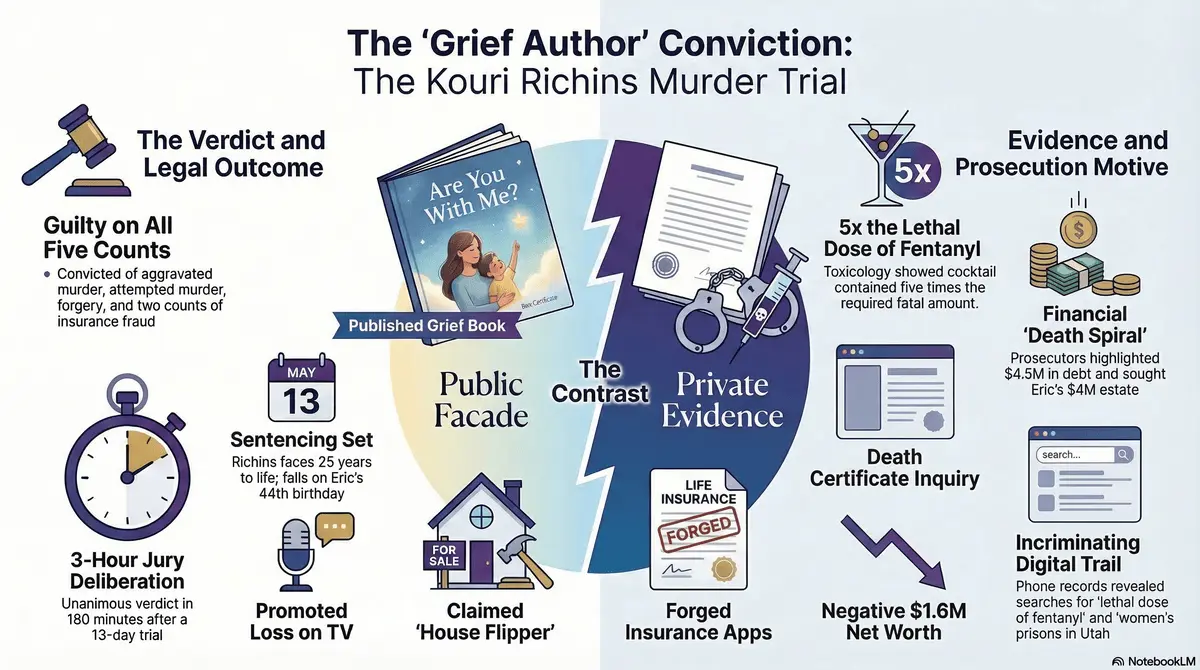
Park City, Utah — A Summit County jury has convicted children’s book author Kouri Richins of aggravated murder and multiple financial crimes related to the lethal poisoning of her husband, Eric Richins. The jury delivered the guilty verdicts after approximately three hours of deliberation on March 16, 2026. The conviction brings a close to a highly publicized trial that exposed severe financial debts, allegations of a fabricated public image, and digital evidence of premeditation.
Below is a detailed breakdown of the verdict, the prosecution’s evidence, and the defense’s core arguments.
Context & Background
The Crime and the Verdict On March 4, 2022, Eric Richins was found dead in the couple’s home in Kamas, Utah, with an autopsy revealing he had ingested roughly five times the lethal dose of illicit fentanyl. Prosecutors successfully convinced the jury that Kouri Richins intentionally poisoned her husband’s Moscow Mule cocktail, a fatal act that followed an earlier attempt to poison him with a laced sandwich on Valentine’s Day. As a result, the jury convicted her of aggravated murder, attempted aggravated murder, forgery, and two counts of insurance fraud.
Financial Motives and the Defense The state, led by prosecutor Brad Bloodworth, characterized the defendant as an ambitious individual trapped in a downward financial death spiral. Facing a negative net worth from a failing real estate business, Kouri Richins allegedly sought to inherit her husband’s estate and collect on fraudulently obtained life insurance policies. Defense attorney Wendy Lewis countered these claims by arguing the investigation was sloppy, driven by confirmation bias, and lacked physical evidence linking the defendant directly to the poisoned drink.
The Children’s Book and Public Image Roughly a year after the murder, Kouri Richins gained national media attention by publishing a children’s book on grief designed to help her three sons process the loss of their father. Prosecutors utilized this publication during the trial, arguing it was a calculated maneuver to maintain a public facade of innocence while deflecting suspicion away from her involvement in the homicide.
Family Reaction and Next Steps Following the reading of the verdict, Amy Richins, the victim’s sister, expressed the family’s profound relief and their commitment to honoring her brother’s memory. Kouri Richins, who bowed her head as the verdict was read, now faces a maximum penalty of life in prison without the possibility of parole. Her sentencing hearing is officially scheduled for May 13, 2026, which coincides with what would have been the 44th birthday of Eric Richins.
Q&A: Unpacking The Kouri Richins Verdict
Q: How did the prosecution dismantle the defense’s claim that the victim may have accidentally overdosed?
A: Prosecutors utilized witness testimony and digital forensics to prove the death was a calculated poisoning rather than a tragic accident.
- Victim’s History: Family and friends testified that Eric Richins had no history of illicit drug use, making an accidental fentanyl overdose highly unlikely.
- Search History: Digital analysts revealed that Kouri Richins searched online for “what is a lethal dose of fentanyl” and “if someone is poisoned what does it go down on the death certificate as,” indicating clear premeditation.
- Alibi Distancing: During the 911 call, the defendant immediately attempted to establish an alibi by emphasizing she was in her son’s room, rather than initiating immediate lifesaving measures on her husband.
Q: Why was the testimony of the housekeeper considered a pivotal, yet contentious, element of the trial?
A: The housekeeper provided the direct link between the defendant and the murder weapon, though the defense heavily scrutinized her credibility.
- Drug Procurement: Carmen Lauber, the former housekeeper, testified that Kouri Richins repeatedly asked her to procure illicit pills, specifically requesting the “Michael Jackson stuff”.
- Cellular Tracking: The prosecution corroborated the housekeeper’s claims by showing that her phone and a known drug dealer’s phone were located near the same gas station on dates corresponding to the timeline of the poisoning attempts.
- Defense Rebuttal: The defense argued the housekeeper merely parroted a narrative fed to her by detectives to secure immunity and avoid prison time for her own unrelated criminal charges.
Q: How did the defendant’s financial situation establish a motive for the murder?
A: Financial records demonstrated that the defendant was facing insurmountable debt and stood to gain millions from her husband’s death.
- Business Insolvency: A forensic accountant testified that the real estate flipping business operated by Kouri Richins was imploding, leaving her with a negative net worth of $1.6 million just after the murder.
- Fraudulent Insurance: The prosecution presented evidence that the defendant forged the signature of Eric Richins on a $100,000 life insurance policy application, adding to the $2.2 million in total coverage.
- Rapid Spending: Shortly after her husband’s death, the defendant spent $1.3 million of the life insurance payout in a matter of months, yet still remained in substantial debt.
Q: How did the publication of the children’s book influence the prosecution’s strategy?
A: The state framed the book as a calculated maneuver to maintain a facade of innocence and capitalize on the victim’s death.
- Public Facade: Prosecutors argued the book, “Are You With Me?”, was commissioned by Kouri Richins to deflect suspicion and portray herself as a grieving widow to the public.
- Ghostwritten Content: The lead investigator revealed during testimony that the defendant had actually paid a ghostwriting company to pen the narrative.
- Media Tour: Her appearances on local television to promote the book occurred just weeks before her arrest, underscoring the prosecution’s claim that she was an intensely ambitious individual focused on managing her image.
Q: Why did the defense argue that the investigation was fundamentally flawed from the beginning?
A: The defense asserted that authorities suffered from confirmation bias and failed to adequately pursue alternative leads regarding the victim’s death.
- Missing Physical Evidence: Attorney Wendy Lewis stressed to the jury that there was zero physical evidence directly proving fentanyl was placed in the Moscow Mule cocktail by Kouri Richins.
- Ignored Leads: The defense criticized investigators for failing to look into a recent trip the victim took to Mexico or to systematically test an old prescription bottle found on his nightstand.
- Jailhouse Letter Context: While prosecutors claimed a letter found in the defendant’s cell was an attempt to fabricate an alibi involving the victim obtaining drugs from Mexico, the defense argued the claims in the letter were not properly investigated by authorities.
Editorial Note & Transparency
Verification Log:
- Court Records: Sourced directly from trial proceedings at the Summit County Courthouse.
- Law Enforcement Statements: Information verified via police charging documents, testimony from the lead detective, and 911 audio.
- Financial Forensics: Corroborated by expert witness testimony and forensic accounting presented during the trial.
Compliance:
- Privacy: This article respects user data under our Privacy Policy.
- Transparency: No sponsored content influenced this reporting.
Contact Us: For corrections or feedback, please email: news.desk@qnanews.com