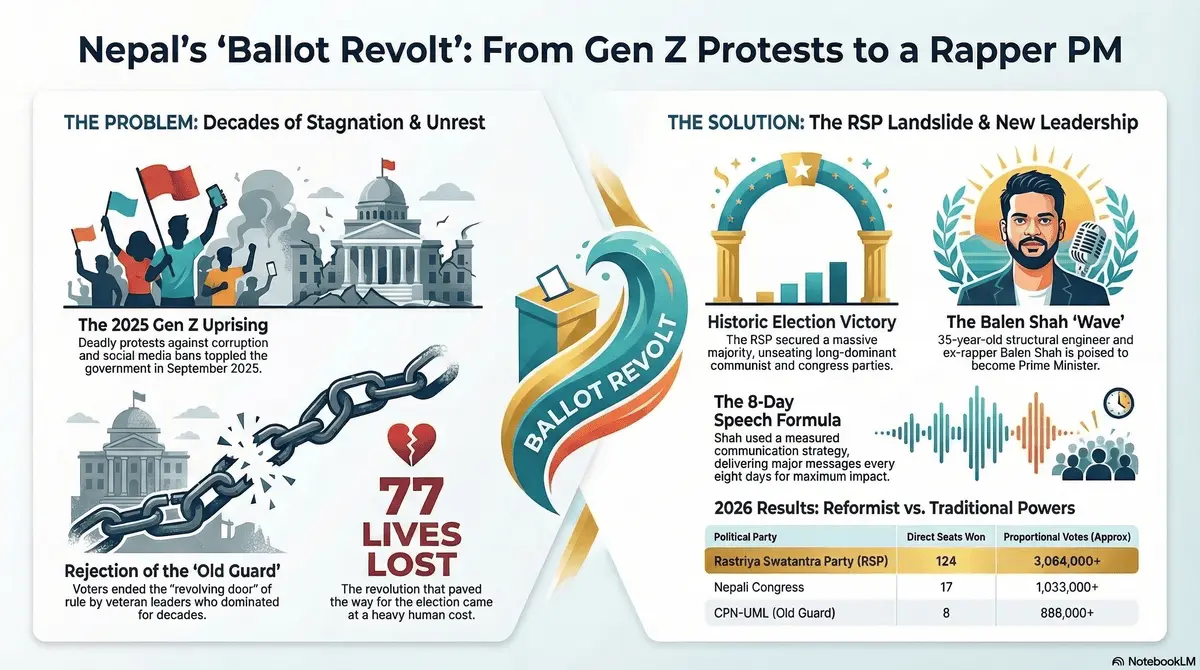
Kathmandu— A newly formed political party led by a former rapper is set to secure a sweeping victory in the country’s first general election since a youth-led uprising ousted the previous government. Preliminary results published on March 8, 2026 indicate that the Rastriya Swatantra Party has captured a decisive majority in the House of Representatives. This election marks a significant political shift, effectively ending the long-standing dominance of traditional political establishment figures in the Himalayan nation.
Below is a detailed examination of the political dynamics, campaign strategies, and historical context defining this unprecedented electoral outcome.
Context & Background
How did this political shift begin? The momentum for this change originated from the Gen Z protests in September 2025, which were initially triggered by a government ban on social media platforms. The movement rapidly evolved into a mass revolt against corruption, poor governance, and economic stagnation, resulting in 77 deaths and the forced resignation of the Marxist government led by former Prime Minister Khadga Prasad Oli.
The rise of the key players Balendra Shah, widely known as Balen, gained national prominence after winning the 2022 Kathmandu mayoral election as an independent outsider candidate. The 35-year-old structural engineer and former rapper later joined the Rastriya Swatantra Party, merging his significant youth appeal with the party’s organized platform focused on anti-corruption and job creation.
Electoral significance and system This election represents the first time in decades that a single party might secure an outright majority in Nepal, a nation accustomed to fragile coalition governments. Voters elect 165 members directly to the House of Representatives, while an additional 110 seats are allocated through a proportional representation system, both of which the Rastriya Swatantra Party has dominated.
Historical and geopolitical implications The victory signals a reckoning for the entrenched political elites who have ruled Nepal for decades, shifting the focus towards domestic governance and away from traditional nationalist rhetoric used to deflect from internal issues. It also requires neighboring powers like India and China to adapt to a new generation of leadership that is not tied to established historical alliances and patronage networks.
Q&A: Unpacking the Election Results
Q: How did the Rastriya Swatantra Party campaign successfully against established political machines?
A: The party utilized a highly organized digital strategy combined with measured public messaging and substantial overseas support.
- Communication Strategy: Balendra Shah employed an “eight-day gap formula,” delivering major speeches only once every eight days to allow messages to spread organically rather than flooding the public.
- Digital Organization: The campaign was backed by a 660-person social media operation and coordinated by a central research department in Kathmandu that tracked local voter feedback.
- Financial Backing: A significant portion of the campaign funding came from the Nepali diaspora, particularly from supporters based in the United States.
Q: Why did traditional political heavyweights fail to retain their strongholds?
A: Voters were largely exhausted by decades of political musical chairs, corruption, and a failure to deliver on economic promises.
- Incumbent Defeats: Former Prime Minister Khadga Prasad Oli was decisively defeated by Balendra Shah in his traditional safe seat of Jhapa-5.
- Generational Disconnect: The established party leaders, mostly in their 70s, failed to resonate with a demographic where over 40 percent of the nearly 30 million citizens are under 35.
- Demand for Accountability: Voters rejected the older parties due to perceived nepotism, impunity, and an inability to create local employment, forcing young citizens to seek work abroad.
Q: How might the new government approach its relationship with neighboring countries?
A: The new leadership appears to be recalibrating its foreign policy to be more cautious and domestically focused, though past controversial statements suggest potential unpredictability.
- Economic Recalibration: Balendra Shah conspicuously omitted a China-backed industrial park linked to the Belt and Road Initiative from his election manifesto, signaling sensitivity to regional dynamics, especially regarding India.
- Diplomatic Outreach: India‘s Prime Minister Narendra Modi has already issued a congratulatory message, indicating a willingness from New Delhi to build ties with the new generation.
- Past Controversies: At this time, how Balendra Shah‘s past controversial social media posts criticizing India, China, and the United States will affect formal diplomatic relations remains unverified by official sources.
Q: Why has the figure of Balendra Shah attracted significant controversy despite his popularity?
A: His confrontational public persona and anti-establishment rhetoric have frequently put him at odds with administrative norms and foreign diplomatic protocols.
- Institutional Conflicts: During his tenure as mayor of Kathmandu, he threatened to set fire to Singha Durbar, the seat of the government, after his official vehicle was stopped by a traffic policeman.
- Geopolitical Provocations: He placed a “Greater Nepal” map in his office, claiming Indian territories, and banned the screening of Indian films in the capital.
- Public Scrutiny: He has faced criticism from rights groups for his heavy-handed use of police against street vendors and has largely avoided direct press scrutiny during his national campaign.
Q: How will the incoming administration address the legacy of the September 2025 protests?
A: The new government faces the immediate challenge of addressing demands for justice and transparency regarding the state’s violent response to the uprising.
- Investigation Reports: The leadership must decide on the release and implementation of the Gauri Bahadur Karki Commission report, which investigated the use of force against the protesters.
- Legal Action: If the findings implicate senior political figures, the administration will have to balance the pursuit of accountability with maintaining national political stability.
- Institutional Reform: Fulfilling the structural reforms demanded by the youth protesters will require building consensus among all stakeholders, a complex task for a newly formed party.
Editorial Note & Transparency
Verification Log:
- International News Agencies: Reporting from The Associated Press, Reuters, and AFP detailing election statistics, constituent outcomes, and international reactions.
- Regional News Outlets: Analyses from The Himalayan Times, The Kathmandu Post, and Firstpost outlining campaign strategies, controversies, and local voter sentiment.
- Global Broadcasters: Coverage from BBC News and Al Jazeera providing on-the-ground interviews, demographic context, and historical background on the 2025 protests.
Compliance:
- Privacy: This article respects user data under our Privacy Policy.
- Transparency: No sponsored content influenced this reporting.
Contact Us: For corrections or feedback, please email: news.desk@qnanews.com