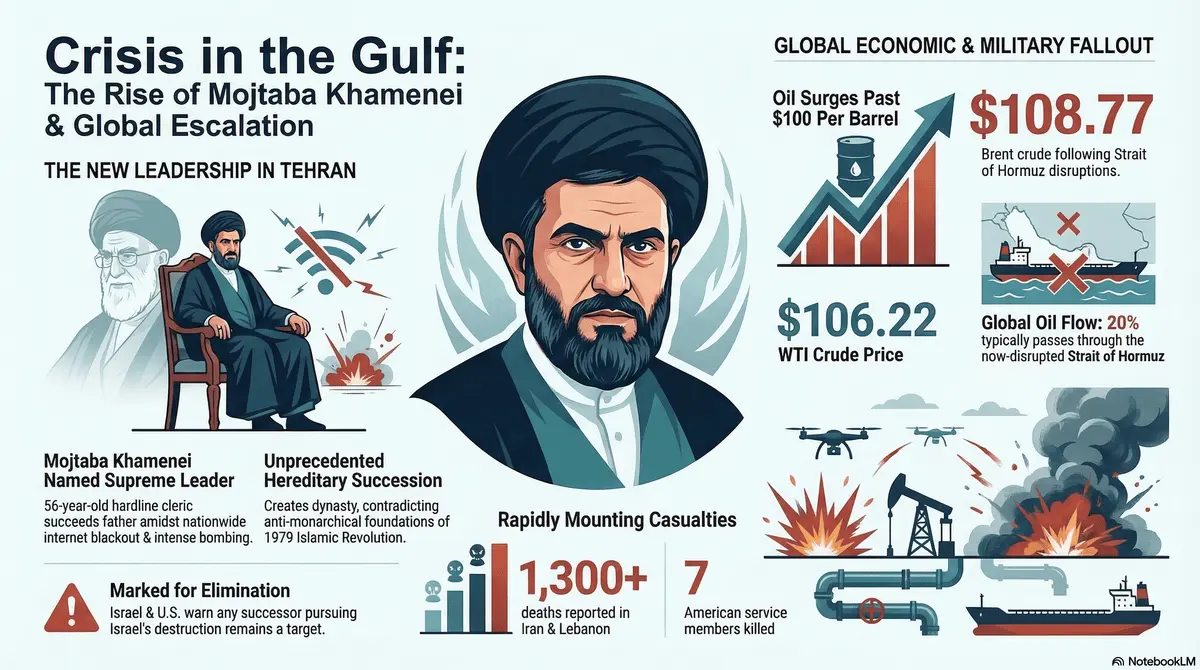
Tehran/Washington — Iran’s Assembly of Experts has reportedly chosen Mojtaba Khamenei as the nation’s new supreme leader following the assassination of his father. The appointment, confirmed by multiple sources, took place on March 8, 2026, amidst intense US-Israeli airstrikes. The transition marks a critical moment for the region as oil prices soar and military actions spread across the Middle East.
Below is a detailed examination of Mojtaba Khamenei‘s succession and the ongoing geopolitical crisis.
Context & Background
The Rise of Mojtaba Khamenei Mojtaba Khamenei, the 56-year-old son of the late Ayatollah Ali Khamenei, was born in Mashhad and has long been considered a powerful figure operating behind the scenes. He holds deep ties to the Islamic Revolutionary Guard Corps (IRGC) and the Basij militia, though he has never held public office.
A Shift Toward Hereditary Succession The Islamic Republic, founded after the 1979 revolution that overthrew a hereditary monarchy, traditionally selects leaders based on religious standing rather than lineage. The choice of Mojtaba Khamenei by the Assembly of Experts represents a profound shift, with opposition figures like Maryam Rajavi in Paris describing the move as the creation of a hereditary monarchy.
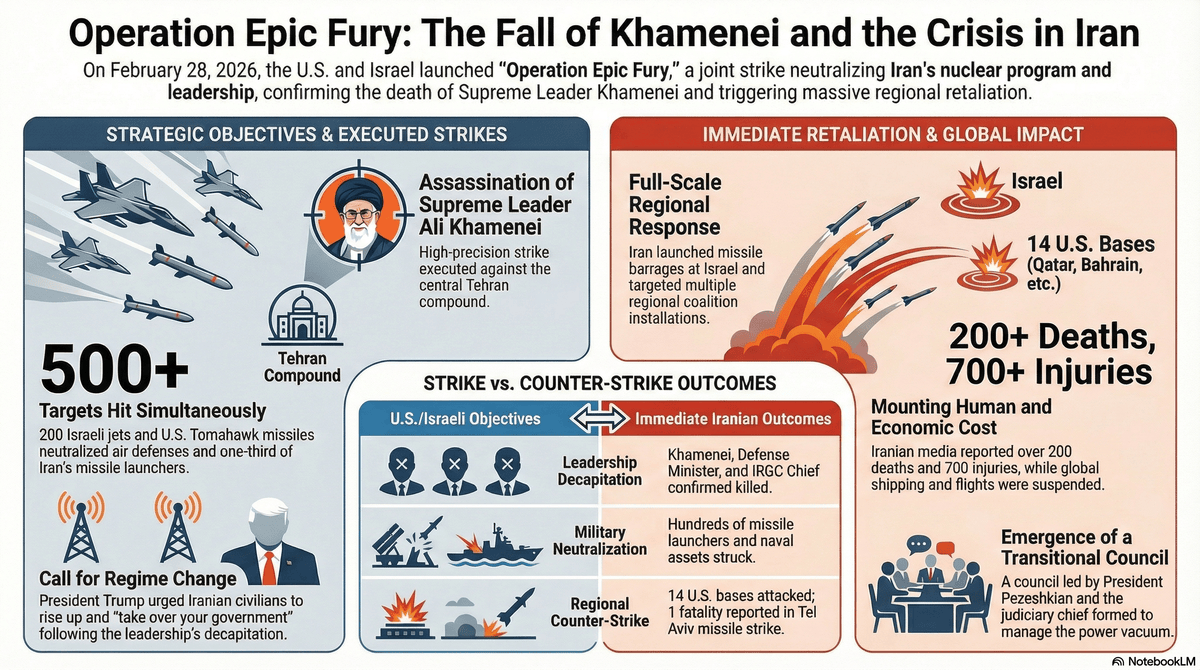
The Catalyst: The Assassination of Ayatollah Ali Khamenei This rapid succession was triggered by the death of Ayatollah Ali Khamenei during joint strikes launched by the United States and Israel on February 28, 2026. The strikes eliminated key leadership and severely escalated the ongoing war, which has now engulfed regions including Lebanon, Syria, and Saudi Arabia.
Global Economic and Security Repercussions The conflict’s escalation has heavily impacted global markets, driving the price of Brent crude oil to nearly $109 per barrel as of March 8, 2026. With both Donald Trump and Benjamin Netanyahu signaling prolonged military engagement, the prospect of a severe energy crisis and widened regional war threatens international stability.
Q&A: Unpacking the Succession and Conflict
Q: How will the appointment of Mojtaba Khamenei affect Iran’s current military strategy?
A: Observers expect the new supreme leader to maintain a hardline approach of defiance against foreign adversaries.
- Defiant Messaging: His swift appointment amidst heavy bombardment signals to the United States and Israel that the Iranian leadership remains intact and unyielding.
- IRGC Influence: The decision was reportedly made under pressure from the Islamic Revolutionary Guard Corps (IRGC), suggesting that military commanders will maintain significant sway over the nation’s wartime posture.
- Public Allegiance: Iran’s armed forces, national police, and political figures like Ali Larijani quickly pledged allegiance, indicating a consolidated military front.
Q: Why are global oil markets reacting so violently to this specific conflict?
A: The strategic location of the war directly threatens major arteries of global energy distribution.
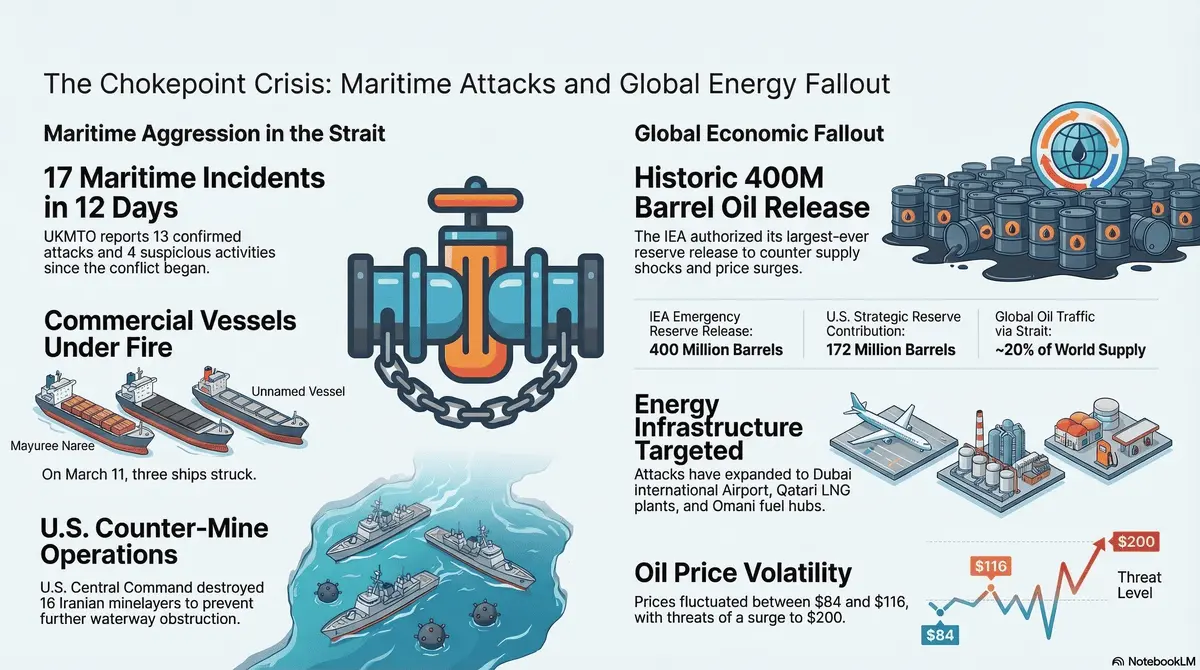
- Strait of Hormuz Threat: Approximately 20% of the world’s oil supply transits through the Strait of Hormuz, where Iranian forces have been attacking shipping vessels.
- Infrastructure Strikes: The United States and Israel recently struck multiple oil depots and a petroleum transport center in Tehran and Alborz, further jeopardizing supply.
- Price Surges: As a direct result, Brent crude oil spiked to over $108 a barrel, the largest daily gain since the 2020 pandemic.
Q: How is the United States administration approaching the leadership transition in Iran?
A: Donald Trump has openly rejected the succession and issued direct threats against the new leader.
- Executive Disapproval: Donald Trump stated he is “not happy” with the selection and argued that any new leader requires American approval to remain in power.
- Assassination Threats: The president warned that Mojtaba Khamenei “is not going to last long” without such approval, mirroring the fate of his father.
- Diplomatic Posture: Donald Trump demanded an “unconditional surrender,” while Iranian President Masoud Pezeshkian dismissed the demand as a futile dream.
Q: How is Israel responding to the establishment of the new Iranian leadership?
A: Israel has vowed to militarily target anyone involved in leading or appointing the next generation of Iranian officials.
- Targeted Assassinations: Defense Minister Israel Katz and the Israel Defense Forces (IDF) announced they would pursue and eliminate the new leader and the members of the Assembly of Experts in Qom.
- Ongoing Bombardments: The Israel Defense Forces (IDF) launched waves of attacks against over 400 Iranian military infrastructure sites, emphasizing that the war continues unabated.
- Strategic Calculus: Israeli officials view the appointment of Ayatollah Ali Khamenei‘s son as a sign of regime continuity, prioritizing its total collapse over diplomatic resolutions.
Q: Why is the internal legitimacy of Mojtaba Khamenei contested within Iran?
A: His lack of formal public standing and history of alleged political interference fuel domestic skepticism.
- Electoral Interference: Reformist figures, including Mehdi Karroubi and Mostafa Tajzadeh, have historically accused him of engineering the 2005 and 2009 elections to favor hardliners like Mahmoud Ahmadinejad.
- Religious Credentials: As a mid-ranking cleric (Hojatoleslam) rather than a high-ranking Ayatollah, his religious qualifications to serve as supreme leader are heavily debated.
- Dynastic Resentment: Many Iranians resent the establishment of a hereditary system; however, at this time, widespread domestic protests remain unverified by official sources due to internet blackouts.
Editorial Note & Transparency
Verification Log:
- Digital Media Source: Al Jazeera English live coverage detailing the succession and strikes.
- International Broadcaster: BBC News profiling the history and controversies of the new supreme leader.
- Domestic News Network: NBC News reporting on the global economic impact and political responses.
Compliance:
- Privacy: This article respects user data under our Privacy Policy.
- Transparency: No sponsored content influenced this reporting.
Contact Us: For corrections or feedback, please email: news.desk@qnanews.com