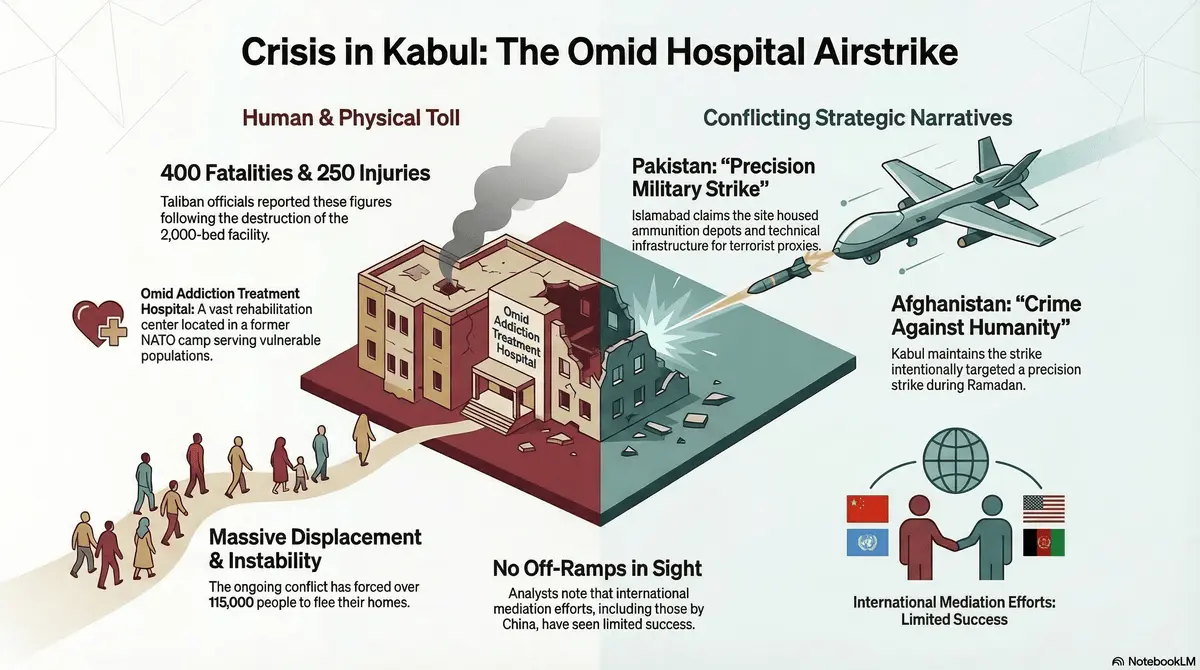
Kabul — Afghanistan has accused Pakistan of conducting a deadly airstrike on a drug rehabilitation hospital in the Afghan capital, resulting in massive casualties. The attack, which Taliban officials claim killed up to 400 people, occurred on March 16, 2026. Pakistan has vehemently denied targeting civilian infrastructure, asserting instead that it carried out precision strikes against military installations and terrorist support networks in Kabul and Nangarhar.
Below is a detailed examination of the escalating border conflict and the disputed airstrike.
Context & Background
How did the current escalation start? The ongoing clashes represent a dramatic escalation of a conflict that re-erupted in late February, when Afghanistan launched cross-border attacks in response to earlier Pakistani airstrikes that Kabul claimed killed Afghan civilians. The Pakistani government has since declared an open war with Afghanistan, accusing the Taliban administration of harboring the Tehrik-i-Taliban Pakistan (TTP) and other militant groups. This recent violence disrupted a fragile ceasefire brokered by Qatar in October.
What are the key allegations regarding the Kabul hospital? Taliban spokesman Zabihullah Mujahid and deputy spokesman Hamdullah Fitrat claim that a Pakistani jet bombed the 2,000-bed Omid Addiction Treatment Hospital in Kabul, killing 400 civilians and injuring approximately 250 others. Afghan officials, alongside prominent figures like cricketer Rashid Khan, have condemned the attack as a crime against humanity and a war crime. Conversely, Pakistani Information Minister Attaullah Tarar rejected the hospital claim as false, stating the military conducted precision airstrikes specifically on technical support infrastructure and ammunition storage facilities used by terror proxies.
Why does this conflict matter regionally? The severe deterioration in relations between Pakistan and Afghanistan has significantly impacted regional stability, causing cross-border trade to halt and displacing over 115,000 people. International observers and mediators, such as China, have repeatedly urged an immediate ceasefire, but experts like Michael Kugelman warn that there are no off-ramps in sight for the fighting. Furthermore, the conflict has alarmed the international community due to the risk of militant organizations like al-Qaida and the Islamic State resurfacing in the destabilized region.
Q&A: Unpacking The Pakistan-Afghanistan Border Conflict
Q: How are both nations justifying their military actions across the border?
A: Both countries claim they are acting in self-defense against militant threats or unprovoked aggression from the other side.
- Pakistani Security Justification: Pakistan argues it is conducting intelligence-based operations and precision strikes to eliminate Tehrik-i-Taliban Pakistan (TTP) safe havens and terrorist infrastructure inside Afghanistan that facilitate attacks on Pakistani soil.
- Afghan Sovereignty Defense: Afghanistan‘s Deputy Prime Minister Abdul Salam Hanafi stated that defending the nation’s sovereignty is the duty of all citizens, viewing Pakistani cross-border strikes as an invasion.
- Retaliatory Cycles: Afghan forces have engaged in retaliatory shelling, such as attacking a Pakistani army camp in South Waziristan, framing it as a direct response to Pakistani bombardment.
Q: Why is the target of the Kabul airstrike highly disputed?
A: The Taliban and the Pakistani government offer entirely contradictory accounts regarding what was actually bombed and the resulting casualties.
- Afghan Civilian Claims: Afghan officials assert the strike hit a 2,000-bed drug treatment center, resulting in 400 civilian deaths, a claim supported by journalists witnessing burning hospital buildings and bodies.
- Pakistani Military Claims: Pakistan explicitly denies hitting any hospital or civilian sites, stating they destroyed drone assembly workshops and ammunition depots.
- Secondary Detonations: Pakistani authorities argue that visible secondary explosions following the initial strikes prove the presence of large ammunition caches, contradicting the claim that it was a civilian medical facility.
At this time, the exact death toll of 400 remains unverified by official sources.
Q: How is the international community responding to the escalating violence?
A: Global powers and international organizations are urging restraint while managing the humanitarian fallout.
- Chinese Mediation: China has dispatched a special envoy, Lin Jian, to shuttle between Kabul and Islamabad for a week, urging both sides to engage in face-to-face dialogue and achieve a ceasefire.
- UN Intervention: The United Nations Security Council unanimously adopted a resolution extending the UNAMA political mission and demanding that the Taliban step up efforts to combat terrorism.
- Humanitarian Relief: The World Food Programme has mobilized to deliver life-saving food to over 20,000 displaced Afghan families, warning that further instability will exacerbate hunger.
Q: Why have previous diplomatic efforts, such as the Qatar ceasefire, failed?
A: Underlying grievances regarding militant safe havens have prevented lasting peace between the two nations.
- Ceasefire Breakdown: A ceasefire brokered by Qatar in October collapsed as Pakistan accused Afghanistan of continuing to harbor militants who carry out cross-border attacks.
- Mediation Fatigue: Arab Gulf nations that previously mediated are currently bogged down by the broader Middle East conflict involving the United States, Israel, and Iran, limiting their diplomatic bandwidth.
- Asymmetric Tactics: The Taliban‘s alleged use of drones and sponsorship of militant proxies inside Pakistan has crossed what Pakistani President Asif Ali Zardari termed a red line, escalating the military response.
Q: How is the conflict impacting the civilian populations in both countries?
A: The ongoing fighting has caused significant civilian casualties, displacement, and public outrage.
- Displacement Crisis: The United Nations reports that approximately 115,000 people have been forced to leave their homes due to the border clashes.
- Civilian Casualties: The United Nations confirmed the deaths of at least 75 civilians in Afghanistan since late February, while cross-border mortar fire from Afghanistan recently killed four family members in Bajaur, Pakistan.
- Public Outcry: High-profile Afghan figures, including cricketers Rashid Khan and Naveen-ul-Haq, have publicly condemned the strikes, comparing the violence to war crimes and international atrocities.
Editorial Note & Transparency
Verification Log:
- News Agency Reports: Aggregated accounts from AFP, AP, and Reuters detailing the airstrikes and official statements.
- Government Statements: Direct quotes and press releases from Taliban spokespersons and the Pakistani Ministry of Information.
- International Organizations: Reports and resolutions from the United Nations and the World Food Programme regarding the humanitarian impact.
Compliance:
- Privacy: This article respects user data under our Privacy Policy.
- Transparency: No sponsored content influenced this reporting.
Contact Us: For corrections or feedback, please email: news.desk@qnanews.com