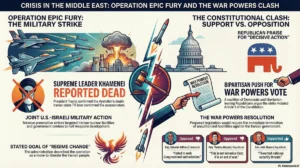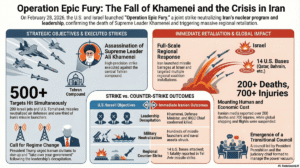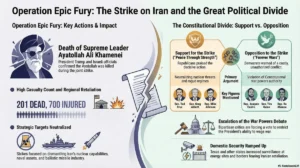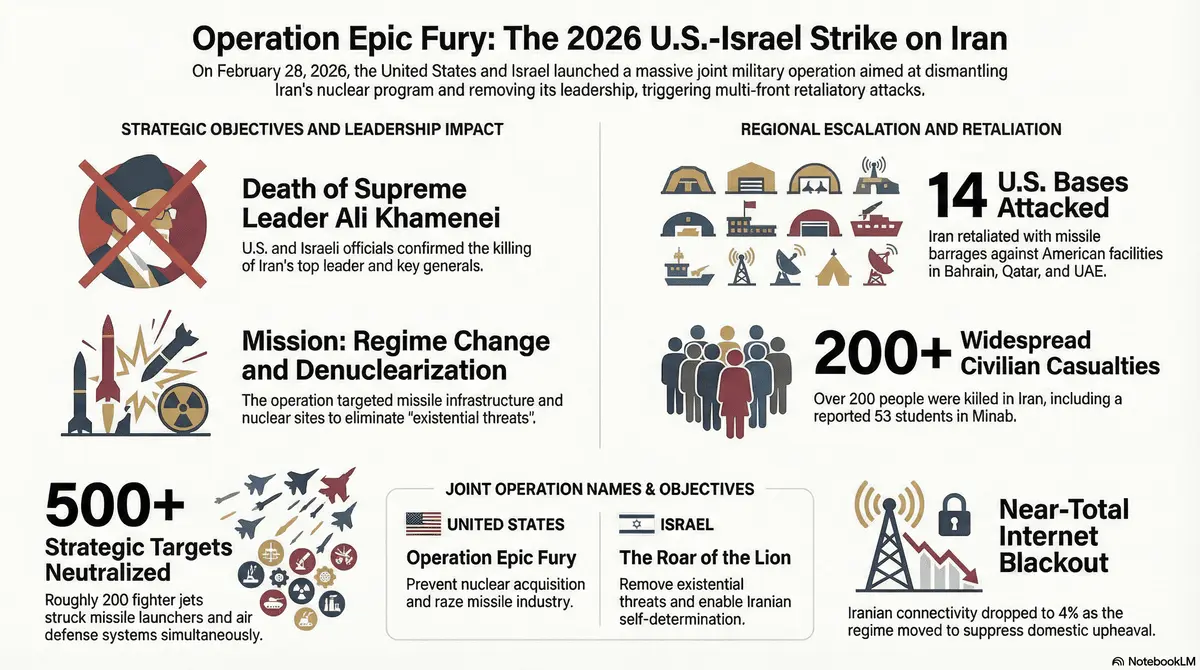
Tehran/Washington — The United States and Israel have launched extensive coordinated airstrikes across Iran, targeting military infrastructure and leadership compounds. On February 28, 2026, US President Donald Trump announced the initiation of major combat operations aimed at regime change and dismantling Iran’s nuclear and missile capabilities. In retaliation, Iran fired multiple ballistic missile barrages at Israel and American military bases stationed across the Middle East, escalating fears of a broader regional conflict.
Below is a detailed examination of the military operation and its geopolitical implications.
Context & Background
How did this military escalation begin? The strikes were preceded by months of stalled diplomatic negotiations regarding the nuclear program in Iran and its support for regional proxy groups. Following previous strikes in June 2025, the United States assessed that Iran was rapidly rebuilding its advanced nuclear centrifuges and preparing preemptive conventional missile attacks. Consequently, Donald Trump and Israeli Prime Minister Benjamin Netanyahu coordinated a preemptive military campaign aimed at neutralizing these perceived imminent threats.
Who are the key figures involved? The primary architects of the offensive are Donald Trump and Benjamin Netanyahu, who have openly called for the Iranian populace to overthrow the current government. The principal target of the decapitation strikes was Ayatollah Ali Khamenei, the Supreme Leader of Iran since 1989, who is presumed dead following heavy bombardment of his compound in Tehran. Other targeted individuals include President Masoud Pezeshkian and senior leaders of the Islamic Revolutionary Guard Corps.
What is the historical significance of these strikes? This operation marks a direct, unprecedented kinetic conflict between the United States, Israel, and Iran, moving beyond decades of shadow wars and proxy skirmishes. By explicitly stating the objective of toppling the Islamic Republic, the United States has abandoned its previous strategies of containment and maximum economic pressure in favor of direct military intervention and regime change.
Why does the regional response matter? The conflict immediately spilled over the borders of Iran, with Tehran launching retaliatory ballistic missile strikes against Israel and American bases in Bahrain, Jordan, Kuwait, Qatar, and the United Arab Emirates. This widespread retaliation threatens to draw neighboring Arab nations into a full-scale regional war, severely disrupting global stability, commercial airspace, and international security.
Q&A: Unpacking The US-Israeli Strikes on Iran
Q: Why did diplomatic negotiations between the United States and Iran fail to prevent this conflict?
A: Negotiations stalled due to fundamental disagreements over uranium enrichment capabilities and the refusal of Iranian officials to discuss their ballistic missile arsenal and proxy network.
- Nuclear Demands: The United States offered a civil nuclear program, but Iran insisted on domestic enrichment capabilities, which American officials interpreted as a stalling tactic to buy time for building a nuclear bomb.
- Missile Refusal: Iranian negotiators treated their ballistic missile program and support for regional proxies as non-negotiable issues, deadlocking the talks.
- Preemptive Threat: American intelligence concluded that Iran was expanding its manufacturing capacity for advanced centrifuges and considering preemptive missile use, prompting the military strike.
Q: How did the United States and Israel coordinate and execute the initial strikes?
A: The joint operation involved extensive, unprecedented intelligence sharing and the simultaneous deployment of fighter jets and long-range missiles.
- Aerial Superiority: The Israel Defense Forces utilized approximately 200 fighter jets to target Iranian air defense systems and missile launchers, establishing aerial dominance over Iran.
- Suppression Tactics: The United States military launched Tomahawk Land Attack Missiles and one-way attack drones to suppress Iranian anti-aircraft defenses.
- Target Scope: The strikes hit hundreds of military targets, including leadership compounds in Tehran, IRGC naval assets, and nuclear-related infrastructure in western and central Iran.
Q: How has Iran strategically responded to the decapitation and infrastructure strikes?
A: Iran launched a widespread retaliatory campaign using ballistic missiles to target Israeli territory and American military installations across the Middle East.
- Regional Targets: Iranian forces fired missiles at the United States Navy’s Fifth Fleet in Bahrain, as well as bases in Kuwait, Qatar, Jordan, and the United Arab Emirates.
- Missile Types: The Iranian military deployed Emad and Ghadr ballistic missiles, though some barrages appeared uncoordinated due to the disruption caused by the preemptive Israeli and American strikes.
- Official Stance: Iranian officials, including Foreign Minister Abbas Araghchi, condemned the attacks as violations of sovereignty and vowed to respond with full military might.
Q: Why is the reported death of Ayatollah Ali Khamenei critical to the operation’s goals?
A: The elimination of the Supreme Leader aims to collapse the regime’s central authority, encouraging civilian uprisings and internal military defection.
- Regime Decapitation: By targeting the entire Iranian leadership, including Ayatollah Ali Khamenei and top security commanders, the strikes seek to disable the command structure of the Islamic Republic.
- Public Rebellion: Both Donald Trump and Benjamin Netanyahu have publicly urged Iranian civilians to capitalize on the leadership vacuum to overthrow their government.
- Military Defection: American officials have claimed that factions within the Iranian military and police are seeking immunity, signaling potential fractures within the state’s enforcement apparatus.
Q: How are international governments and organizations reacting to the escalation?
A: The global community is deeply divided, with key Western allies supporting the intervention while the United Nations and other nations warn of catastrophic regional consequences.
- Allied Support: Nations such as Canada, Australia, and the United Kingdom voiced support for preventing Iran from acquiring nuclear weapons, though they urged restraint to avoid a wider war.
- Diplomatic Condemnation: Russia labeled the strikes an unprovoked act of armed aggression, and Omani mediators expressed dismay over the disruption of ongoing peace talks.
- Civilian Concerns: The United Nations Secretary-General António Guterres condemned the escalation and called for immediate de-escalation to prevent mass civilian casualties and regional instability. At this time, an Iranian claim that a strike hit a girls’ school in Minab remains unverified by official sources.
Editorial Notes & Transparency
Verification Log:
- Live Updates: CBS News live reporting and official statements from US, Israeli, and Iranian government representatives.
- Think Tank Analysis: Institute for the Study of War (ISW) special updates detailing strike locations, military assessments, and leadership casualties.
- International Broadcasting: BBC News and Al Jazeera reports covering global diplomatic reactions, historical background, and regional fallout.
Compliance:
- Privacy: This article respects user data under our Privacy Policy.
- Transparency: No sponsored content influenced this reporting.
Contact Us: For corrections or feedback, please email: news.desk@qnanews.com