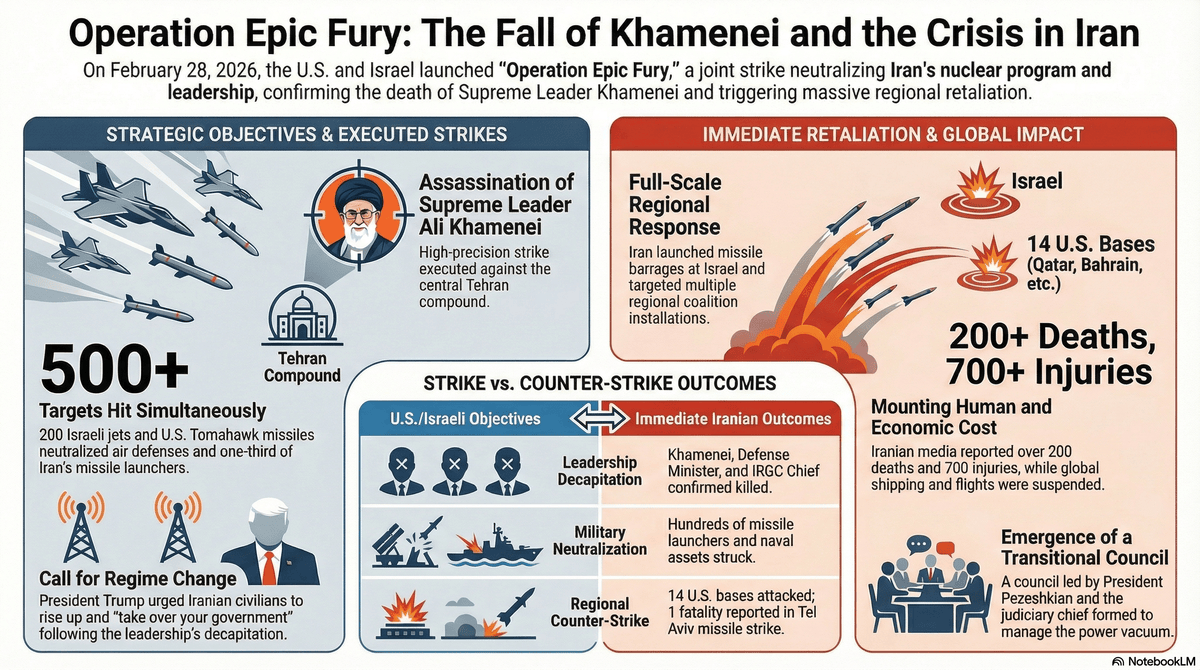
Washington/Tehran — The United States and Israel initiated a massive joint military operation targeting Iran, resulting in the death of Iranian Supreme Leader Ayatollah Ali Khamenei. The unprecedented assault, dubbed “Operation Epic Fury,” officially commenced on Saturday, February 28, 2026, aiming to dismantle Iranian nuclear and missile capabilities while inciting regime change. Iranian forces swiftly retaliated by launching ballistic missiles at Israel and multiple American military bases across the Middle East.
Below is a detailed examination of the military operations, geopolitical implications, and regional fallout.
Context & Background
What catalyzed Operation Epic Fury? The military intervention was driven by long-standing concerns over Iran‘s nuclear ambitions and its conventional missile program, which U.S. and Israeli officials view as an existential threat. According to senior administration officials under President Donald Trump, recent diplomatic negotiations stalled as Iran refused to address its ballistic missile capabilities and proxy networks, prompting preemptive military action to prevent the regime from reaching weapons-grade uranium enrichment.
Who are the key players involved? President Donald Trump and Israeli Prime Minister Benjamin Netanyahu spearheaded the coordinated strikes, explicitly targeting the top echelons of the Iranian government and its military infrastructure. On the Iranian side, Supreme Leader Ayatollah Ali Khamenei, who had ruled since 1989, was the central target alongside the Islamic Revolutionary Guard Corps (IRGC), leading to a profound power vacuum within the theocracy.
How has Iran historically positioned itself against the West? Under Ayatollah Ali Khamenei‘s decades-long rule, Iran maintained a persistent posture of resistance and “forward defence” through a vast network of proxy militias collectively known as the Axis of Resistance. This anti-Western doctrine, forged during the devastating Iran-Iraq War of the 1980s, institutionalized deep distrust of the United States and Israel, fostering isolated self-reliance and continuous shadow conflicts.
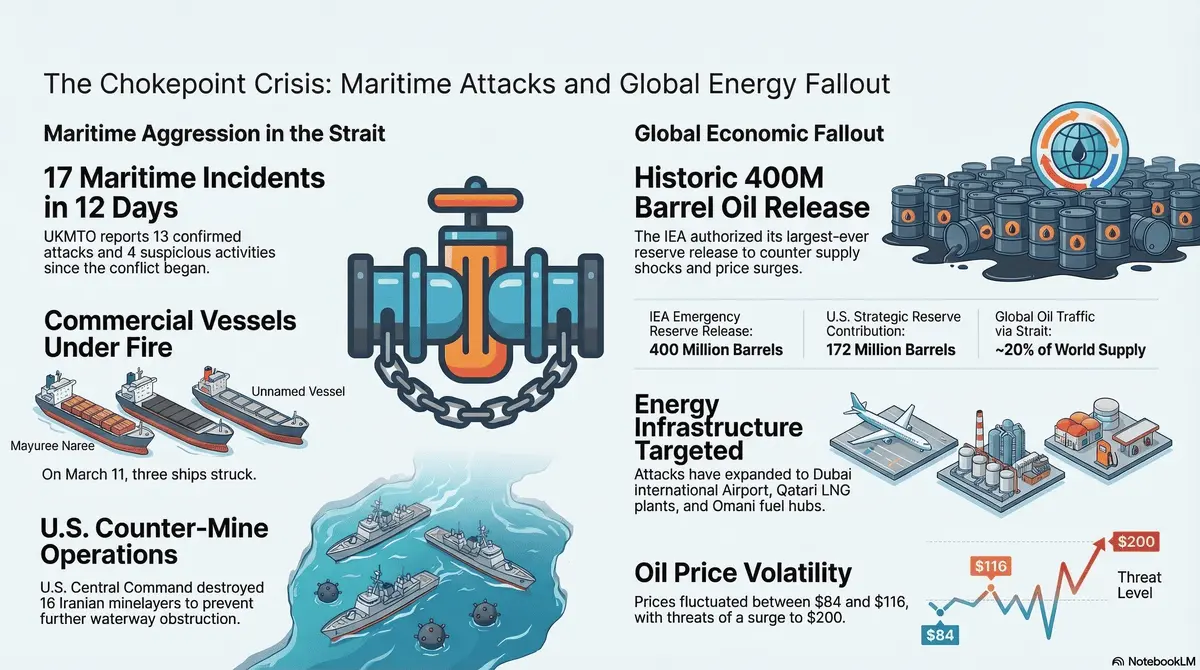
Why does this matter for global security? The decapitation of the Iranian leadership and subsequent retaliatory missile strikes drastically escalate the risk of a full-scale regional war in the Middle East. Furthermore, the closure of vital airspace and the targeting of strategic infrastructure, such as the Jebel Ali Port in Dubai, threaten to severely disrupt international trade, global energy markets, and international aviation.
Q&A: Unpacking Operation Epic Fury
Q: How did the United States and Israel execute the strikes against Iranian targets?
A: The joint forces utilized a combination of sophisticated precision weaponry and lower-cost drones to overwhelm Iranian defenses and target critical infrastructure.
- Precision Airstrikes: The Israel Defense Forces (IDF) deployed approximately 200 fighter jets to drop hundreds of munitions simultaneously on military command centers, missile launchers, and aerial defense systems.
- Drone Swarms: The United States Central Command (CENTCOM) deployed one-way attack drones, modeled after Iranian Shahed drones, to strike secondary targets and degrade communication systems.
- Missile Suppression: American forces utilized Tomahawk Land Attack Missiles (TLAMs) to systematically dismantle and suppress Iranian air defense capabilities before deploying more expensive, manned assets.
Q: Why did the United States administration decide to launch a preemptive military attack?
A: U.S. officials cited the immediate threat of Iranian conventional missile attacks and the looming danger of Tehran acquiring a nuclear weapon.
- Imminent Threat: Intelligence indicated that Iran was preparing to use conventional missiles against the United States and its allies either preemptively or simultaneously during ongoing negotiations.
- Nuclear Enrichment: Officials warned that Iran was merely weeks away from producing 90 percent weapons-grade uranium, possessing approximately 450 kilograms of highly enriched material.
- Diplomatic Failure: The Donald Trump administration concluded that Iran was utilizing diplomatic talks as a stalling tactic to rebuild its nuclear infrastructure following earlier strikes in 2025.
Q: How has Iran responded to the coordinated bombardment?
A: The Iranian regime immediately launched extensive missile and drone barrages targeting both Israeli territory and American military installations across the region.
- Attacks on Israel: Iran fired waves of ballistic missiles, including Emad and Ghadr variants, at central Israel, resulting in at least one civilian fatality and over 120 injuries in the Tel Aviv area.
- Regional Base Strikes: Iranian missiles targeted American military bases in Bahrain, Qatar, the United Arab Emirates, Kuwait, Jordan, and Saudi Arabia.
- Strategic Escalation: The Islamic Revolutionary Guard Corps threatened to initiate the most intense offensive operations in its history to punish the perpetrators.
Q: How are Iranian citizens and the international diaspora reacting to the supreme leader’s death?
A: Reactions are deeply polarized, featuring widespread celebrations among dissidents mixed with official mourning and defiance from regime loyalists.
- Domestic Celebrations: Videos emerged from Tehran showing citizens clapping, whistling, and cheering from rooftops as news of the regime’s losses spread.
- Diaspora Rallies: Exiled Iranians in cities like Los Angeles and London took to the streets to dance, wave pre-revolution flags, and express gratitude toward President Donald Trump.
- Official Mourning: Conversely, the Iranian government declared 40 days of public mourning, while loyalists raised black flags at religious shrines in Mashhad.
Q: How is the sudden power vacuum in Iran being managed?
A: An emergency governing council has been formed to oversee the nation while authorities attempt to project continuity amidst severe leadership losses.
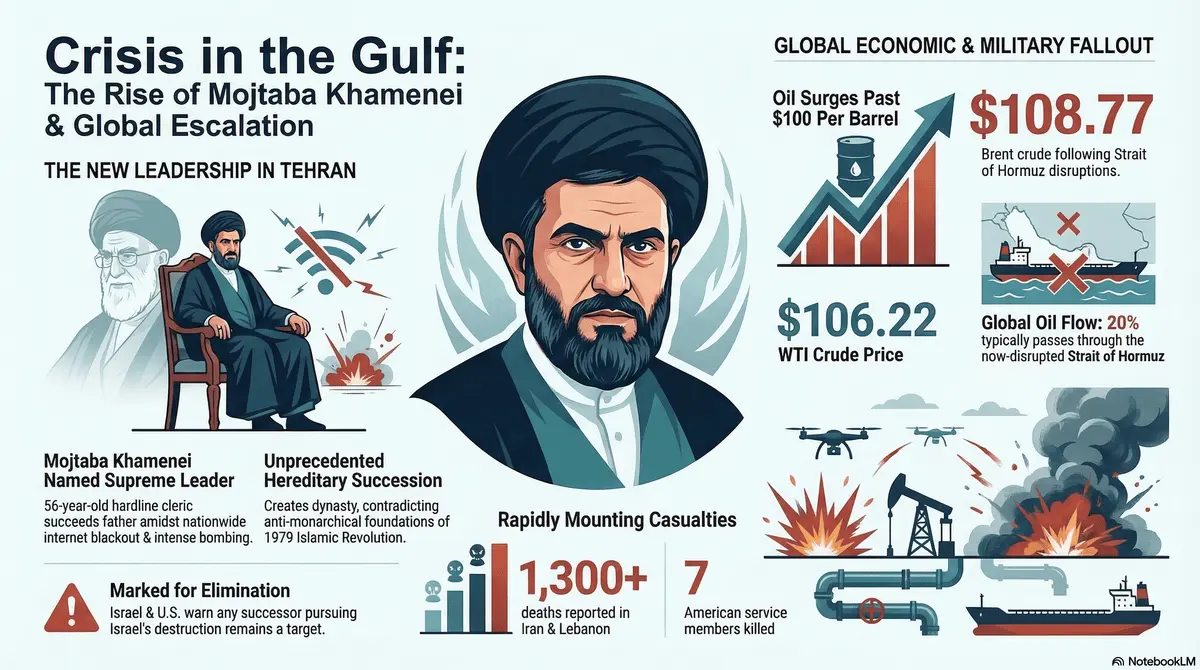
- Transitional Governance: A legally enshrined council, consisting of President Masoud Pezeshkian, judiciary chief Gholamhossein Mohseni Ejei, and a Guardian Council member, has assumed temporary governance.
- Succession Uncertainty: While the Assembly of Experts is tasked with selecting a new supreme leader, experts warn that the abrupt decapitation of leadership could spark severe internal friction during the wartime crisis.
- Unverified Casualties: At this time, the exact death toll among the broader Iranian leadership remains unverified by official sources, though senior figures like Ali Shamkhani and Major General Mohammad Pakpour are presumed dead.
Q: Why are neighboring Arab states concerned about the conflict’s expansion?
A: Gulf monarchies and surrounding nations fear being dragged into a devastating regional war due to the use of their airspace and the presence of American bases on their soil.
- Direct Casualties: Iranian retaliatory strikes resulted in at least one fatality and multiple injuries in Abu Dhabi, marking direct civilian harm within the United Arab Emirates.
- Sovereignty Violations: Nations like Saudi Arabia and Syria strongly condemned the Iranian missile barrages for violating their territorial sovereignty and escalating regional instability.
- Infrastructure Threats: Debris from intercepted projectiles caused fires at major economic hubs, including Dubai‘s Jebel Ali Port and the Burj Al Arab hotel.
Editorial Notes & Transparency
Verification Log:
- Government Statements: Verified official declarations from the United States Central Command, the Israel Defense Forces, and Iranian state media apparatuses.
- Live News Reports: Aggregated real-time geopolitical developments reported by Al Jazeera, CBS News, AP News, and Fox News.
- Expert Analysis: Incorporated strategic assessments from the Institute for the Study of War and various Middle East policy analysts.
Compliance:
- Privacy: This article respects user data under our Privacy Policy.
- Transparency: No sponsored content influenced this reporting.
Contact Us: For corrections or feedback, please email: news.desk@qnanews.com