Washington/Dubai — US President Donald Trump is facing resistance from global allies over demands to provide military security in the Strait of Hormuz. The closure of the waterway by Iran has severely disrupted global energy markets, prompting the US to seek international assistance by March 16, 2026. The conflict has recently expanded with Iranian drone strikes on Gulf nations and a new Israeli ground operation in southern Lebanon.
Below is a detailed examination of the international response and regional escalation.
Context & Background
The Origins of the Strait Blockade The ongoing conflict escalated when the United States and Israel launched a war against Iran, prompting Tehran to effectively close the Strait of Hormuz to its adversaries. This chokepoint is critical for global energy supplies, normally handling about a fifth of the world’s traded oil.
Trump’s Ultimatum to Allies President Donald Trump has publicly demanded that nations reliant on Middle Eastern oil, including China, Japan, South Korea, and NATO members, send warships to secure the strait. He warned that a failure to contribute military assets would result in a “very bad future” for the NATO alliance.
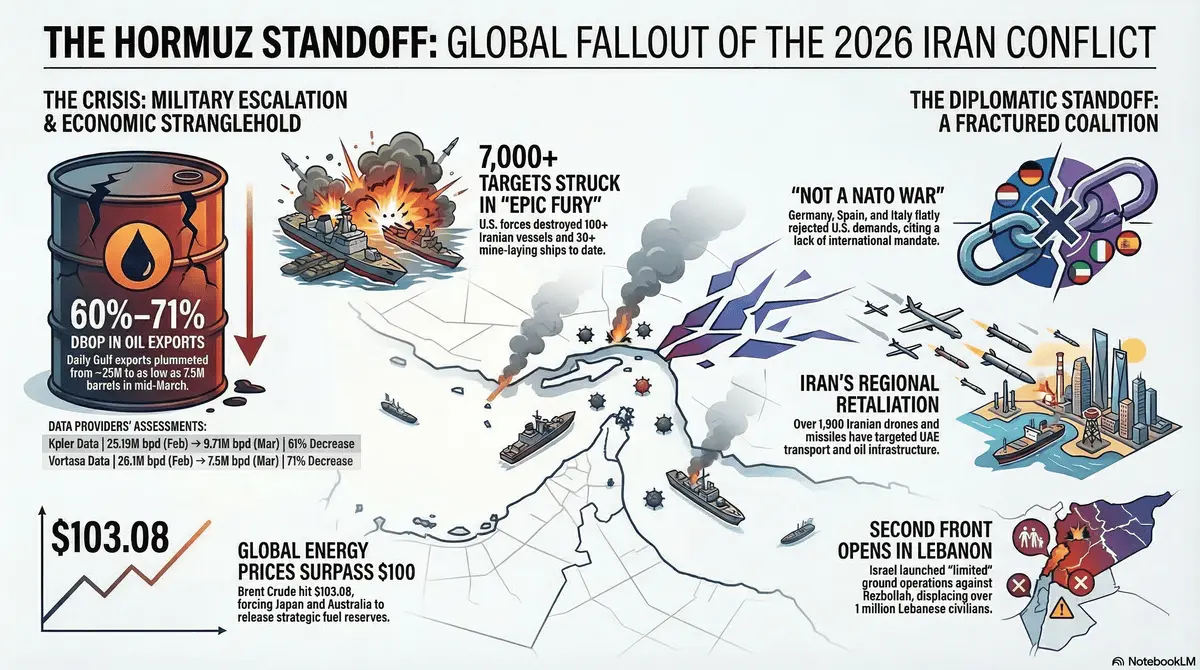
International Resistance Despite the pressure, major powers such as Germany, Spain, Italy, and the United Kingdom have refused to commit warships or expand existing European Union naval missions into the strait. U.K. Prime Minister Keir Starmer and German Chancellor Friedrich Merz emphasized that they will not be drawn into the wider US-led war.
Expansion of Regional Hostilities The war has rapidly spilled over beyond Iran and Israel, with Tehran launching missile and drone strikes against US-aligned nations in the Gulf. The United Arab Emirates was forced to temporarily close its airspace after strikes hit critical infrastructure, including fuel tanks near Dubai International Airport.
Q&A: Unpacking The Iran Conflict and Hormuz Blockade
Q: How are global energy markets responding to the Hormuz blockade?
A: Oil exports from the Middle East have plummeted, triggering a significant surge in global crude prices.
- Export Reduction: Daily oil shipments from the Gulf dropped by at least 60 percent in the first half of March 2026.
- Price Surges: US crude oil prices briefly surpassed $100 per barrel, rising nearly 40 percent since the war began.
- Strategic Reserves: Nations like Japan have been forced to release millions of barrels from their strategic petroleum reserves to offset the shortages.
Q: Why are NATO allies refusing to deploy warships to the strait?
A: European leaders assert the conflict was initiated without their consultation and falls outside the alliance’s defensive mandate.
- Lack of Mandate: German Chancellor Friedrich Merz stated that the war lacks a United Nations or NATO mandate, arguing it is not a matter for the alliance.
- Fear of Escalation: Officials like U.K. Prime Minister Keir Starmer and Italian Deputy Prime Minister Matteo Salvini warned that sending ships would mean directly entering the war.
- Alternative Missions: The European Union is exploring whether its existing defensive Aspides naval mission can be adapted, but unanimous agreement is required.
Q: How is the war affecting US relations with China?
A: The conflict is threatening to delay high-level diplomatic and trade engagements between the two global powers.
- Summit Delay: President Donald Trump requested to postpone his late-March trip to Beijing by about a month, citing his need to remain in the US to manage the war.
- Strait Security Demands: The US has pressed China to help protect the strait, though Treasury Secretary Scott Bessent claimed any summit delay would be due to logistics, not a dispute over the waterway.
- Chinese Neutrality: Beijing has called for an immediate halt to military operations but has remained noncommittal regarding the deployment of naval assets to the Gulf.
Q: Why has Israel initiated ground operations in southern Lebanon?
A: Israel claims the operations are necessary to secure its northern border and dismantle infrastructure belonging to the Iran-backed militant group Hezbollah.
- Targeted Raids: The Israel Defense Forces launched what they described as limited and targeted ground maneuvers to remove threats near the border.
- Mass Displacement: Defense Minister Israel Katz stated that Lebanese civilians who evacuated south of the Litani River will not be permitted to return until northern Israel is secure.
- International Condemnation: Leaders from the United Kingdom, France, Germany, and others issued a joint statement warning of devastating humanitarian consequences from a protracted ground offensive.
Q: How are neighboring Gulf states being impacted by Iranian retaliation?
A: Iran is actively targeting the infrastructure of nations hosting US military assets or aligned with American interests.
- Aviation Disruptions: Drone strikes near Dubai International Airport caused fuel fires, leading the United Arab Emirates to temporarily suspend flights and close its airspace.
- Energy Infrastructure Hits: Drones caused a fire at the Shah gas field in Abu Dhabi, though operations were subsequently suspended without reported injuries.
- Mine-Laying Capabilities: President Donald Trump claimed all 30 Iranian mine-laying ships were destroyed. At this time, the complete destruction of these vessels remains unverified by official sources.
Editorial Note & Transparency
Verification Log:
- News Agency Reports: Sourced from global news wires detailing diplomatic responses and oil market data.
- Official Statements: Direct quotes and press releases from the White House, Israel Defense Forces, and European ministries.
- Live Broadcast Transcripts: Information drawn from real-time news coverage and press conferences.
Compliance:
- Privacy: This article respects user data under our Privacy Policy.
- Transparency: No sponsored content influenced this reporting.
Contact Us: For corrections or feedback, please email: news.desk@qnanews.com